


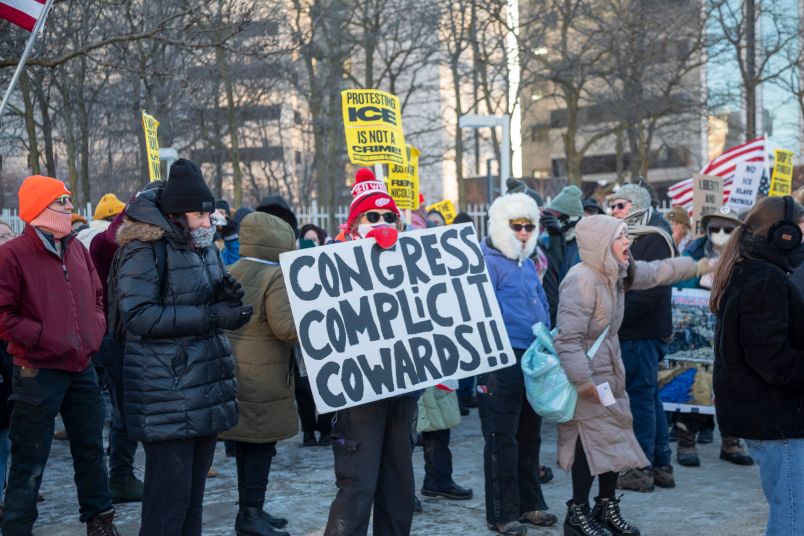
On Thursday, a Michigan State Senate committee held a hearing on a package of bills that restrict federal immigration enforcement in the state, legislation that comes amid a nationwide outcry over immigration enforcement operations that have grown increasingly deadly. The three bills would make it a misdemeanor for law enforcement officers to wear masks, except in certain health-related circumstances; limit government agencies from sharing information with ICE; and outlaw immigration enforcement in “sensitive locations” like schools, places of worship, hospitals, women’s shelters, and courthouses.
Michigan is home to a swirl of political, legislative, and immigration dynamics that makes it a hotspot for ICE-related activity and activism as President Donald Trump’s federal immigration enforcement apparatus reaches new, violent lows. Public desire for ICE to be reformed — or outright abolished — is reaching new highs. And, while the future of actions to rein in ICE at the congressional level remains murky, blue and purple states like Michigan are moving ahead on their own.
State Futures, an organization creating a multi-state coalition along shared political and policy priorities, is tracking at least 85 ICE-related bills in nationwide state legislatures, said Montana State. Sen. Cora Neumann, a Democrat, at a press event held by the organization this week.
At least seven such bills have been proposed in New York, along with several in Washington, Georgia, Pennsylvania, Tennessee, and New Jersey. Championed by Democrats, the anti-ICE bills are emerging in red and blue states alike.
“If the government can run roughshod over the rights of the people of Minnesota, they will do it in Missouri,” said Missouri State Rep. Keri Ingle said during a press call this week, describing a coalition of elected officials from 27 states that will oppose ICE and the Trump administration’s actions in Minnesota.
A Signal for the Midterms
In addition to prompting state action, the issue is sure to feature prominently in Michigan — and other states’ — midterms. Democratic Senator Gary Peters is retiring, leaving an open Senate seat that will determine the margins of control in the upper chamber of Congress. A handful of House seats are all toss-ups, according to The Cook Political report, including GOP incumbent Rep. Tom Barrett (R-MI). The state is poised to see an unusual, three-way governors’ race, with Independent Detroit Mayor Mike Duggan challenging whoever wins the Republican and Democratic primaries.
What state legislators are able to accomplish in Michigan could offer insight into midterm elections, and the ability of state legislators to respond to voter outrage about Trump’s immigration enforcement actions.
ICE arrests quadrupled nationwide in 2025, according to a Deportation Data Project report authored by professors from the University of California, Los Angeles and Berkeley. In Michigan, ICE arrests nearly tripled in 2025 compared to the year before. Earlier this week, there were reports of ICE detaining childrens’ parents near a school bus stop in the city of Ypsilanti.
The anti-ICE bills heard in committee Thursday have a good chance to pass the state’s Democratic-controlled Senate, Levi Teitel of Progress Michigan, a progressive voter engagement organization, told TPM. It’ll be a different story in the Republican-majority House.
Michigan’s slate of legislation aligns with efforts in more than a dozen other states where politicians closer to the communities subject to violent and deadly federal immigration enforcement — mayors and governors, state legislators, municipal district attorneys and even top local law enforcement officials — have resolved to oppose Trump and rein in ICE. Philadelphia’s progressive top prosecutor, District Attorney Larry Krasner, compared rogue ICE agents to Nazis during a press conference on Tuesday and vowed to “hunt” down federal officers who commit crimes even after Trump leaves office. Krasner said state attorneys nationwide are banding together to support Minnesota and oppose federal law enforcement misconduct. Across the country, California Attorney General Rob Bonta’s office launched a portal where residents can share evidence of unlawful activity by federal officers.
Lawmakers in at least 15 states have proposed bills to unmask ICE agents. At least eight states want their residents to be able to sue individual federal agents who violate their civil rights. And at least 16 states either have, or are considering, bills that ban immigration enforcement from sensitive locations.
“In Michigan, we have also seen parents ripped apart from their families while dropping kids off at school or the bus stop,” said Democratic State Sen. Stephanie Chang of Michigan at the State Futures press event. Chang chairs the Civil Rights, Judiciary, and Public Safety Committee which held the Thursday hearing, and said she believed her state was committed to “creating the bold policy changes that our immigrant and refugee communities require in this pivotal moment.”
Legislators’ anti-ICE platforms aren’t solely altruistic. Polling shows most voters have had enough and think Trump has gone too far in his bid to un-diversify America, though numbers tend to split predictably along partisan lines. The president’s assessment of how mainstream it is to invade American cities, allow ICE agents to operate with impunity, and vilify two passive American citizens killed by said agents, looks increasingly like a miscalculation ahead of midterms that’ll determine whether he can continue to act without consequence.
Progress Michigan published a poll Thursday which found more than half of Michigan residents disapprove of the job ICE is doing. Fifty-four percent of voters polled in the state said Trump is wrongfully prioritizing deportations over affordability issues.
“There is a very big fear among certain Republicans in tough target districts,” Teitel said. State GOP candidates have taken steps to “at least show some Republicans are concerned about the rhetoric Stephen Miller has been spoon-feeding Kristi Noem.”
Barrett’s in a toss-up race, and might be one of them. Endorsed by Trump, Barrett has aligned closely with the president’s priorities. While running in 2024, Barrett said he supported stronger immigration enforcement and supported Trump’s OBBBA once elected to Congress. But his office has also made an effort to seemingly soften its image on immigration issues. He publicized his role in helping free a documented Hmong immigrant from ICE custody, and released a statement mourning Pretti’s death and calling for a “thorough investigation,” in direct opposition to the administration’s stance.
“This is not a partisan issue,” said Montana’s Neumann, a Democrat in a deep red state. “We do have power. We have state power and we are here to reassert state power, federalism, and the Constitution.”



They absolutely, positively, without delay, need to address the presence of ICEholes at polling places during midterm and general elections. They cannot be permitted to interfere with voters casting their ballots for any elected position. No way, no how.
Start now. Put them on notice they are not welcome under any circumstances.
https://www.mass.gov/news/governor-healey-takes-action-to-keep-ice-out-of-schools-hospitals-courthouses-and-places-of-worship
Gov. Healey in Massachusetts just filed similar legislation.
Only 49 plus DC to go.
States Rights!
We passed HB 9 in the NM House last night that prevents state and local law enforcement and other agencies from working with ICE. On to the state Senate.