


A hallmark of the second Trump presidency is the White House’s insatiable, gradually progressing power grab.
It has steadily crafted, through legal and illegal means, a once-unimaginably muscular presidency. In recent months, the administration has started to itch for more, jealously eyeing Congress’ greatest power and responsibility and coveting it for itself.
These long-laid plans started to come to fruition in late July, when congressional Republicans bowed to Trump’s will and signed off on a rescissions bill — a once anodyne mechanism through which Congress could reclaim funds that it had allocated for the executive branch to spend, but that had proved unnecessary. The White House and acquiescent Republican senators, this summer, weaponized this kind of legislative package as a filibuster-proof hack to strip out Democratic priorities from government spending packages after cynically securing the party’s legislators’ votes. The recently passed rescissions bill axed billions in public media funding and foreign aid.
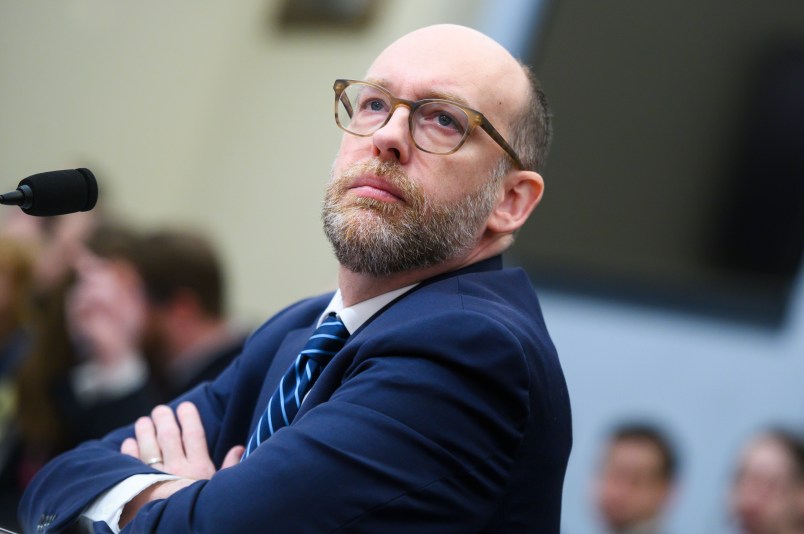
Russ Vought, the public face of this newest power grab and a rare holdover from the first Trump administration, has led the charge from his post atop the Office of Management and Budget. Turning rescissions into a neat way to renege on bipartisan compromise — part of his mission to achieve a “more partisan appropriations process” — is just the beginning, to hear him tell it. This presidential intrusion into Congress’ key function — the “power of the purse” — is just a foot jammed in the door.
Vought has been threatening to wield a so-called “pocket rescission” that would do away with the need for invertebrate congressional Republican cooperation altogether. Under his theory of the case, President Trump can merely run out the clock on the fiscal year, waiting to use his limited power to request rescissions until 45 days or so before the end. The request would freeze the process, he claims, until the year rolls over and the unspent funds have lapsed. Trump, just by waiting until mid-August, could pinpoint the funds he doesn’t want spent — despite Congress having passed the appropriations — and theoretically use this bizarre timing trickery to zero them out himself.
“It’s a provision that has been rarely used, but it is there,” Vought said of pocket rescissions on CNN earlier this summer. “And we intend to use all of these tools.” (No doubt responding to statements such as these, the Government Accountability Office, a legislative branch watchdog agency, published an article reasserting, unequivocally, that pocket rescissions are illegal.)
As August creeps by, the window in which Vought would have to make good on this threat inches closer. He remains publicly cocky about the legality of the gambit — and with a right-wing supermajority controlling the Supreme Court, his threats are difficult to dismiss. But experts, tallying up the obstacles he’ll have to overcome in the text of the relevant laws, their purpose and Supreme Court precedent, remain skeptical that the bluster isn’t more in service of keeping congressional Republicans in line than an expression of actual confidence in such a far-fetched legal argument.
“Frankly, I don’t think he gets a single vote,” David Super, a professor of law and economics at Georgetown Law who has written extensively on rescissions, said of Vought’s odds at the Supreme Court.
Legal Minefield
One obstacle comes in the text of the statutes standing up many of the programs Trump and Vought would like to defund. For example, the act establishing the Head Start program — which provides education and nutrition services to low-income families, and which the Trump administration has targeted for cuts — says explicitly that the funds appropriated to the program must be spent, and how. For Trump to unilaterally impound that money would violate the law, and the laws establishing many programs like it.
Vought may try turning to the Impoundment Control Act (ICA) to wiggle out of that obligation (he has also dismissed that act as likely unconstitutional, as it contains presidential constraints that thwart his scheme). But the ICA says specifically that it cannot be read as “superseding any provision of law which requires the obligation of budget authority or the making of outlays thereunder.” If the ICA can be read in any way to trump the mandates of the Head Start Act, the ICA says, the Head Start Act wins.
“The Supreme Court has said they are textualists, and that works out badly for liberals in many settings — but this one is hard to win for the textualists when there’s no support in the text,” Super quipped.
Layer that atop the purpose of the ICA, which Congress passed to curtail presidential power in response to President Nixon’s illegal withholding of funds for programs he didn’t support. Soon after the law’s passage, the Supreme Court slapped down Nixon’s attempt to impound money Congress had allocated to states under the Clean Water Act; the entire amount Congress authorized, the Court ordered, must be released.
Made Their Bed
The legal obstacles are many, but this is an unusual Supreme Court with an unusual predilection for finding innovative ways to give the right what it wants. Still, some of the theories and doctrines developed within the right-wing legal world that the Court rubberstamped — and employed frequently, to conservatives’ delight, during the Biden administration — will make it additionally difficult to reverse engineer a Trump win on pocket rescissions.
The Court has been openly hostile to executive branch agencies exerting what was once thought to be their clear authority. In recent terms, the Roberts Court killed the Chevron doctrine, which gave agencies the ability to interpret ambiguous laws, and spun up “doctrines” including major questions and nondelegation, which require unusually explicit congressional directions in order for agencies to act.
The major questions theory, in particular, holds that you “shouldn’t find broad executive powers in obscure provisions of statutes, which is exactly what Vought is trying to do,” said Matthew Lawrence, a professor and administrative law expert at Emory Law.
Should Vought triumph, despite the steep odds, it’ll be less a power shift from legislature to executive, and more a power landslide. Lawrence pointed to an increased likelihood of shutdowns and breaching the debt ceiling. Members of Congress would never have any actual assurance that deals they struck are ironclad if the President could simply change his mind and snatch back the funding later.
Super cast his gaze back to the 1787 Constitutional Convention held in Philadelphia, where delegates decided that the best way to prevent the presidency from becoming a dictatorship was to put Congress in charge of the money.
“If the President can disregard appropriations bills and threaten members of Congress with defunding their states if they don’t vote for whatever he asks for, he’d have more power than the English kings had prior to the Revolution,” Super said.


Is it sanctions or tariffs that work? Trump imposed a 50% tariff on Indian goods imports only to have Indian refiners today say that they would “pause” imports of Russian oil. A lot of this oil going to India before the drop in oil prices was circumventing Western sanctions, allowing India to buy oil at large discounts. When Western sanctions countries refused to insure seaworthy tankers, less scrupulous companies, including Indian shipping companies, started using rust-bucket tankers, even in the Baltic and Mediterranean, creating massive danger to the environment. They were also helping Putin fund his war. Less noticed in today’s story is that the EU, formerly Russia’s top oil customer, had already shifted to a new floating sanctions-pricing regime and had banned almost 500 specific vessels in Russia’s “shadow fleet” of sanctions-violating tankers. The targeting of the EU is quite precise. I know Trump will take credit for the change of heart by India’s state oil refiners, but tariff rates, unlike sanctions, could change quickly. Third-country workarounds are also impossible for specified tankers. If Modi really wants to score points with the West, he could join the sanctions regime like e.g. South Korea and Japan, and call for Russia to end occupation of illegally annexed areas, and specifically Crimea and cities such as Mariupol on the coast of the Azov Sea.
We don’t want a fucking King, especially one as venal and corrupt and flat out stupid as Trump and his henchmen like Vought. These people are a disease, a sickness, a plague that kills intelligence and understanding, that attacks and cripples intelligent thought and factual understanding of science and the world. And those out there in the electorate that support them are just as sick and diseased and dangerous. How many people will Robert F. Kennedy, Jr. slaughter with his ignorant, willfully ignorant, willfully destructive, deadly policies? These people are marching hard-working decent people to concentration camps now. How long before they come for you and you and you? They will. They always have.
Russ Vought is evil, carrying out the evil agenda of DJT.
That’s pretty clearly the goal: a king in all but name and then some.
The textualists on the court only rule based on the text when they agree with it…