



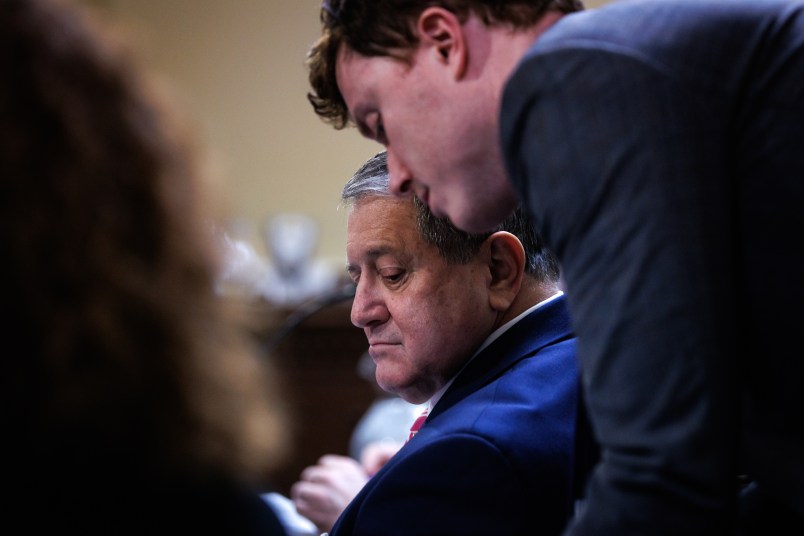
As a member of the House Appropriations Committee, Rep. Joe Morelle (D-NY) has had a front row seat to the process for funding President Donald Trump’s ongoing war in Iran.
“He’s got a lot of problems here,” Morelle said of Trump in a Wednesday conversation with TPM during which he shared his perspective on the administration’s plan to ask Congress to cover hundreds of billions of dollars in costs for the military operations. He described the situation as a chaotic one, with a lack of concrete information, clear goals, mounting Democratic opposition, and a president who “has no credibility.”
“Its unpopularity is going to continue to grow over time,” Morelle said of the war, “because there’s going to be no stated objective. There’s going to be no way to determine whether or not you met the standards that you set forward at the beginning of this process, so I just think it’s a mess.”
Trump began strikes on Iran in conjunction with Israel just over three weeks ago. Since then, Trump and his top officials have made a series of questionable statements about the operation’s goals and progress. The administration, which has maintained the war will last between four and six weeks, has said it is in negotiations with Iran. Iranian officials have disputed that. At various points, Trump has seemingly declared victory before modifying those remarks. Meanwhile, polls have shown Americans believe the war has gone too far and should not have been launched in the first place. The military action has also caused Trump’s approval rating to hit a new low.
Against this backdrop, the Pentagon is reportedly preparing to ask Congress for $200 billion in additional supplemental funding for the war. Morelle is vice ranking member of the Appropriations Committee, and is a member of its Defense subcommittee. However, even in that position, Morelle said he has received scant communication about where the new money would be going and how much has been spent so far.
“I don’t think the American public appreciates it, and it’s certainly not a way to conduct your conversations with Congress,” Morelle said. “Even in classified briefings where we don’t talk about what we learn, there’s literally no actionable intelligence that you get from him.”
The information vacuum has left Morelle to come up with his own estimates based on the $200 billion ask.
“I think it’s fair to say, without any real detail from the Pentagon — and no one has really disputed it — that it’s at least a billion dollars a day,” Morelle said of the war’s costs. “So, we are closing in on $30 billion, which is really, when you consider all the things that Trump rejects or the Republicans reject as too costly, the fact that they have now spent $30 billion in effectively the span of a month without even talking to Congress about this expenditure is really somewhat staggering.”
That billion-dollar-per-day figure is in line with expert estimates. Morelle, who was first elected to the U.S. House in 2018, said the lack of information Congress has received for such a large operation is “not normal” compared to the standards set by President Joe Biden or even during Trump’s first term. He also noted that, in addition to the new supplemental request, the Pentagon already received substantial additional funding via Trump’s “One Big Beautiful Bill,” which became law last year via the budget reconciliation process, through which legislation can pass both chambers with only a simple majority. Republicans are also discussing granting the Pentagon another $600 billion in additional funding to meet Trump’s larger goal of a $1.5 trillion defense budget.
“So, we are closing in on $30 billion, which is really, when you consider all the things that Trump rejects or the Republicans reject as too costly, the fact that they have now spent $30 billion in effectively the span of a month without even talking to Congress about this expenditure is really somewhat staggering.”
Joe Morelle
Morelle walked through some simple back-of-the-envelope math as he tracked all of these requests.
“I did a little calculation. I was asked earlier today at an event, ‘where are we with this?’ And if you’ll just permit me, the president — and it’s hard to tell whether this is overlapping or if I’m double counting, I don’t think I am — he’s talked about and they’ve talked about it openly now … they are going to request roughly $600 billion more in the appropriation process than they got in appropriations last year: $900 billion roughly to $1.5 trillion. That’s a $600 billion increase.”
Combined, Morelle noted all of this would more than double the military budget, with nearly $1 trillion in additional spending.
“They’re suggesting $200 billion in a supplemental and they’ve already gotten $150 billion in the, you know, the big reconciliation bill that he signed last July,” Morelle said. “I don’t think any of that is double counting because it hasn’t been spoken about as double counting. That’s $950 billion that effectively doubles the amount of money we spent last year.”
These massive figures and the public opposition have led to mounting concerns about Iran funding, including from some Republicans. And, on Wednesday, the Democratic Progressive Caucus announced it would oppose any funding for what Chairman Greg Casar called an “illegal war.”
For his part, Morelle said it’s hard to, at this point, declare opposition to the new defense funding because there has been so little clarity about what the Pentagon will ask for.
“I think it’s early to say whether Democrats are united, because we haven’t seen the specific requests and what the money would be used for,” Morelle explained. “But I do think Democrats are certainly united in their questioning the wisdom of this and I don’t think the president has persuaded, so far, very many Democrats.”
Morelle said he could envision certain items he or other Democrats might be willing to fund, such as replacements for ballistic missile interceptor stockpiles that have been badly depleted and also moved from other theaters during the conflict.
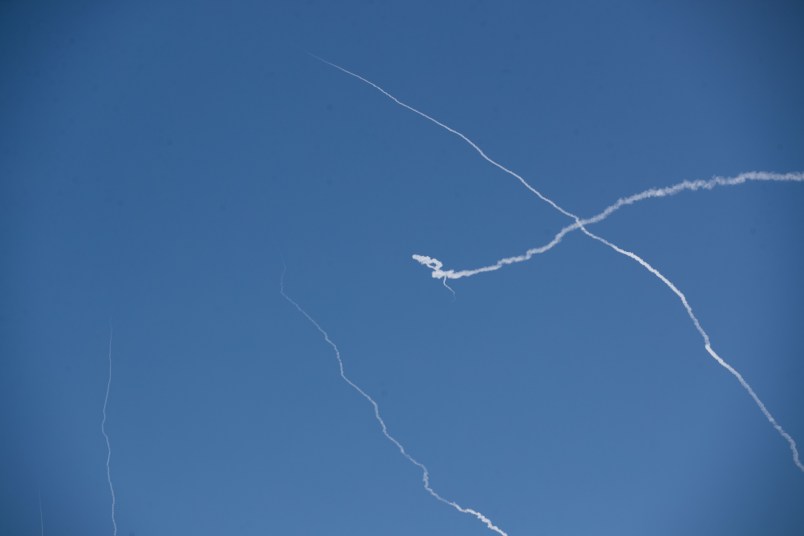
“The question is, we’re going to have to replenish stocks. Some of that is just an essential element of what they do to keep people safe. But does some of this include ground troops landing somewhere in Iran?” Morelle asked.
Overall, Morelle said that, with the administration’s opacity, what he wanted was some minimal level of clarity on what the White House would like Congress to fund. Absent “specificity,” he doubted that it would be “likely Democrats are going to be okay with the whole thing.”
He also noted that, even in a world where the White House was providing Congress with more concrete information, it would be hard to trust the president due to his consistently shifting statements about the war’s goals and progress.
“The challenge here too is although they haven’t given us much in the way of specifics, I’m not sure it would matter anyway because the president changes his mind so frequently,” Morelle said, adding, “He might say something and literally without exaggeration, a half hour later say something completely different, or even sometimes within the same press conference, give two wildly different answers.”
The divergent scenarios thrown out by Trump have included confusing messaging and implausible confidence related to Iran’s closure of the Strait of Hormuz, a key waterway whose blockage could cause an outsized impact on oil and gas prices. Morelle noted any new spending would increase the national debt, impact social programs, and add strain on American people who will also be feeling the impact of fuel costs.
The war is also a clear reversal from some of Trump’s past campaign promises and has even exposed divisions within his administration. That landscape leaves Morelle doubtful about whether even Republicans — many of whom have sought to establish personal brands as “deficit hawks” — will have the political will needed to pursue the new funding via reconciliation, which would require almost all of the party’s congressional representatives to get on board.
“I think they’ll have all kinds of problems with this in reconciliation. I never say no when it comes to Republicans being, you know, compliant minions of the president, so they’ll twist themselves into a pretzel to get there, but I don’t know,” Morelle said. “I’m highly skeptical they can do it in that way and then, frankly, they’ll own the entire thing.”
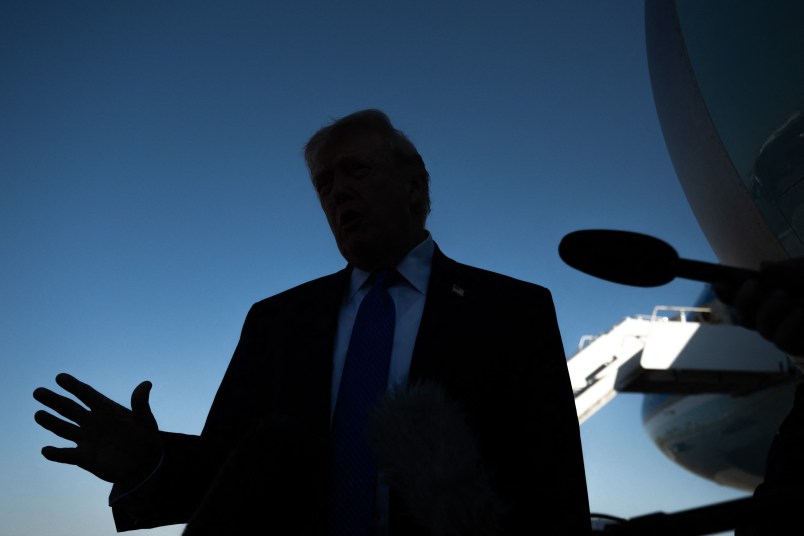
Hanging in the background of any potential funding request is the reality that Congress never approved the war in the first place. That places the basic legality of military operations in question, at best.
Trump has 60 days from when the war began to obtain congressional approval for it under the War Powers Resolution, a Vietnam-era federal law intended to rein in unilateral, presidential use of the military. After late April, the war would be in violation of the law. That’s unlikely to force a change in White House policy, though it does set the stage for a series of war powers votes that force members to take a position on whether they support or oppose the war.
In a Congress defined by its subordination to the White House, Morelle believes that dynamic, coupled with the unpopularity of the war, could cause a rare break between Republican members and the president on an issue that has already divided right wing pundits and the MAGA base.
“There’s going to be increasing pressure on some Republicans to at least limit the military operations,” he said, adding that it would become “increasingly difficult for them to reject” the idea that Congress should not vote on whether to authorize the war.
Trump launched the war absent any attempt to legitimize it before the public or receive approval from Congress beforehand. It’s an extreme example of an approach the Trump White House has cultivated since the administration began last year: simultaneously sidelining Congress to an unprecedented degree while also using what remains of its power to assert a form of one-party rule.
Passing war funding in some form, war powers experts say, could be used to authorize the campaign retroactively. That would offer the White House a means to continue to wage war on Iran while claiming that it’s now legal.
With the lack of information coming from the Pentagon to Capitol Hill, the question that remains is how Trump might ask to fund the war, and what the leadership in each chamber will choose to vote on.
Where previous defense supplementals largely tended to be bipartisan, Morelle said that Democrats’ opposition to this conflict and Speaker of the House Mike Johnson’s (R-LA) past unwillingness to use his power to check Trump means the funding requests will likely have to proceed along a party-line vote. That could be via reconciliation, or through other means.
“Johnson rejected all that because he wouldn’t be speaker without Donald Trump, and he knows that, and we all know it,” Morelle said. “So his ability to act independently and to help insist on Article One duties and responsibilities and powers has just simply eroded.”
Reconciliation bills are subject to a set of rules that often requires new spending to be offset by revenue raising provisions or cuts. This could force Republicans to balance the cost of the war funding that Trump wants with other measures. That could mean steep cuts to domestic programs, even after the $500 billion in cuts to Medicare that were included in the One Big Beautiful Bill Act.
“If you don’t want to raise taxes and you don’t wanna borrow more money, you take it out of domestic programs,” Morelle said.
For Morelle, both the money that has already been spent on the war and potential future funding raise serious questions about the country’s priorities. At various points during the conversation, he rattled off things that could have been paid for with the money that has gone to attacking Iran, including building “hundreds of thousands of units” of affordable housing, “six months of NIH cancer research money,” and “childcare for 1.5 million American children for a whole year.”
Morelle said that the fact that those resources are instead going to a conflict with unclear aims and results is the hardest and most mind boggling math of all.
“They fight us on things that will help American families be able to pursue dreams, take care of the food, housing, and healthcare needs of millions of families that they can’t afford,” he said of Republicans. “But they can go into an ill-conceived military action that has neither the support of Congress nor the support of American families, which has no clear objectives, shifting goals, and has alienated our allies and made us less safe.”



Frist.
Obligatory catwalk:
TMF has put his foot in it and has no f-ing clue how to get out of it. This looks to be the issue that finally drives a stake through the heart of the MAGA movement. Hopefully, we survive this.
This war does not serve America.
“They fight us on things that will help American families be able to pursue dreams, take care of the food, housing, and healthcare needs of millions of families that they can’t afford,” he said of Republicans. “But they can go into an ill-conceived military action that has neither the support of Congress nor the support of American families, which has no clear objectives, shifting goals, and has alienated our allies and made us less safe.”
Exactly.
Ok, gotta say it: a trillion here, a trillion there, pretty soon we are talking about a lot of money.
They are only questionable if you didn’t know about them beforehand to place an appropriate bet.
Come on congressman, you know exactly where it will be going into the pockets of the TRUMP clan and their sycophantic billionaire buddies