


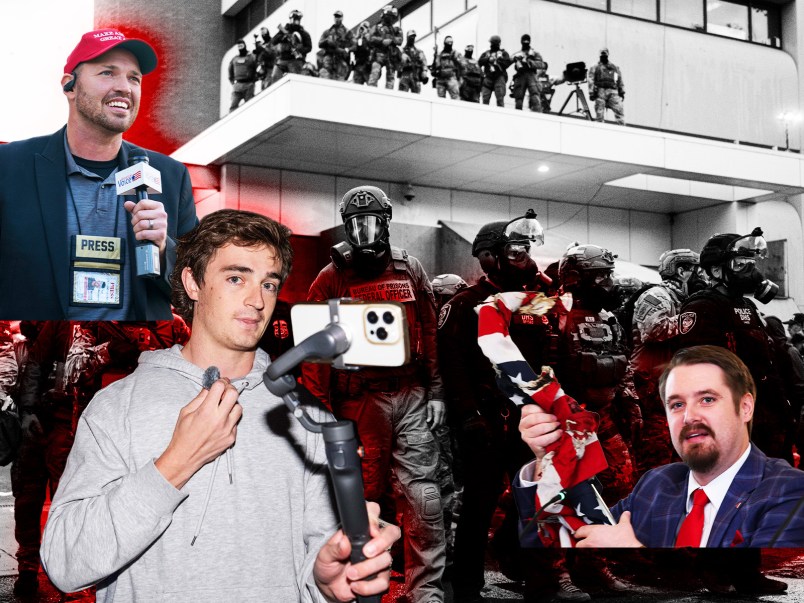
As DHS officers flooded into Minneapolis on an early December day, Mahamed Eydarus was out with his mom, shoveling snow.
In a subsequent declaration filed in a lawsuit, Eydarus would detail what unfolded over the next few minutes: An unmarked car suddenly drove up. A group of masked men wearing vests labeled “POLICE” and patches labeled “ICE” exited, and began questioning him and his mother: could they produce citizenship documents to prove that they were “not illegal”?
For Eydarus, a 25-year-old Somali-American U.S. citizen, the experience was harrowing. But amid the stress, he noticed that two men who emerged from the same car were acting differently. Unlike the others, they were unmasked, and were recording the encounter with cameras and phones. As the masked men, who Eydarus would later learn were ICE agents, questioned him, Eydarus felt intimidated for another reason: because the two men were recording, Eydarus began to fear that his answers to ICE’s questions would be broadcast to a potentially infinite online audience. Beyond that, the men, whom Eydarus called “livestreamers,” appeared to receive special treatment: bystanders had gathered, many filming the encounter on their phones. ICE told them to back off; they made no such request of the two unmasked men, Eydarus said.
In court papers, Eydarus later identified one of the unmasked men filming him as Ben Bergquam, a livestreamer and MAGA influencer who works for Real America’s Voice. Bergquam came up in the world of right-wing media after spending years hyping the Fresno Proud Boys chapter. After livestreaming January 6, he campaigned to free violent January 6 defendants like the Proud Boys and the Oath Keepers.
Bergquam is one of several right-wing influencers — they tend to prefer to be called content creators — who joined ICE on ride-alongs as the Trump administration directed DHS to inundate select American cities with federal agents. Over the course of 2025 and the early months of 2026, these influencers became part of a feedback loop for Trump’s mass deportation operations.
DHS has established its own in-house video creation operation to recruit agents and sell Americans on Trump’s mass deportation goals. This is different. These are outside influencers and livestreamers who are not known to have been paid by the federal government. Here, DHS has allowed influencers to join ICE on enforcement operations in the country’s interior. That’s meant interviews with detainees in the back of DHS vehicles, recording close-ups of arrests as they took place, and visits to ICE facilities — access to operations that federal agents have denied to other media. At the same time, federal agents have often threatened bystanders who record their activities. New, previously unreported details about these influencers’ involvement with ICE’s operations have surfaced in litigation in recent months and in interviews with TPM, helping to paint a fuller picture of the relationship between the federal agency and these far-right content creators.
Experts on social media platforms describe the dynamic as a symbiotic relationship: influencers get access to situations that result in outrageous, often-violent videos that suck in users. For those who make their money on views and hits, that can mean income. And in return, the Trump administration gets a platform from which to spread its version of events to an audience that is already sympathetic to its spin and agenda, and more fodder for the social media habits of its own officials.
The right-wing influencers who receive special access have also seen their content spur federal action. Nick Shirley, a 23-year-old influencer with a massive online following, released videos alleging fraud by Minneapolis’ Somali community that the White House elevated and used to justify DHS’s surge into the city; another Shirley video calling street vendors on Manhattan’s Canal Street “scammers” preceded a showy ICE raid there. In other, smaller-scale situations, like that of Eydarus, people under questioning by federal agents felt additional pressure from the presence of pro-mass deportation influencers, according to court documents.
The Trump administration’s pattern of granting sympathetic, right-wing influencers with large digital followings special access to its mass deportation operation is broad and involves dozens of people. TPM chose to focus in depth on four influencers, each with different audiences, approaches, and backgrounds. They are Bergquam, his sometimes associate Josh Fulfer, Shirley, and conservative influencer Nick Sortor. Together, they offer a cross-section of how DHS has created a feedback loop between explosive videos and federal policy.
Platform power
The mass deportation videos that these influencers create are only occasionally boosted directly by DHS or ICE officials. Instead, the payoff for DHS seems to be in leveraging the influencers’ followings to secure glowing coverage of the administration’s immigration actions. Per internal messages obtained by the Washington Post, ICE’s public affairs team saw benefit in granting right-wing media figures exclusive access in exchange for positive coverage. That included a June incident in which Charlie Kirk, months before his death, posted a video of ICE arresting a “thug,” garnering praise from within ICE. Another influencer with a massive reach, Benny Johnson, recorded then-DHS Secretary Kristi Noem going along for an ICE raid on a Chicago Walmart in October.
For the White House, these hyper-online, overtly political video creators offer a tantalizing way to communicate with huge segments of an untrusting and tuned-out public. Figures like Nick Sortor (1.5 million X followers; 56.6k on Instagram), Shirley (1.5 million X followers, 2.8 million on Instagram), and others provide a mechanism to reach the millions of people who do not consume political news in extreme detail, experts tell TPM. For those who, say, scroll through X or Instagram and come across a post here or there about a supposed riot in Portland, a call for the Insurrection Act in Minneapolis, or a confrontation on New York City’s Canal Street, these influencers can be powerful means to shape their political views. And for diehards committed to the spectacle of mass deportations, the videos and commentary that these influencers produce can serve as powerful sources of validation.
“Because of the way that recommendation and trending algorithms are set up on social media, content creators have a massive amount of power, a disproportionate amount of power when compared to regular users,” Sam Woolley, a media studies professor at the University of Pittsburgh who focuses on modern propaganda techniques, told TPM.
“It’s sensible that political entities on both the right and the left have begun to harness the attention that content creators hold over tens of millions, if not, you know, hundreds of millions of Americans,” Woolley continued. “Whereas the Venn diagram between government and political influencers used to have more separation than overlap, now there’s arguably, especially on the right, a lot more overlap than there is separation.”
“They are becoming inextricable from the U.S. government,” he added.
DHS did not return TPM’s requests for comment. It told the Daily Beast that it doesn’t enforce the law based on content creators.
Right-wing content creators “are becoming inextricable from the U.S. government.”
Sam Woolley, a media studies professor at the University of Pittsburgh
The Proud Boys and Face Time with Noem
Figures like Bergquam, or his frequent collaborator Josh Fulfer, have built up their audiences over the years through livestreaming Proud Boys events, expressions of support for the group, and advocacy for January 6 defendants.
On the day of the Eydarus encounter, Bergquam released a video showing his ride-along with ICE that day. It takes place at an intersection that Eydarus identified in his declaration, and shows Bergquam getting into increasingly volatile confrontations with anti-ICE protestors who gather at the scene. Nobody in the video is identified as an undocumented immigrant; instead, Bergquam focuses mostly on U.S. citizens that he calls “the enemies within.”
Unlike the others, who are all independent content creators, Bergquam works for Real America’s Voice, a right-wing news outlet. Fulfer’s professional ties are less clear; he has gained his own online following through his account, OreoExpress.
The pair “embedded” with ICE on an operation in Baltimore in January. That happened to coincide with a check-in for Kilmar Abrego Garcia, the man unlawfully sent to El Salvador’s CECOT prison last year, at ICE’s Baltimore Field Office. The pair filmed themselves following Abrego Garcia to a waiting car, asking him if he was “MS-13 or Barrio 18?”, “who named you a Maryland Man?” and “how many additional crimes have you committed?”
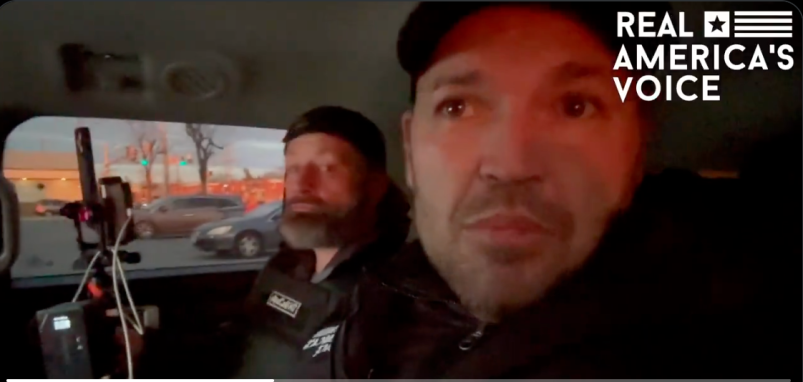
Some of the influencers who have received access to DHS operations, including Fulfer and Bergquam, have faced allegations of violence in the past.
Devin Burghart, president of the Institute for Research and Education on Human Rights, told TPM that the Proud Boys had come to rely on these types of livestreamers to communicate with the outside world, particularly during the post-Jan. 6 period when social media platforms cut off their access. It meant “relying on those individuals who had platforms to promote the kind of messaging and organizing that was going on on that particular range of the far right,” he said.
Fulfer filmed the encounter with Abrego Garcia. Along with Bergquam, he rode along with ICE on detention operations in Los Angeles in January. Fulfer was in D.C. on Jan. 6, though he spent much of Trump’s first term on probation stemming from a 2016 domestic violence charge. Prosecutors dropped the case after a probation term. Federal prosecutors asked for records from his case in 2023; it’s not clear why they did so.
When TPM asked Fulfer in a brief phone conversation about the domestic violence charge and his ties to the Proud Boys, Fulfer told TPM that he had one thing to say: “Deport every illegal.” When TPM asked Fulfer how he came to embed with DHS, he replied “deport every illegal” before hanging up.
Bergquam was convicted of misdemeanor assault over a 2019 altercation with a Telemundo reporter, before successfully reversing it on appeal (Bergquam told TPM that he was grateful “the appeals court saw the truth.”).
In a text message, Bergquam told TPM that while he’s never been a member of the Proud Boys, “I thank God for them. They were one of the only groups standing up against the violent Antifa terrorists during President Trump‘s first term when leftist cities had their police forces stand down.”
Bergquam added that the people filming him and ICE in Minneapolis were “traitors” part of a “coordinated effort by leftist activist organizations to stop ICE from deporting the illegals,” and argued that “reporters on both sides, right and left were given access to ICE ride alongs.” CBS, NBC, and ABC have all done ride-alongs with ICE over the last year. Bergquam declined to comment further.
Operating on anarchic social media, figures like Fulfer, Bergquam, and others can exert a level of influence largely denied them offline. That influence can also mean special treatment from the Trump administration.
Nick Sortor is an influencer who appeared at the White House’s Antifa Roundtable in October. It came one day after he was granted special access to DHS operations in Portland. There, he embedded with then-DHS Secretary Noem on an ICE ride-along and appeared on the roof of the Portland ICE facility alongside her. Two other right-wing influencers — Benny Johnson and a local media figure named Tim Medina — were included as well.

On the ride-along, Sortor posted a video of Noem speaking with a detainee in the back of a law enforcement vehicle. “🚨 NOW: Kristi Noem confronts an illegal in ICE custody, who was convicted of s*x crimes with a MINOR,” Sortor wrote at the top of the post. Sortor also posted a video from the roof of the ICE facility of protestors below.
The Portland ICE facility had been a flashpoint for days. Local media outlets reported that ICE had denied their journalists access to the facility; Sen. Ron Wyden (D-OR) questioned how DHS was granting access.
Days before his appearance with Noem, Sortor had walked through an encampment of protestors outside the facility. An altercation ensued. Accounts differ, but Sortor was initially charged over the incident; an ICE protestor was tried and acquitted this month of charges arising from the encounter.
Within hours, the Trump administration brought the force of federal law enforcement on Sortor’s behalf. Attorney General Pam Bondi called Sortor and told him that federal prosecutors would examine his arrest, while Assistant Attorney General Harmeet Dhillon said that the DOJ would investigate the Portland Police Department for viewpoint discrimination.
Under pressure, Portland police released Sortor. Trump reportedly called him within hours of his release; White House Press Secretary Karoline Leavitt said that the administration would review federal funding for the city.
The Portland incident was not Sortor’s first arrest.
Per court records obtained by TPM and first reported by the Lexington, Kentucky, Herald-Leader, Sortor was charged with felony burglary over a November 2020 incident. Per a police citation, Sortor allegedly called a woman 27 times, appeared at her house in the middle of the night, forced his way inside, “grabbed the victim by her hair, and pulled her outside the apartment.” He allegedly retrieved his laptop and stole her dog; “the victim stated the suspect slapped her in the face as he was leaving.”
For Sortor, that case isn’t over. After pleading to a misdemeanor criminal mischief charge, court records show that he failed to appear for probation, prompting a still-active state arrest warrant, per a search of state records. Sortor didn’t return TPM’s requests for comment; he told the Herald-Leader in October that he was surprised there was an open warrant for his arrest and would “handle it.”
Showdown on Canal Street
Towering above the other influencers in influence, popularity, and closeness to the administration is Nick Shirley. He’s from a family that’s made online influencing into a small business model: his mother, Brooke, told TPM that she helps shoot and produce his videos. Another brother focuses on travel content.
Shirley has had unparalleled influence and access in the Trump administration. It’s a microcosm of the chicken-and-egg question at the heart of DHS’s relationships with these influencers: is Shirley making videos that showcase DHS policy? Or is he prompting federal action?
DHS and Republican officials have granted him extensive access. Shirley spoke at the Antifa roundtable in October, telling Trump that in Portland, he was “chased out by a member of Antifa who said he would smoke me. And next thing I knew, a DHS sniper had lasers on his chest.” Shirley described it in a post as an “opportunity to brief President Trump about some of my reporting over the past year or so.”
Later that month, Shirley went on a ride-along with ICE agents in Chicago. It took place in mid-October, during the peak of the surge of federal immigration enforcers into the city. Greg Bovino, the CBP official given out-of-the-chain-of-command control of the operation, was staging enforcement actions across the city designed to garner attention. In that environment, Shirley received access not only to ICE operations but to those being apprehended. He interviewed a detainee in the backseat of an ICE car. The resulting video was titled, “Nick Shirley Deports Migrants with ICE.”

In December, Shirley released a video purporting to expose fraud in Minneapolis’ Somali community, though what exactly the video actually shows about Minneapolis’ day care centers remains murky, at best. Republican state legislators said that they helped Shirley prepare the video.
The video went viral. After it was released, the White House and Republicans rewarded Shirley. Vice President JD Vance quote-tweeted the video with, “This dude has done far more useful journalism than any of the winners of the 2024 @pulitzercenter prizes.” The White House cited his video purporting to expose public services fraud in the Somali community in Minneapolis as a justification for surging DHS agents into the city. Rep. Eli Crane (R-AZ) introduced a bill in January to award Shirley a Congressional Gold Medal.
The Minneapolis surge had already begun at the time that the video was released. But after it went viral, DHS said that it would send 2,000 additional agents to the city, calling it on X “the largest DHS operation ever.”
Shirley began posting videos online when he was 15, his mother, Brooke, told TPM in a phone interview. They began as mostly prank videos with his friends, but turned more political over time.
Brooke, an influencer in her own right, told TPM that she and Nick began to post political videos out of a belief that the border trumped all other concerns. Growing up in San Diego, she said, the consequences of what she characterized as untrammeled immigration were everywhere. “I would see, you know, Mexicans in the fields just coming across to work,” she said.
Both of their influencing careers took off under Biden. In 2021, Brooke said, she paid for a trip to do videos at the southern border. In 2023, she said, Nick returned from a two-year mission trip to Chile with fluent Spanish. In 2024, he posted a video from Springfield, Ohio, the focus of attacks from the Trump campaign on the Haitian community there, titled, “Are the Rumors True?”
Brooke said that her son “wanted to be the next Logan Paul” when he started recording videos.
That’s led to a burgeoning empire. In addition to ad revenue, Shirley solicits donations, sells T-shirts (one is labeled “The Battle of Minneapolis”), and offers subscriptions through a website, “Anti Fraud Club.”
Under Trump II, that influence has also meant DHS following his lead in flooding large American cities.
“Walking down the street, your life is automatically changed by some guys who record you and put you on YouTube to make money off of you.”
Mamadou Ndoye, an immigrant who was featured in one of Nick Shirley’s videos
In September, Shirley released a video called “I Confronted Dangerous Migrant Scammers in NYC.” In it, he went to Manhattan’s Canal Street, where street vendors, a large number of whom are immigrants from Africa, sell their goods. In the video, Shirley accuses several men of scamming, before one angrily confronts him.
One month later, ICE descended on Canal Street and detained several people, including the man who Shirley recorded confronting him.
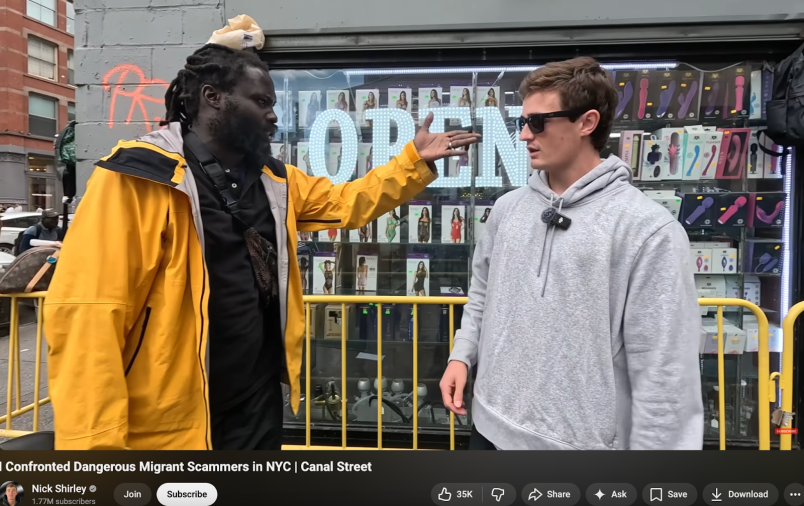
The man, Mamadou Ndoye, was released in February after filing a successful habeas corpus petition, before ICE detained him again one week later. In a declaration in a second habeas case, filed after his second detention, Ndoye said an officer asked him during an ICE check-in why he had been so aggressive toward Shirley on the video. He was then detained for a month until a judge ordered him released again last week, calling his arrest “cursory.”
Ndoye told TPM that his encounter with Shirley and subsequent detentions by ICE had forced him to consider self-deporting. He had spent three years saving up money that he used to open a restaurant in lower Manhattan in 2024, he said. Business had been going well, but five months in detention had put him behind on rent and left the restaurant with fewer customers. After his detention on Canal Street, DHS called him a “criminal.” Ndoye has previous arrests for unauthorized use of a vehicle and misdemeanor assault.
When TPM asked Brooke Shirley about whether she and her son coordinate with the administration, she denied it.
“No one knows what we’re doing. No one tells us, no one shows us. We had no talkings with them,” she said. She told TPM that Shirley “just asked” to do the ride-along in Chicago, before later saying: “he was asked to go.”
When TPM asked about Ndoye, Brooke demanded to know the location of his restaurant and began to envision an opportunity to make content.
“I’d like to go to that restaurant, and I’d like to ask him how his life has been ruined, and I’d like to see how an illegal immigrant can own a restaurant,” she said.
Ndoye told TPM that he was surprised at the impact the video had. His children began to be bullied in school after the video was released, he said. It’s shocking to him that “walking down the street, your life is automatically changed by some guys who record you and put you on YouTube to make money off of you.”
When TPM read out these quotes to Brooke, she gave a long pause.
“That could happen to anybody,” she said. “A lot of people’s lives are changed by things that happen.”



I’m hoping today’s space launch and mission succeed. We can then definitively settle whether Donald Trump’s depravity is visible from the moon.
Instead of content creators, can we call them Mini Riefenstahls?
The US pays about 15% of NATO costs, but historically has had a much larger overall military budget. NATO includes the populous Turkey, so its 32 members together represent 970 million people. The US population is about 340 million. Rubio’s latest free-riding attacks on other NATO members and threatening to take his ball and go home look odd to say the least. Quitting NATO is Putin’s wet dream, and the US seems hell-bent on giving him that. It feels like we’re living in an alternative universe.
Those fuckwads need to find a real job. But first they need to be educated.
This is without a doubt the most corrupt and lawless administration ever. We have had individuals in the past who have been crooks but nothing on the scale of Trump and his fellow criminals.