


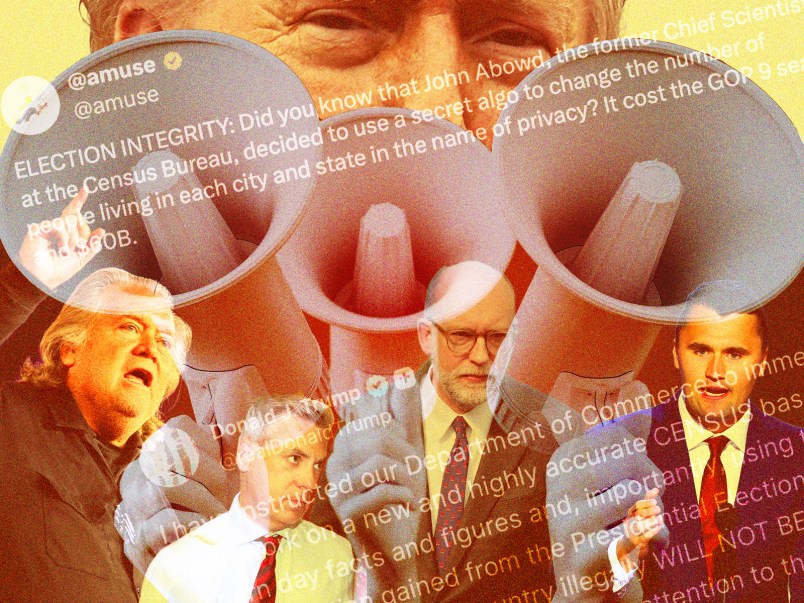
When longtime Indiana politician Sen. Jim Banks (R-IN) lobbed a powerful allegation against the Census Bureau last October, what had been a low-profile, fringe GOP conspiracy theory burst to the fore. Banks said he believed the Census Bureau had injected errors in the decennial population count and survey which were so severe, they netted Democrats more representation in Congress at the expense of Republican seats.
“The Biden admin used a shady ‘privacy’ formula,” Banks wrote on X, adding that the 2020 census “scrambled the data and miscounted 14 states. It included illegal immigrants and handed Democrats extra seats.”
In a letter to Commerce Secretary Howard Lutnik that Banks posted on X, the senator repeatedly asserted that the use of a privacy technique called noise infusion, rolled out to help the Census Bureau better protect the individual identities of respondents, resulted in population count errors that interfered with the process of allocating political representation in Congress, known as apportionment. Those errors overwhelmingly supported blue states and hurt red ones, said Banks, who also conflated the use of the technique with myths about noncitizen voting.
His post has more than 9,000 reposts and has, according to X, been viewed more than 8.5 million times. Becoming a rallying cry for Trump allies and MAGA-aligned influencers against Democratic “fraud,” Banks’ post was quoted by far-right provocateur Mike Cernovich, known for promoting the fringe conspiracy theory known as Pizzagate, to his 1.4 million followers.
Peter Bernegger, a staunch election denier with more than 100,000 followers, also pushed it, writing in a lengthy post that the “2020 Census was manipulated via a secret algorithm.”
The editorial board at the right-leaning Washington Times wrote in October that the Census’ use of noise infusion, a type of differential privacy, “formalized the publication of fraudulent information.”
The problem is, Banks’ viral post wasn’t true. It was part of a disinformation campaign using categorically false information about census administration that has reduced a highly advanced statistical technique to just another arm of the disproven, right-wing delusion that immigrants are somehow enabling Democrats to rig federal elections and claim undeserved political power. More extreme versions of the claim allege that privacy protections used by the Census Bureau distort apportionment — the process of using decennial census data to determine how many congressional seats each state receives. It overlaps with hardline GOP immigration policy, as Trump officials and allied groups imagine huge numbers of immigrants have been wrongly imputed to blue states. Less extreme versions of the claim focus instead on individual congressional districts and redistricting. Ending the use of differential privacy, both wings assert, will alleviate this unfair blue state advantage.
Experts say both versions are baseless.
“The business of getting rid of differential privacy will have no impact on anything political,” Steven Ruggles, a professor at the University of Minnesota and a creator and director of IPUMS, the world’s largest population database, told TPM. “Nothing regarding differential privacy or swapping could possibly affect apportionment. It’s just much too subtle; very small adjustments to the data.”
Banks’ office did not respond to a TPM request for comment.
The Census Bureau is legally required to protect the identities of people who respond to its surveys. In 2020, Bureau employees accomplished this by using noise infusion, which added and subtracted information from individual respondents’ data at granular geographic levels to fuzzy the figures and keep bad actors from re-identifying people who filled out the census.
Differential privacy isn’t applied at all to the state population totals that are used to determine congressional representation by state, experts told TPM. And the amount of “noise” eventually added to fuzzy individual demographic data is too small to impact redistricting, as Republicans claim.
“The odds that [differential privacy] could ever affect a majority-minority voting district is also very implausible,” said Ruggles, who had once been an outspoken critic of the 2020 Census roll-out of differential privacy. “It’s sort of about the likelihood of an election being determined by one vote.”
Nevertheless, the idea that “covert” census policies help Democrats animates nearly everything about how Trump’s reactionary movement sees its crusade against the Census Bureau, which it has targeted as part of its larger mission to change how the population is counted — and help cement Republican legislative power. It is likely to play a crucial role as it works to fulfill the president’s demand for a whole “new” census in time for 2030.
TPM set out to figure out where these ideas about differential privacy came from. Some of the research that underlies this reporting was conducted by Jae June Lee, a privacy researcher at Cornell University, and shared with TPM.
Our interest in this conversation was piqued because Trump’s Census Bureau appears to be acting on these unfounded beliefs. In recent months, the administration took a series of unprecedented actions aimed at changing how the agency handles privacy, apparently in hope of shrinking Democrats’ political power.
In June, it banned a set of policies for protecting Americans’ privacy, including differential privacy — policies that had been carefully fine-tuned over the last several years — seemingly without any expert input.
Then, TPM uncovered a draft Census Bureau rule circulating within the administration that sought, among other things, to exclude many immigrants from the population count used for apportionment, an attempt to redistribute that violates the 14th Amendment requirement for the census to count all whole persons in the country. It also sought to end the collection of most demographic information, citing concerns about privacy.
Underlying each of these developments is the right-wing, conspiratorial belief that the Census Bureau’s handling of privacy somehow favors Democrats in redistricting and apportionment. That idea, TPM found, was having a moment back in 2021.
In March of that year, the state of Alabama filed a lawsuit, which it would later lose, challenging the Census Bureau’s use of differential privacy and calling for a complete re-do of the 2020 Census. Two months later, the Claremont Institute, a conservative think tank, published an article critiquing the technique written by a future Project 2025 contributor who worked at the Census Bureau during Trump I.
Before differential privacy was used in the 2020 Census, experts like Ruggles and others were concerned about its impact on data accuracy, which resulted in public debates and data demonstrations. After years of tests, Ruggles said he was satisfied that the amount of noise was so miniscule, it wouldn’t compromise data quality. Today, right-wingers seem to be seizing on that controversy, contorting early, valid concerns about differential privacy into an ongoing, devious and misleading political campaign.
With these early challenges to differential privacy as a foundation, the issue reemerged after Trump was reelected.
“I think the fact that it’s rather complex and difficult to understand makes it a prime target for politically mischievous groups who want to sow distrust within systems and distrust within the government.”
Misty Heggeness, professor at the University of Kansas’ School of Public Affairs and Administration
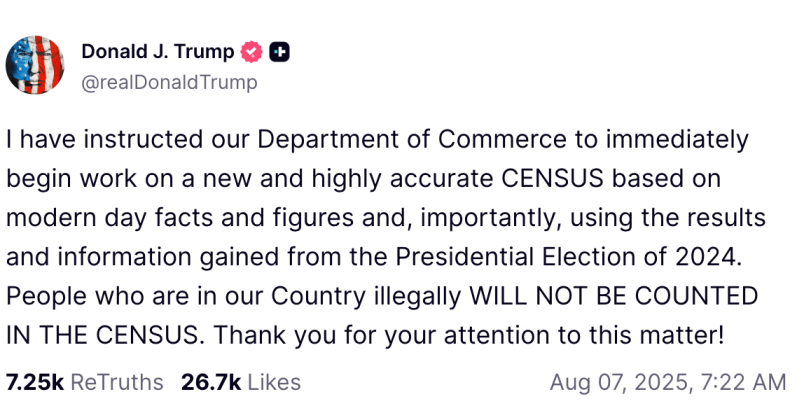
On Aug. 7, 2025, Trump, in a post on the social media platform he owns, Truth Social, directed the “Department of Commerce to immediately begin work on a new and highly accurate CENSUS.” That census, Trump wrote, should exclude undocumented immigrants.
The same day, the Center for Renewing America — a think tank founded by now-Office of Management and Budget Director Russ Vought — published a 6,000 word report called “The 2020 Census Fraud: How Differential Privacy Skewed Representation.” The Census Bureau’s differential privacy use “tilted the political scales favorably toward Democrats for redistricting purposes,” the report said, in opposition to widely accepted professional understanding about differential privacy’s lack of impact on anything political. The write-up also falsely held that differential privacy “damages the reapportionment process,” and called on the Commerce Department to ban the technique more than a year before the department put such a ban in place.
The complexity of the method makes it ripe for weaponization, former Census Bureau employee Misty Heggeness told TPM.
“I think the fact that it’s rather complex and difficult to understand makes it a prime target for politically mischievous groups who want to sow distrust within systems and distrust within the government,” said Heggeness, who was a principal economist at the Census Bureau when differential privacy was rolled out.
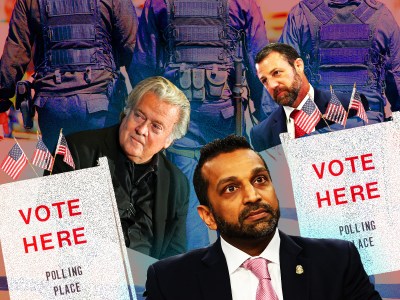
The right-wing differential privacy disinfo campaign has followed a consistent playbook both in 2021 and during Trump’s second term: Around the same time that government and elected officials take action on or mention the census and its privacy protections, MAGA allies blitz social media and their websites with conspiracy theories about the use of differential privacy in the count. They post about how Democrats working at the Census Bureau have used a “secretive” algorithm to rig the population count and therefore affect political representation. Posts on X about differential privacy from right-wing accounts have gone viral, amassed hundreds of thousands of views, and have even been boosted by the site’s owner, Trump ally Elon Musk. The campaign has been fueled by known MAGA associates like Steve Bannon and, before his death, Charlie Kirk, as well as less public far-right figures and a handful of influencer accounts on X.
At the nucleus of this effort to demonize differential privacy, TPM found, is Vought’s thinktank, the Center for Renewing America, and Wade Miller, the organization’s current director.
The Center for Renewing America did not return multiple TPM requests for comment.
In addition to the aforementioned 6,000-word report, the Center for Renewing America would publish two more briefs about differential privacy before August 2025 ended.
Some elected officials joined in. Florida Attorney General James Uthmeier in August 2025, for example, sent a letter to Lutnik, and posted to X, claiming that differential privacy skewed census data. He called for a re-do of the 2020 Census results. That post was viewed more than 33,000 times, according to X.
“Just like the immigration crisis,” Uthmeier wrote, “we are proposing solutions for a corrected Census to give Floridians the representation they deserve in Congress.”
Miller, from the Center for Renewing America, joined the Charlie Kirk Show last August when, in responding to a question from Kirk, Miller said differential privacy allowed the Census Bureau to “make up fake numbers.”
“I think the Trump administration is aware of this,” Miller told Kirk. “If not, I hope they’re watching this.”
The same month, Miller joined Bannon’s podcast.
“We gotta get spun up and educated on differential privacy as it pertains to the Census,” Miller told Bannon. About undocumented people, he added: “We have to know exactly where they’re at to account for that in redistricting.”
MILLER: We have to get educated on differential privacy in the census. It scrambles the data, and we cannot allow that for population and illegal alien counts. We need to know exactly where they are to account for it in redistricting. @WadeMiller_USMC pic.twitter.com/ysaYOd7zjT
— Grace Chong, MBI (@gc22gc) August 14, 2025
The idea that the Commerce Department would ban a slate of statistical techniques based on “crazy, insane, right-wing conspiracy theories that somehow differential privacy and disclosure control more broadly is somehow biased towards Democrats or something — I mean, that’s just dumb,” said Ruggles.
Dumb or not, the idea that “Obama-era bureaucrats” commandeered the census for their own political gain continues to thrive among right-wing influencers.
In October 2025, a prominentX account, @amuse, published a 2,200 word essay titled, “The Algorithm That Rigged the Census: How One Bureaucrat Stole the House and Billions in Funding.” It was viewed more than 668,000 times, promoted by Miller, and embraced the maximalist version of the conspiracy theory. Its opening section contained factual inaccuracies about the ways differential privacy interacts with census data. It was significantly boosted when Musk replied to the post saying, “Wow.”
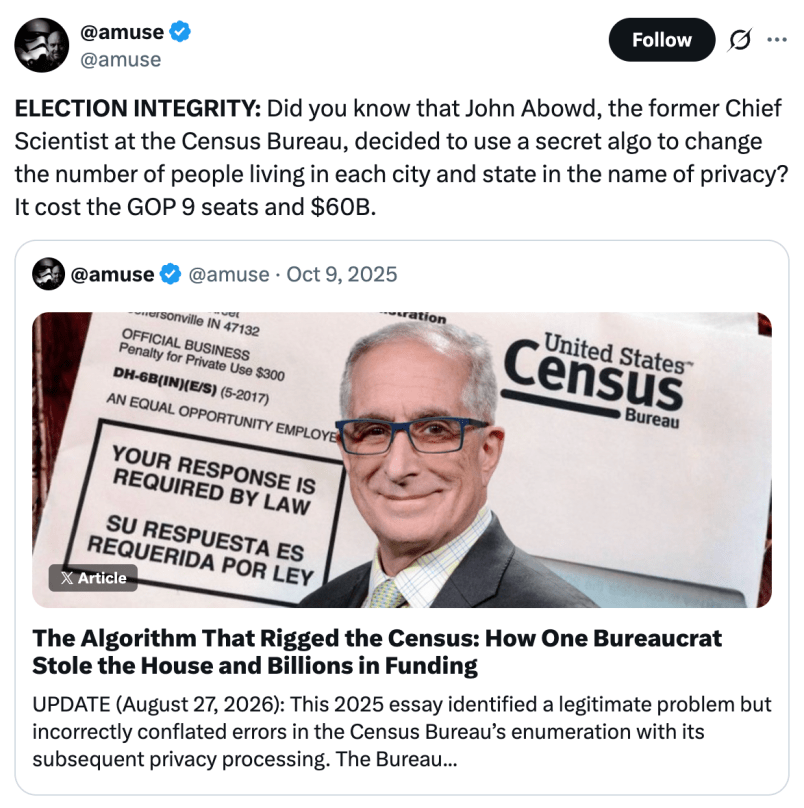
The Census Bureau’s use of differential privacy meant it didn’t produce an accurate population count for apportionment, the essay alleged.
“I sometimes get a feeling they use it as a scapegoat exactly because nobody really understands it.”
Jan Vink, extension associate at Cornell University’s Program on Applied Demographics
Reached by TPM on a Signal account listed in @amuse’s X bio, the person behind the account, Alexander Muse, walked back that claim and other aspects of his essay.
The 2020 Census overcounts and undercounts “are not a privacy-method story,” Muse told TPM in written responses over Signal. “I would not now claim that differential privacy changed the state apportionment totals, or that it handed particular states House seats.”
After speaking with TPM, Muse updated his essay on X to “retract the article’s claims connecting differential privacy to state-level miscounts and the allocation of House seats while continuing to defend its central criticism of publishing deliberately altered local figures as though they were exact counts.”
Muse, over Signal, described himself to TPM as a serial entrepreneur. His X account is highly influential. He’s posted conservative, AI-generated content, including the infamous “Swifites for Trump” images, one of which the president himself, in 2024, reshared, including Muse’s X handle.
Muse said he became interested in differential privacy after following the public dispute about the Census Bureau’s plans to use the statistical privacy method ahead of 2020, and that he read papers from the bureau and academics, as well as material from the Center for Renewing America and America First Legal, founded by now-White House official Stephen Miller. Muse said he was not in contact with either group and that his piece was composed independently.
“I sometimes get a feeling they use it as a scapegoat exactly because nobody really understands it,” Jan Vink, a demographer at Cornell University who represents New York State in the U.S. Census Bureau’s Federal-State Cooperatives for Population Estimates and Projections, told TPM.
“They are confusing differential privacy with under and overcounts and apportionment,” Vink said of conspiracy theorists. “It has nothing to do with over-under count, it has nothing to do with apportionment — but they use those arguments anyhow.”
One day before the Commerce Department banned noise infusion via a June 4 memo, the Center for Renewing America’s Miller appeared on Lindell TV, a streaming channel helmed by Mike Lindell, the MyPillow founder and 2020 election denier who recently lost the Minnesota GOP gubernatorial primary. Miller continued to make false claims about differential privacy.
“We think that the weaponized Census Bureau used this algorithm… to move population around,” Miller said.
Trump’s Vought-run OMB coordinated with the Commerce Department on the ban, according to Census Bureau officials who spoke on a panel at a recent industry conference. OMB, the Commerce Department and the Census Bureau did not respond to TPM requests for comment.
The June ban has not stopped the right-wing online campaign against a statistical method that those involved do not appear to fully understand.
Some of the accounts post very similar text and media at semi-regular intervals. An X account from someone called @Real_RobN with 339,000 followers posted about differential privacy in April, May, and August. Each time, he starts with the words “Here it is,” shares a video from the Center for Renewing America and perpetuates untrue claims about differential privacy’s impact on congressional appropriation.
“States were intentionally over- and undercounted, costing citizens seats in Congress and Electoral College votes,” he wrote, falsely, each time.



Trumpers want to ignore the US constitution, math, and science.
Can we sue the GOP for emotional and financial distress?
Right wing crackpots run the U.S. government.
That is my comment.
A. Categorically not a “Biden admin” thing if Census Bureau employees were already using this technique in 2020. But perhaps the language here is loose and the second quote should have started “In the 2020 census, …”
B. Extremely unlikely that Bureau under Biden went from not using noise infusion, to using noise infusion and pissing off Alabama enough to garner a lawsuit in the space of 2 months (January 20th - March whatevereth).
Conclusion: the technique was developed, chosen, and instituted during the Trump I admin.
If it weren’t for bad faith, they’d have no faith at all.
I don’t know why Republicans have such difficulty understanding differential privacy.
The definition is right there on wikipedia: