


A new Trump administration prohibition on privacy protections at the Census Bureau appears to be teeing up a fight that touches on everything from government data to political representation, immigration to redistricting — and even opens the door to a world in which federal data used for everything from disaster planning to school enrollment may all but disappear.
It all stems from an early June Commerce Department memo banning certain privacy techniques used in the 2020 Census, techniques that were designed to allow federal statisticians to extract and publish data down to the block level while protecting the identity of individuals.
The ban came out of nowhere, experts told TPM. Detailed information on the policy change hasn’t been posted publicly, nor has it been subject to public or expert input, a departure from the way the Census Bureau handled its rollout of previous updates.
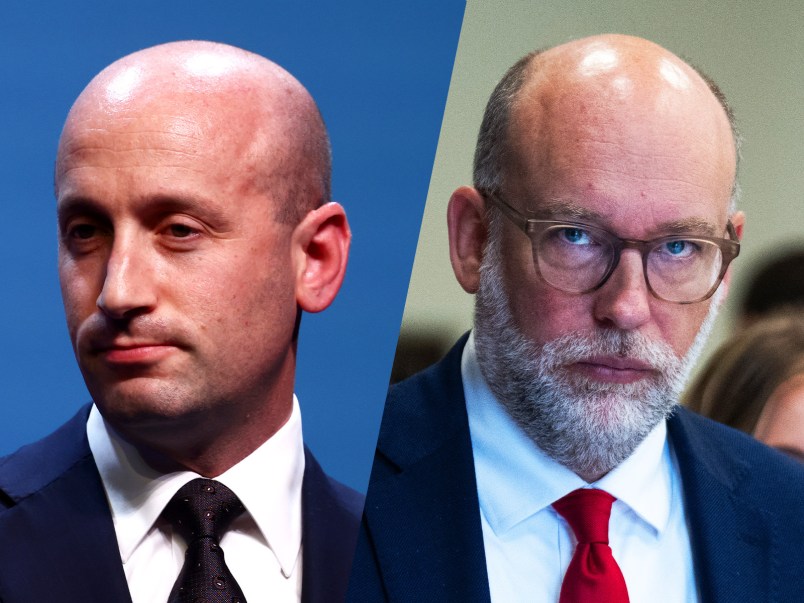
But it echoes a push to nix a broad slate of so-called disclosure avoidance techniques that has repeatedly bubbled up among right-wing groups. A camp of conservative officials and advocacy organizations — including Stephen Miller’s America First Legal, and the Russell Vought-founded think tank the Center for Renewing America — say they believe the techniques disproportionately benefit Democrats when it comes to congressional apportionment and political map redrawing.
The Commerce Department, Census Bureau and Bureau of Economic Analysis, which is also affected by the memo, did not respond to TPM questions about the policy change.
Several statisticians and economists, including the former chief scientist at the U.S. Census Bureau, told TPM claims of privacy protections interfering with political processes are based on misinformation. It’s unclear why the Commerce Department abruptly halted its disclosure avoidance methods, and expert guesses about the policy shift vary.
That is, in part, because there are many overlapping potential causes and motives: misinformation about the role this data plays in redistricting; a documented desire among administration officials to add a question about citizenship to the Census; a longtime right-wing goal of excluding noncitizens from apportionment.
Regardless of the administration’s true aims, experts said, the policy change has dramatic implications for people and neighborhoods. It stands to eradicate a data set used for disaster planning and could render obsolete information used for everything from school enrollment to housing development and public infrastructure planning.
The Way in Which the Bureau Protected You is Going Away
Ahead of the 2020 Census, the bureau rolled out a new privacy program called differential privacy. The technique utilized in 2020 adds “noise” to data, relying on a mathematical technique to fuzz up information collected in such a way that the agency can publish hyper-specific, granular datasets without making specific survey respondents identifiable.
The protections work to shield the identities of people in small and minority communities. In some cases, the technique might be used to anonymize data about enclaves of small ethnic groups, Beth Jarosz, senior fellow at the Georgetown University Massive Data Institute, told TPM. In others, it might be applied to data about veterans, disabled populations, or the number of three to five year olds in a given neighborhood.
In its order barring the privacy methods, the Commerce Department identified two alternative methods agencies should use going forward. The first is called coarsening, and would force scientists to “aggregate up,” Jarosz explained, collecting data on the county level, for example, rather than the hyper-local community level. The second, suppression, would scrap the publishing of the data altogether if agencies couldn’t guarantee adequate privacy protections.
“There are lots of different disadvantaged groups or historically marginalized groups where we will likely have less visibility into what their life experience is like,” Jarosz said.
Differential privacy and noise infusion fall under an umbrella of disclosure avoidance methods, and have not been without good-faith criticism. The techniques deployed during the 2020 Census was met with critiques from experts, who feared it could distort the accuracy of data. The bureau made tweaks at the time.
Right-Wing Panic About Immigrants and Political Representation
A high-profile legal battle hinging on the wonky pieces of statistical science began when in 2018 the state of Alabama sued the federal government, objecting to the inclusion of noncitizens in population counts used for apportionment to determine how many congressional seats a state is allotted. The suit claimed the state would lose a House seat and an Electoral College vote as a result of including noncitizens; noncitizens have been included in apportionment since the first census was taken in 1790. A state with more undocumented immigrants, Alabama argued, would gain the representation to which Alabama believed it was entitled.
That lawsuit was dismissed without prejudice in 2021.
In 2021, Alabama tried a similar suit. This time, the state claimed the Census Bureau’s use of differential privacy would interfere with redrawn political maps. Again, a U.S. District Court dismissed the case without prejudice.
Last September, Stephen Miller’s America First Legal joined prominent Trump lawyers at a Florida-based firm called Weber, Crabb & Wein, P.A., in another suit seeking to ban differential privacy in the 2030 Census. The suit also seeks to declare the 2020 Census unlawful, and calls for the creation of a new 2020 Census report with privacy mechanisms removed.
The Miller-backed suit claims the census’s population count diluted “the representative power of lawfully enumerated citizens.”
The claim that the impacts of privacy tools on the census shifted political representation is false, experts told TPM.
“First of all, none of the privacy protections affected apportionment,” John Abowd, former chief scientist at the Census Bureau, told TPM. “Every time you see that they did, that’s a lie.”
“There’s disinformation that says, ‘Oh, it changed state population totals for apportionment,’” Jarosz said. “That is not true, but some people believe it.”
On July 7, the U.S. District Court for the Middle District of Florida dismissed the most recent suit with prejudice, barring the conservative plaintiffs from renewing their suit against the government. The 2-1 decision dismissed the suit on several grounds including plaintiff’s lack of standing. The following day, the plaintiffs filed a notice of appeal to the Supreme Court.
America First Legal did not respond to TPM questions for this article.
Russell Vought’s Think Tank Repeatedly Targeted Privacy Protections
Less than a month before the mid-September lawsuit filed by America First Legal, another prominent right-wing group associated with a top Trump official published an explainer on differential privacy.
Russell Vought’s Center for Renewing America identified the protection of noncitizens as one of three issues with the privacy measure in a late August 2025 brief.
That concern was wrapped up with a long-time right-wing goal related to the objectives pursued by Alabama and America First Legal: adding a question about citizenship to the Census to exclude non-citizens during apportionment.
“Even if the citizenship question is added to the Census, it will be impossible to ascertain the status of individuals so long as differential privacy is used,” the CRA explainer says, adding that counting noncitizens boosts political representation in blue areas and “draws political power away” from conservative enclaves.
That belief, Abowd said, is the true driver behind the Commerce Department’s seemingly out-of-left-field memo. Abowd was the lead scientist at the Census Bureau during the unprecedentedly challenging 2020 Census, which came during the COVID pandemic.
“The Center for Renewing America wants the block-level citizenship data without the privacy protections,” he said, “because they want to know who the noncitizens are in that block. They are assuming that noncitizens would be crazy enough to say so on the census form if they knew what was coming.”
Abowd, statistics and data science professor emeritus at Cornell University, was a prominent witness throughout the first Trump administration when then-Secretary of Commerce Wilbur Ross fought unsuccessfully to add a question about citizenship to the 2020 Census. An analysis Abowd and his bureau colleagues conducted in 2017 and 2018 about the impacts of adding such a question to the census found it would produce a less accurate count. Abowd made clear that he did not think adding the question was a “good idea,” TPM reported at the time.
Speaking about the most recent Census Bureau policy change, Abowd said the Trump I push to include a citizenship question goes hand-in-hand with the adoption of differential privacy.
“Because of that order, the Census Bureau was determined to strengthen the confidentiality protections of the data,” Abowd said.
The Center for Renewing America did not respond to TPM’s questions for this article.
Even Critics of Differential Privacy Are ‘Concerned’ About Policy Change
Jarosz acknowledged critiques on the 2020 use of differential privacy, and said that changes the bureau made following a public comment section still “didn’t make everybody happy.”
There are people, said Lars Vilhuber, an economist and data expert who helped create and launch prominent data set infrastructure at the Census Bureau, told TPM, who oppose the amount of noise infused and care less about respondent privacy. Those challenges are different, said Vilhuber, than people wanting to do away with these kinds of privacy protections altogether. He made a distinction between critics with issues about the methodology and critics who don’t like the outcome of the data.
The existing legal process requiring agencies to publicly post rule and policy changes is the backstop against deeply unpopular policy change and bad science, said Jarosz. There are valid outlets for objections to the bureau’s privacy measures. But Commerce’s sudden, all-out ban is, data experts told TPM, widely unpopular.
“This is taking the decision out of that accountability framework and making it an administration political process instead of a public process with expertise in oversight,” Jarosz said. “Even people who didn’t like the methods are very concerned about that.”
Emergency Response Planning, Evacuation Routes, and More at Risk
The politicization of Census Bureau data, whether that comes from pointed, intentional attacks or truly misguided decisionmaking, will destroy sets of data if Commerce moves forward, experts warned.
Information sets that help businesses know granular workforce statistics and labor market sizes will shrink to 10% of what they are now, said Vilhuber, who helped create the Quarterly Workforce Indicators.
When building the product, the team “actually toyed with the idea of using suppression,” he said. The simulated what the set would contain if sensitive were left out, or suppressed, rather than if differential privacy measures were used. “And the entire data product would be about 10% of what’s published now, approximately.”
OnTheMap is another tool that could be hit, experts said. It is used for emergency management and preparedness, and helps policymakers understand where people live, work, and the infrastructure they use to get between those places, to establish evacuation routes. When communities had to be evacuated because of a failed toxic chemical tank in California earlier this year, responders would have used this data to map the safest routes.
If the Commerce Department’s proposal to make published data less hyper-local or cease publishing it at all, that kind of tangible use case will be hard hit.
“I cannot see a path forward for that data without these tools,” Jarosz said. “And that has sweeping implications for this. Local chambers of commerce, workforce development agencies, emergency response, are all going to feel the loss of that data.”




If Miller and Vought are not sent to prison forever we have failed as a nation
“The way in which”? Say “how” instead.
Oh, that part’s easy. They intend to pervert the constitutionally mandated census process into an Orwellian police state tool, and dump all the (deanonymized) data into Palantir.
Ask me a harder one.
Evil!! Even the accompanying individual photos of Miller and Vought exhibit their evil countenance.