

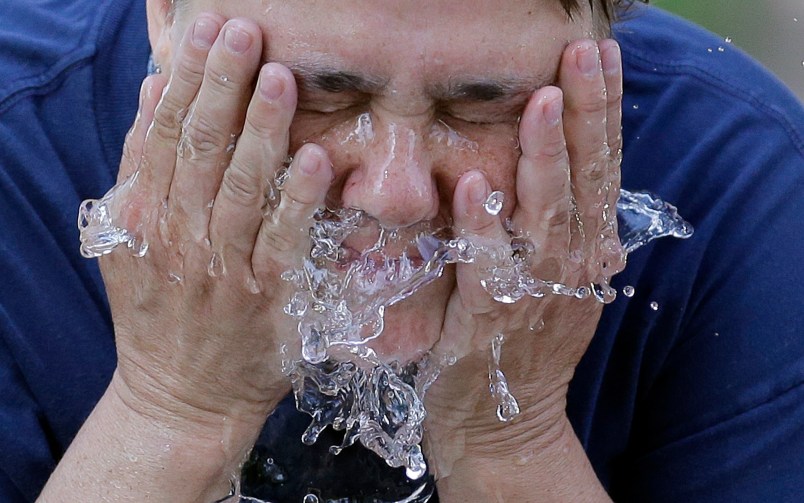
WASHINGTON (AP) — The first half of 2017 was the second warmest on record for Earth, only behind last year.
The National Oceanic and Atmospheric Administration announced Tuesday Earth’s average temperature from January to June was 57.9 degrees (14.4 degrees Celsius). That’s 1.6 degrees warmer than the 20th century average.
Natural El Ninos spike global temperatures. But NOAA climate scientist Ahira Sanchez-Lugo says it is remarkable that 2017 without an El Nino so far beats all but the super El Nino year of 2016.
She says that’s the world changing into an ever warming climate.
Record warmth was measured in much of Mexico, western Europe, eastern Russia, eastern Africa and eastern China. The U.S. had its second warmest start.
Globally, June was the third warmest on record. Records go back to 1880.






The average temperature for Tucson this June was 90. That’s averaging the nite time low and day time high. We had 2 days at 114 F. and 25 days of 100+. That’s just June. 2017
“But NOAA climate scientist Ahira Sanchez-Lugo says it is remarkable that 2017 without an El Nino so far beats all but the super El Nino year of 2016.”
Definitely remarkable.
Remarks like - “Oh poop.” and "“Well, it’s not that big a deal while the solar minimum lasts. I hope.”
Tucson is always hot in June…I remember working as a lifeguard on the then-hottest day of 117, fun times. What’s bothered me more about Tucson weather is the changing pattern of monsoon season…when I lived there it always started on July 4th, and June was basically cloud free. Now, the clouds start showing up earlier, and rain can actually fall in June (the average rain amount for June used to be 0.01 inches!).
This is just an example of how the global changes are going to percolate down into local changes. We’re now crossing a point where people are noticing that the weather they remember from 20-30 years ago is different than what’s happening now, and you hear that all over, from warmer winters to hot summers. The problem is that those indicators are lagging…even if we shut down all CO2 production right now the temperature would continue to increase for a few decades. Even following the Paris accords isn’t going to be enough to reverse things, we’ll just stabilize at a new, higher temperature, and the Earth will adjust to that. It will never go back to what we remember as children, or even what we remember from a couple decades ago.