


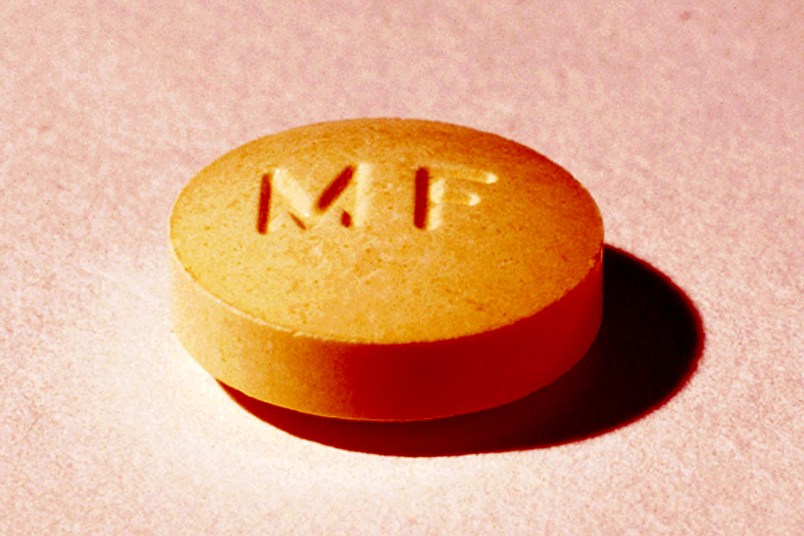
Louisiana was met with a chilly reception Wednesday, as it pushed to make the abortion pill mifepristone less accessible nationwide.
The state is arguing that the Food and Drug Administration is to blame for mifepristone being prescribed to Louisiana patients by blue state providers and entering the state through the mail, because it lifted the in-person dispensing requirement during the Biden administration. It then had to add a couple more steps to find an injury, settling on the extra money it has to pay through Medicaid when certain patients who took that mifepristone go to the emergency room with complications. The state also argues that the Biden administration was targeting Louisiana and its anti-abortion regime when it lifted the restrictions temporarily in 2021 and permanently in 2023.
“I’m looking at six different steps…and we’re gonna attribute that to the federal government?” asked Fifth Circuit Court of Appeals Judge Stephen Higginson, an Obama appointee, incredulously.
Louisiana is struggling with the same defect that doomed the last big anti-abortion legal push to ban mifepristone. Back in 2024, the Supreme Court unanimously ruled that a group of anti-abortion doctors lacked standing to challenge the FDA’s lifting of restrictions from the drug. In that case, the group similarly tried to prove injury through attenuation — what if, hypothetically, one of these anti-abortion doctors was the only person working when a woman came in needing care for mifepristone complications?
“The plaintiffs want FDA to make mifepristone more difficult for other doctors to prescribe and for pregnant women to obtain,” Justice Brett Kavanaugh wrote for the majority in FDA v. Alliance for Hippocratic Medicine. “Under Article III of the Constitution, a plaintiff ’s desire to make a drug less available for others does not establish standing to sue.”
Louisiana is trying to accomplish the same thing under a different suite of alleged injuries.
Back in June, Judge David C. Joseph, a Trump appointee, swallowed many of Louisiana’s arguments, but didn’t give the state the relief it sought. He stayed the case, pointing to FDA’s assertion that it was already in the process of reevaluating mifepristone’s safety profile. This assessment — which the former FDA administrator slowwalked explicitly so it doesn’t conclude until after the midterms to avoid political blowback — will almost certainly give the administration pretense to make the drug harder to get. Anti-abortion groups have been frustrated with the Trump administration’s languor in attacking the drug, though they were assuaged by the recent nomination of Heidi Overton, an avowed abortion opponent who has expressed desire to restrict “abortion on demand,” as the new FDA administrator.
This left the FDA in a very awkward spot during Wednesday’s hearing before the 5th Circuit. The agency doesn’t want Louisiana to have standing, the better to narrow mifepristone access itself. But it also doesn’t want to defend its record, knowing that it’ll have to contradict findings from the Biden era that the drug is safe enough to be prescribed through telehealth and taken at home.
The judges frequently expressed frustration with the FDA’s Daniel Winik Wednesday, as he declined to stray from his narrow argument that Louisiana lacks standing to bring the case.
“I find that very unsatisfactory, that the agency won’t give an opinion as to its own regulations,” said Higginson.
Ever since Dobbs ended the constitutional right to abortion, activists opposed to the procedure have homed in on mifepristone in their quest not to “leave it to the states,” but to outlaw it everywhere. Many blue states have stood up shield laws to protect their providers when they prescribe mifepristone to patients in red ones. So far, when the red state has tried to prosecute the doctor — as when Texas Attorney General Ken Paxton (R) tried to punish New York doctor Margaret Carpenter in 2024 — the blue states have simply refused to extradite her or enforce the judgment. The bigger battle of state jurisdictions is inevitable, though, where shield laws will be held against states’ constitutional obligation to enforce other states’ judicial proceedings.
For now, the anti-abortion activists at the tip of the spear are trying to run back 2024’s failed effort again, this time in a slightly different outfit. If Wednesday’s case, Louisiana v. FDA, makes its way up to the Supreme Court, the justices will again face an effort to restrict mifepristone for blue states as well as red ones, premised on the wobbliest of injuries.






Your articles are always clearly-written and explain the issues and arguments well. I do think it would be useful to identify the other two members of the panel. The Fifth Circuit is usually correctly identified as being very conservative. But, depending on what panel is drawn, that’s not always the case
I have two problems with Louisiana, or any other state, trying to regulate the prescription of mifepristone from out of state or the shipping of it into that state. The first is rather abstract - it’s that the state of Louisiana is asserting that a drug repeatedly found to be safe by the Federal Government and that is commonly prescribed in much of the nation, is not safe and violates state law. It has no such authority to rule on the drug’s safety, nor is such an assertion based on any kind of science; it’s based on religious and political opinions. For all intents and purposes, they can be regarded as practicing medicine without a license.
The second problem is more likely to be attractive to courts not eager to rubber-stamp the Louisiana law. And that is, Louisiana is attempting to regulate interstate commerce, which Constitutionally it may not do. Only Congress has the power to regulate interstate commerce.
Also, Louisiana argues that shield laws and allowing mifepristone to be shipped into the state violates the Constitution’s provision that each state will honor every other state’s laws. But the very existence of such a Louisiana law itself directly violates other states’ laws. Frankly, their argument cuts both ways, regardless of what they might wish. The same dichotomy results when states that ban abortion seek to punish out-of-state providers who perform legal abortions in their facility on that state’s residents, or even to punish the women receiving the abortions themselves - their very arguments can be turned back upon themselves.
Ultimately, the easy way out for the courts is to focus on interstate commerce, hoping to avoid being drawn into an ideological morass. It’s the coward’s way out, but is also the way most likely to succeed in the long run.