

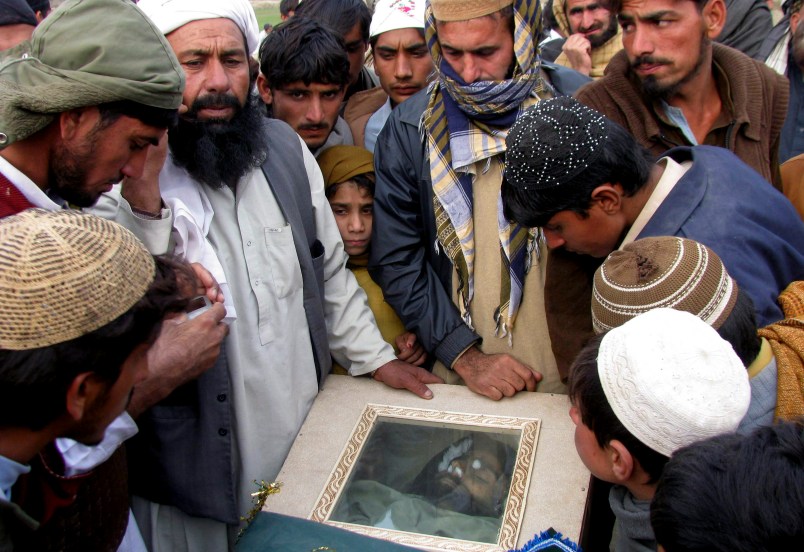
WASHINGTON (AP) — Just after midnight last Christmas, Pakistani officials say, two Hellfire missiles from a U.S. drone slammed into a house in Miramshah, Pakistan, killing four militants.
It was an otherwise unremarkable episode in the sixth year of a relentless unmanned aerial campaign by the CIA. Unremarkable, except for this: There hasn’t been a drone strike reported in Pakistan in the months since.
The secret targeted killing program that once was the mainstay of President Barack Obama’s counterterrorism effort appears to be winding down. In a major foreign policy speech at the U.S. Military Academy on Wednesday, Obama said the U.S. would continue to carry out occasional drone strikes, but he cited Yemen and Somalia, not Pakistan, where drone missiles once rained down at a rate of two per week.
Armed U.S. drones are still flying regularly over Pakistan’s tribal areas, and CIA targeting officers are still nominating militants to a kill list, according to U.S. officials regularly briefed on the covert program who spoke on condition of anonymity because they weren’t authorized to discuss covert programs publicly. But over the past five months, no missiles have been fired.
And while the CIA won’t say the program has ended, Obama announced this week a plan to pull nearly all American troops out of Afghanistan by the end of 2016. The targeted killing program in Pakistan relies on drones flown from, and intelligence gathered in, U.S. bases in Afghanistan that would then be closed.
“The program (in Pakistan) appears to have ended,” said Peter Bergen, who has closely studied drone strikes for the New America Foundation, a Washington think tank.
Several factors are driving the change, U.S. officials say. Many of the senior al-Qaida figures in Pakistan have been killed. Those who remain are much harder to target because they are avoiding mobile phones and traveling with children, benefiting from stricter targeting rules designed to prevent civilian casualties. The drawdown of U.S. troops from Afghanistan has eliminated the need for “force protection” strikes against large gatherings of militants in Pakistan suspected of plotting attacks against American troops.
Also, the tribal areas of Pakistan are no longer the hotbed of al-Qaida activity they once were, officials and outside analysts say. Hardcore al-Qaida militants from Pakistan have gone to Syria and Yemen, home to Al-Qaida in the Arabian Peninsula, which U.S. officials consider the most dangerous al-Qaida affiliate.
And Obama administration officials are pushing to have the U.S. military, not the CIA, carry out drone strikes. Since the military generally requires permission from a country to operate on its territory, most analysts don’t believe it could carry out regular drone attacks in Pakistan.
The CIA and the White House declined to comment for this story.
For as long as they are able to fly over Pakistan, CIA drones will hunt for senior al-Qaida figures, including Ayman al-Zawahiri, al-Qaida’s leader, U.S. officials say. If the agency gets a clean shot at such a target next week or next year, it will push the button, they say.
But as the CIA closes its remote Afghanistan outposts where case officers met with Pakistani sources and technicians eavesdropped on cellphones, intelligence collection will dry up, making militants harder to track.
“By the end of this year, we will have a noticeable degradation in our ability to collect intelligence on people of concern,” said Rep. Mike Rogers, R-Mich., the chairman of the House Intelligence Committee.
Without commenting explicitly about drone strikes, Rogers criticized what he calls “a pullback in the counterterrorism strategy,” a move he says “has made Americans a little less safe.”
The current drone cease-fire in Pakistan is by far the longest pause since President George W. Bush ordered a stepped-up campaign of targeted strikes in that country’s tribal area in the summer of 2008. The pace intensified under Obama. All told, there have been 354 strikes in Pakistan since 2004, according to the Long War Journal, an online publication that tracks the strikes through media reports.
But the rate of strikes began falling in 2011 and decreased each year since. Last year, Obama announced stricter targeting criteria, including a provision that no strike would occur unless there was “a near certainty” that civilians would not be harmed.
Even before that, American officials appear to have made the calculation that it was no longer worth it to attack lower-level militants in Pakistan, given the bitter opposition to the attacks in that country. Last year, an analysis by the New America Foundation found that just 58 known militant leaders had been killed in drone strikes in Pakistan, representing just 2 percent of the total deaths.
Obama seemed to allude to the backlash Wednesday when he said, “Our actions should meet a simple test: We must not create more enemies than we take off the battlefield.”
In December, the Obama administration reached an informal deal with Pakistan that the CIA would suspend drone strikes — except against the most senior al-Qaida leaders — while the government of Prime Minister Nawaz Sharif pursues peace talks with the Taliban. The talks have sputtered, and last week Pakistani fighter jets killed more than 60 people in North Waziristan, a militant stronghold, according to local media reports.
But Pakistani officials say the cessation in drone strikes has strengthened support for counterterrorism operations among a public that deeply resented an American bombing campaign on its soil. A senior Pakistani official said the hiatus made the government feel like the U.S. was hearing their concerns.
Copyright 2014 The Associated Press. All rights reserved. This material may not be published, broadcast, rewritten or redistributed.






Mike Rogers can go jump in a lake.
Barack Obama increased counter-terror operations more than tenfold over the level of George Bush, who was too busy on his Great Mesopotamian Adventure That Couldn’t Possibly Go Wrong, and who closed the bin Laden unit at the CIA.
Now, in response to the success of those efforts, Obama is scaling back counterterrorism operations to a level that’s “only,” say, five times or 8 times greater than those under George Bush.
And yet, was Mike Rogers denouncing George Bush in public for insufficient activity on counter-terrorism?
Republicans just don’t take al Qaeda seriously, and they never have. It’s nothing but a tool for domestic politics - ginning up support for an Iraq war, denouncing Obama, whatever. Actual counter-terrorism is just not something they care about.
The drone program in Somalia has all but ended, too.
The problem with having a covert operations capability is that Presidents are irresistibly tempted to used it. Read Legacy of Ashes, by Tim Weiner, and you’ll probably come to the conclusion that covert ops fall almost entirely into two categories: utter failures or wildly counter-productive (see “The Law of Unintended Consequences”).
The same book will also lead you to conclude that consistenly bad intelligence is actually worse than no intelligence at all. Over the decades, the CIA has either missed the major developments (like the collapse of the Soviet Union), or has gotten its information horribly wrong.
In short, we’d have been better served by having no CIA at all.