


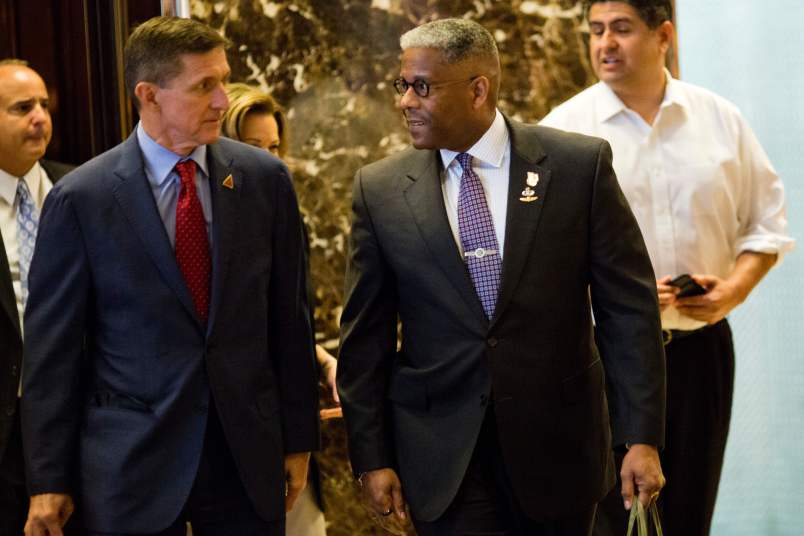
DALLAS – For this city’s Republican Party, the 2026 primaries were supposed to set a national example. Led by Col. Allen West, the party wanted to run the election as purely as it could: no electronic voting machines. A full hand count.
For West, the timing was crucial. He told officials that the state was changing, per the minutes of a November party meeting reviewed by TPM.
“Texas is no longer a Hard RED state. The five largest urban population centers in Texas are no longer RED,” West lamented, according to the document. “We must remain vigilant against the Islamization of Texas,” he added later.
Weeks later, President Trump heralded the party’s efforts to conduct a hand count and bar electronic voting machines as a victory, blaring on Truth Social that “All Republican Governors should mandatorily do this.”
Not all of what the party had planned — and Trump boosted — came to pass. A shortage of volunteers meant that the county GOP wasn’t able to proceed with its plans to hand count ballots. Local officials did, however, force the county to make a critical change in how it ran its March primary. Instead of countywide polling, in which people can vote at any precinct in the county, Dallas Republicans forced both parties to adopt precinct-based polling, in which people can only vote at a preset location.
The result was a fiasco. Per one estimate, more than 12,000 primary voters out of a total of around 120,000 had to be redirected, per Votebeat and the Texas Tribune, which have covered the saga in detail. A judge briefly extended voting hours. Attorney General Ken Paxton, himself on the primary ballot, used his office to ask the Texas Supreme Court to invalidate votes cast in extended voting. The court agreed.
Since the 2020 election, right-wing activists have accelerated their efforts to curtail access to voting by promoting conspiracy theories around voter fraud and electronic voting machines. What the Dallas case demonstrates is that those fervid ideas are increasingly being woven into the fabric of how elections are run. It also shows the consequences: thousands of voters unclear on how and where to vote, muddied results, and an official on the primary ballot intervening to throw out votes whose late arrival was prompted by the chaos.
Dallas has grown rapidly in recent years, attracting the kinds of corporate headquarters that West blamed for bringing in Democratic voters. (The county has in fact voted Democratic in the last five presidential elections.) That growth brought in large numbers of immigrants from South Asia and Muslim-majority countries to the area, which has, in turn, led to local and national far-right activists holding the area up as a supposed example of nonwhite immigrants replacing “heritage Texans.”
Amid these demographic shifts, the local Republican Party is doing all it can to exert control over how elections are carried out. But briefly getting some of what voter fraud conspiracy theorists wanted has broken open a fissure in the local GOP. West, who initially said that the primary chaos affected Democrats more than it did Republicans, reversed himself and agreed to countywide polling for the May runoffs (He’d claimed he was trying to avoid “a lawsuit alleging willful and intentional voter disenfranchisement.”). After a revolt from within the party, he resigned.
Now, with the May runoffs less than 20 days away, the county GOP is suing to override local elections officials and run the election by precinct voting again. They’re alleging “sabotage,” and tried to refer West for criminal prosecution. The mess has gotten national attention from political figures like House Administration Committee Ranking Member Rep. Joe Morelle (D-NY), who traveled to Dallas for a hearing about the fiasco as part of his task force on preventing election interference.
West declined to comment in a brief phone call with TPM. “You take care now,” he said. He did not reply to a detailed list of questions sent by email. Paxton’s office didn’t return a request for comment.
Return of Stop the Steal
When countywide polling first came to Texas in 2006, Lubbock County Elections Administrator Roxzine Stinson told TPM, it faced little opposition. She saw it as a plus: the change made it easier to vote, allowing people to vote depending on where they were in the course of Election Day.
“They didn’t have to rush back home to their neighborhood vote center to be able to vote,” she said. “They were able to go to any location that was open on Election Day.”
Lubbock was an early test case, but it soon spread across the state. Dallas County adopted it in 2019.
The system works, under Texas law, through electronic voting. That, Stinson said, is what prevents people from voting multiple times at several precincts. She said that it wasn’t until after the 2020 election that she began to notice people protesting the change.
Voter fraud alarmists in Texas singled the system out largely because it relies on electronic voting machines. They became an obsession after the 2020 election, in which Trump and national Republican officials tried to pin the President’s defeat on Italian satellites supposedly zapping voting machines. In the case of attorney Sidney Powell, it was partly due to the exploits of “Spyder,” a fake military intelligence expert cited in court filings to allege that electronic voting machines had been hacked.
During the Biden administration, that spread into activism against electronic voting machines and the voting systems that go along with it. In Texas, conservative movement activists accused countywide polling of allowing people to vote “two or three times” at a May 2024 state Senate hearing. One activist, Christine Welborn of Advancing Integrity, a nonprofit associated with right-wing activist and 2020 election denier Cleta Mitchell’s Election Integrity Network, called ending it a “a sound reform that’s going to rebuild trust in elections.”
‘DECLARATION OF TRUTH’
By the time the 2024 election rolled around, some members of the Dallas GOP were ready for a full-blown assault on countywide voting. Barry Wernick, a local attorney and party official, circulated a document titled “DECLARATION OF TRUTH” that allowed voters to claim that countywide voting had caused their vote to be “diluted.”
Trump won his bid for the White House, though Dallas County went for Harris. The local zeal to restrict voting did not end.
Much of what happened next was made possible by a unique feature of Texas’ electoral system, what some regard as a vestige of 19th century electoral practices: county political parties run primaries. County governments run early voting, but election day primaries are operated by the parties. In many parts of the state, the two parties enter into a joint agreement to administer voting. But the parties are within their rights to opt out of any agreement.
In Dallas, it gave the local GOP a sandbox in which to build its ideal election. It announced in September that it would pull out of the joint agreement with the Democrats. It would bar countywide polling, eliminate electronic voting machines, and conduct a hand count so long as costs did not exceed $500,000.
West explained the reasoning for the change in a post titled “Electoral process blocking and tackling.”
“This fight is bigger than Dallas County. We live in a county without a single Republican in elected leadership—that alone explains why the Left is nervous about moving away from machines,” he wrote. “This is about bringing back the blocking and tackling of our American electoral process and restoring public confidence.”
Over the next several months, county Republicans tried and failed to gather enough volunteers to hand count the election results. On December 30, West allowed that they had come “woefully short” of the number of volunteers needed to hand count the results. The GOP primary would be run on electronic voting machines.
But refusing to run the election with the Democrats had still forced a change on both parties. Under Texas law, both parties have to agree to use countywide voting. The GOP pulling out meant that the Democrats would also have to use precinct voting for the primary.
‘Just that devious’
The March 3 primary was a disaster.
One local election commissioner described “bedlam,” with thousands of people appearing at the wrong polling site. The county Democratic Party sued to extend voting hours; a district judge agreed to push voting until 9 PM. Attorney General Ken Paxton, who was on the primary ballot in his fight to unseat Sen. John Cornyn (R-TX), appealed, asking the Texas Supreme Court to negate the extended voting hours. Around 8:30 PM, the Supreme Court agreed, ordering that “votes cast by voters who were not in line to vote at 7pm should be separated.”
The chaos received national coverage. The New York Times wrote that the rulings had thrown the “vote tally into uncertainty.” It led to local recriminations and, eventually, to a fissure among Republicans. The GOP accused the Democrats of failing to prepare, noting that the resolution announcing the GOP’s withdrawal was in September, six months before the March primary. Republicans also accused county election officials of failing to notify people. The county said that it spent $1 million on notifying people of the change. The Democrats accused the GOP of wrecking the election. West wrote on Facebook the next day that while Dallas County Republicans had “evidenced their ability to adapt and overcome,” “it’s apparent that Democrats struggled with grasping basic civics and their usual attempt at lawfare backfired.”
To many observers, this sounded like gloating. County data reported by Votebeat showed that 12,674 Dallas County voters from both parties went to the wrong location on primary day.
The backlash began to grow. Internal county GOP emails released in a lawsuit show that by March 9, party officials were starting to grow suspicious that West would return to countywide polling for the May runoff.
“I believe there may be sabotage from elements who want to kill separate and precinct based primary elections,” wrote one party official in an 11:19 p.m. message to West. “Reverting back to county-wide for Election Day would be our accepting the narrative being laid out that the Republicans are to blame and also that County-wide voting is better.”
On March 17, West did indeed reverse course. The county GOP would use countywide polling for the runoff; “those that disagree with this decision are free to seek to replace me as Chairman,” he wrote in a since-deleted statement.
Pressure on West continued to mount from within the party. On March 29, a group of party chairs sent West a message accusing him of failing to stand up for election integrity.
“You decided, however, not to defend the principles of election integrity nor to defend the DCRP against unfounded negative press accusations. You also failed to hold the Dallas County Elections Department and Secretary of State accountable for their egregious errors and breaching of contractual obligations during our Primary. Instead, in utter disregard for the CEC, you acted unilaterally by publicly issuing a Press Release on March 17th announcing your decision and a bewildering ultimatum regarding opposition. Many of us have spent years working to strengthen election integrity, and we remain firmly committed to precinct-based voting. Your actions are both disrespectful to the body of volunteers and consequentially damaging by severely crippling their efforts and by capitulating to external negative forces,” the message reads.
West gave a hint of the kind of pressure he was under the next week. Rejecting countywide voting for the runoff could result in “a lawsuit alleging willful and intentional voter disenfranchisement, and yes, the political opposition is just that devious,” he wrote in an April 6 message to party members.
On April 16, West resigned.
Days later, members of the local GOP sued the county elections department to overturn West’s decision and keep the runoff as precinct-based voting. They also sent a complaint to the Texas Secretary of State’s office that included a referral to prosecute West for “abuse of official capacity,” “official oppression,” and “impersonating a public servant.”
The courts have so far declined to intervene. An appeal to the state Supreme Court is outstanding; local officials are preparing to hold the May runoff under countywide polling.
Paul Adams, the Dallas County elections administrator, remarked in court last month that the election had taught everyone a lesson: “we do not want any last-minute changes.”






Anyone want to guess whether this chaos will be reflected in the rushed gerrymandering taking place in Louisiana and other States?
Stay tuned.
I thought we were rid of that kook Allen West.
Just FYI, our electronic voting machines print out paper ballots that the voter can review for accuracy, and it is those paper ballots that get counted.
These people are fucking morons anyway.
That kook was just barely too rational for the Dallas County Republican Party. He ended up having to resign.
They’re really working at proving the Crazification Factor here in Dallas County.
I guess technically notifying people of the change back to precinct voting isn’t doing a hand recount, but talk about cutting off your nose to spite your face. “It’s less efficient and more expensive!” is quite a tagline.