

The conference supported the Paris agreement, and according to preliminary results released Saturday morning from an ongoing nationwide survey, the vast majority of U.S. mayors want to work together and with the private sector to respond to climate change.
“There’s near unanimity in this conference that climate change is real and that humans contribute to it. There may be a little bit of a disagreement about how actually to deal with it,” said Landrieu, who will replace Oklahoma City Mayor Mick Cornett as conference president this weekend.
“If the federal government refuses to act or is just paralyzed, the cities themselves, through their mayors, are going to create a new national policy by the accumulation of our individual efforts,” he said.
A May survey of local sustainability efforts, conducted by the conference and the Center for Climate and Energy Solutions, initially only included 80 mayors who hold leadership positions within the conference. It was extended to all conference members and the mayors of about 1,400 cities with populations of 30,000 or more after President Donald Trump pulled the country out of the Paris agreement.
Cities still have months to respond to the questionnaire on low-carbon transportation options, renewable energy and energy efficiency programs, but the data received so far from 66 cities in 30 states showed 90 percent were interested in forming partnerships with other local governments to create climate plans, implement transportation programs or procure equipment such as electric vehicles.
The responses have come from cities ranging in size from 21,000 people in Pleasantville, New Jersey, to New York City’s 8.5 million. According to the survey, the majority of those cities want to buy or already bought green vehicles, and most also have energy efficiency policies for new and existing municipal buildings.
“I think most mayors in America don’t think we have to wait for president,” whose beliefs on climate change are disconnected from science, Landrieu said.
Traditional energy sources still dominate, but the survey noted that more cities could use renewable electricity if their states passed legislation. Forty-seven cities spent nearly $1.2 billion annually on electricity for city operations, and “with this level of purchasing power, coordinated efforts or shifts in demand from U.S. cities will be of interest to energy utilities and provides,” the survey said.
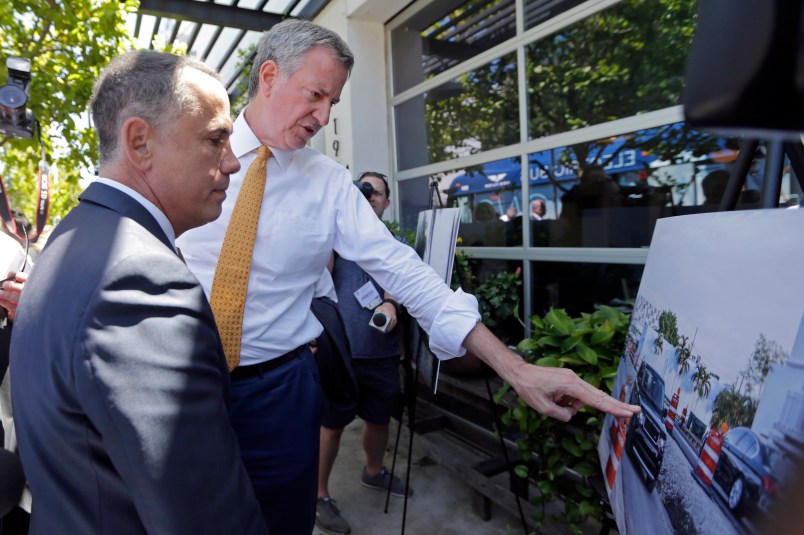
New York City Mayor Bill de Blasio said that U.S. cities too often find themselves alone when trying to address the local effects of climate change.
De Blasio joined Miami Beach Mayor Philip Levine on a tour of a South Beach neighborhood where the city raised streets and installed pumps to send up to 120,000 gallons of water a minute flowing back into Biscayne Bay. The project — aimed at keeping the island city dry amid rising seas — has received national attention, but Levine noted that not all communities can afford to fight climate change without state or federal funding.
“But if we don’t do it, who’s going to do it, right?” de Blasio said. “Cities and states around the country are now doing the kinds of things the national government should do. It’s just that we can’t depend on our national government anymore.”




Pro tip. Moderate to large cites are generally blue. Proportionally, my bet is that mayors of blue cities represent more citizens than red state governors.
Our. “Republic”. Isn’t. Working.
No, it isn’t.
The founders didn’t factor in the kind of authoritarianism that has grown up in the world since the 20th century.
Next up: Republicans claim this proves that giving the state and local governments more authority and decision-making power is a good thing. Except, environment and climate change doesn’t end at the city limits or state line. Very few things are so limited in their impact or extent, and … the feds have most of the resources for research and policy implementation. But, ya know, if the mayors can do something with climate change or anything else … do it, and do it big.
Watch certain Red states (I’m lookin’ at you, Texas) pass laws limiting municipal policies on climate change cooperation, just like they did with immigration.
What a shame.
The country that landed the first man on the moon now turns its back on “science”. The mayors have to find innovative ways to handle the expense of reality, and they will.
They just won’t have the support of the federal government. Trump is not a world leader, by far.