


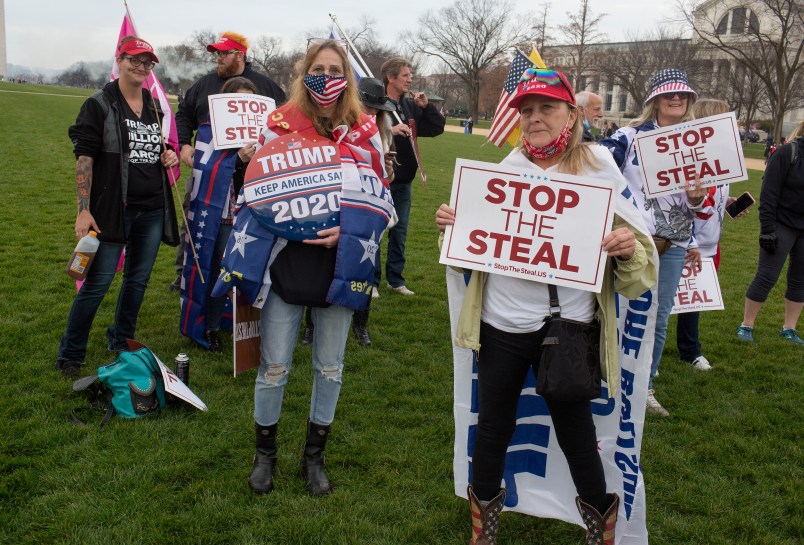
In an increasingly ominous trend, there are currently hundreds of election deniers on the ballot for the 2026 midterm elections. And although history has shown election denialism is not a winning campaign strategy, it continues to be a powerful force in the right-wing movement, from President Donald Trump on down.
According to the nonpartisan non-profit States United Action, there are at least 140 election deniers currently running for statewide and congressional office. In statewide races, there are at least 42 election deniers running in 23 states. And in congressional races, there are at least 98 election deniers running in 25 states.
“We’ve been tracking this movement since right after the 2020 election. And one thing we can say about the election denial movement now is that it seems to be more powerful than ever,” Kelly Rader, research director at States United Action, told TPM.
“In some ways it reflects how election denial has matured into an organized movement,” Brendan Fischer, director of strategic investigations for Campaign Legal Center, similarly told TPM.
“Election denial is no longer just a collection of fringe activists and isolated candidates making unsupported claims of election fraud,” Fischer added. “It’s really evolved into a well-funded, coordinated infrastructure of activists and advocacy organizations that has transformed the fringe conspiracy theories into a cornerstone of the conservative movement.”
Of particular concern are the election denial candidates running for secretary of state positions, potentially putting an elected official who has denied the integrity of a free and fair election at the helm of election administration in a particular state.
“Secretaries in most states are the people who are in charge of elections there and they are going to serve as really important backstops to the president’s overreach into elections, overreach on other issues, and his tendency to sow doubt on legitimate election outcomes,” Rader explained.
Rader said this phenomenon of election deniers running for secretary of state is really part of a “broader power grab.”
“We started originally tracking these statewide offices because they’re important for election administration,” she added, “but now that the president is an election denier, he’s appointing people throughout federal agencies who really have undermined public trust in our elections almost like it’s their job.”
States United Action has been keeping track of all the election deniers running for office, and according to their data, there are election deniers running for secretary of state positions in seven states: Nevada, Arizona, Wyoming, Colorado, Nebraska, Wisconsin and Vermont.
Nevada
In Nevada, Jim Marchant, a longtime election denier, won the Republican primary for Secretary of State in Nevada this month. Marchant, as TPM has previously reported, has been claiming the 2020 election was stolen after he lost his race for a U.S. House seat in 2020, and since Trump lost that year’s presidential election.
Marchant, who has ties to QAnon, was also the founding member of the America First Secretary of State Coalition, a post-2020 group of MAGA election deniers all running for secretary of state positions on a platform of election denialism.
Arizona
Arizona GOP state rep. Alexander Kolodin, who is a member of the right-wing Arizona Freedom Caucus, is an election denier and is now a Republican candidate for secretary of state in Arizona.
Kolodin was sanctioned in 2023 by the State Bar of Arizona for participating in lawsuits, including the so-called “Kraken” lawsuits, a sprawling conspiratorial web of documents challenging the outcome of the 2020 election, per Arizona Mirror.
Wyoming
GOP State Rep. Rachel Rodriquez-Williams is running for secretary of state of Wyoming, and is currently the chairwoman of the far-right Wyoming Freedom Caucus, which has tried to push through a series of “election integrity” bills.
These proposals, which were never approved, included proposals to ban ballot boxes and ballot collecting and require hand-count audits, among other things. All of these measures are rooted in conspiracy theories about the safety and integrity of the country’s election system.
Colorado
James Wiley, who ran unopposed, won the GOP nomination for Colorado secretary of state last month. Wiley is running on a campaign focused on restoring “free and fair elections” and, according to his website, has sued “Dominion Voting Machines, Facebook, Mark Zuckerburg, the Secretary of States and Governors of Georgia, Pennsylvania, and Michigan, Secretary Griswold” for what he describes as “election misconduct.”
Wiley also advocated for the release of Tina Peters, the former elections administrator of Mesa County, Colorado who breached her office’s own voting equipment and was convicted of several felonies related to her efforts to find non-existent 2020 voter fraud. Democratic Colorado Gov. Jared Polis commuted Peters’ nine-year prison sentence in May of this year and she was released on parole shortly after.
Nebraska
Election denier Scott Petersen won the Republican primary for secretary of state in May. Petersen has been repeating lies about the 2020 election for years. In March of this year, per the Nebraska Examiner, he elevated disinfo related to the FBI’s recent Fulton County 2020 election raid.
“By the way, if another state steals elections … our vote doesn’t count as much, right?” he said, referring to the Fulton County FBI raid.
Wisconsin
Wisconsin’s primary will take place on August 11, and election denier Jay Schroeder is currently on the ballot for the GOP nomination for secretary of state.
Schroeder once said in an interview that “there is lots of reasonable doubt” about Joe Biden winning the 2020 election. In Wisconsin, the bipartisan Wisconsin Elections Commission runs elections, and not the secretary of state. Schroeder, as he outlined on his campaign website, wants to strip the commission of that authority and make the secretary of state the state’s chief election official.
Vermont
H. Brooke Paige is on the ballot in Vermont’s primary for Secretary of State on August 11. In the past, Paige has avoided answering questions about whether or not Biden won the 2020 election. “I have a hard time not believing my lyin’ eyes,” he told VTDigger in 2022.




Has there been a single person convicted of trying to rig an election in favor of a Democrat in the Trump era? Not talking about some random person who tried to vote illegally or in the wrong polling place, but someone on the Tina Peters scale of trying to overturn an election.
No. But since election denial is not a fact but a strategy it does not matter.
A good example of this is President Barack Obama and birtherism. 99% of the assh*les who pushed this nonsense about President Obama not being born in the United States knew it was bullsh$t.
But because it was the 21st century the racist frackers could not use the “N” word to say why he was not fit to be the Chief Executive of their imagined White Christian America.
MAGA issues are tactics, maybe soon policy and law.
Taking MAGA at face value, as political arguments made in good faith, is a suckers game.
The 2020 elections were rigged but 2024 elections weren’t?
These effing people..