Call it “Chromegate.”
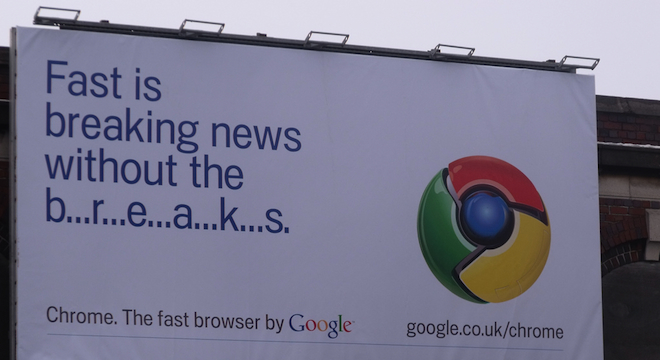
Just a few weeks after Google Chrome was reported to have overtaken Mozilla Firefox to become the second most popular Web browser in the world, Google’s glory has been tarnished by a “jaw-dropping,” massive online Chrome advertising campaign that would seem to violate Google’s own guidelines, uncovered by SEO Book blogger Aaron Wall.
Essentially, Google was caught paying at least one PR company to spam the Web with hundreds of crudely written “sponsored posts” from bloggers promoting Google Chrome — posts comprised of what would seem to be just placeholder text and unsubstantiated pro-Google Chrome statements.
Many of the blogs contained a video ad that linked to the Chrome website, and in at least one instance, a “sponsored post” linked directly to the download page for Google’s free Chrome browser, in seeming violation of Google’s own guidelines against paid links, as Search Engine Land‘s Danny Sullivan pointed out.Most or all of the posts contained the words “This post is sponsored by Google.”
Google, for its part, confessed to Sullivan that it paid outside ad agencies to conduct a Chrome Web campaign and said it was sorry for the spammy results, but denied any knowledge of how the campaign to fix the situation would be implemented.
The third-party agency hired by Google seems to be Essence Digital, which in turns seems to have hired Unruly, another firm, which then hired bloggers to do sponsored posts for $40 in Amazon gift credit, according to Sullivan.
According to a Google statement provided to Search Engine Land:
Google never agreed to anything more than online ads. We have consistently avoided paid sponsorships, including paying bloggers to promote our products, because these kind of promotions are not transparent or in the best interests of users. We’re now looking at what changes we need to make to ensure that this never happens again.
Google later told Sullivan that it would demote its own “Page Rank,” for the Google Chrome download page to penalize itself for the mistake. Google’s Page Rank, named after co-founder and current CEO Larry Page, is the relative numerical value assigned to every webpage crawled by Google according to a specific algorithm. Generally, the higher the Page Rank, the higher up it appears on Google’s search results listings.
Google gave a statement to Sullivan attempting to spin the move as a noble sacrifice on behalf of the evil third parties that committed the error and soiled Google’s good name:
While Google did not authorize this campaign, and we can find no remaining violations of our webmaster guidelines, we believe Google should be held to a higher standard, so we have taken stricter action than we would against a typical site.
However, as Sullivan earlier pointed out, a number of questions and outstanding points remain. Chief among them: Why did Google choose to outsource this Chrome video ad campaign when it has its own in-house video ad service? Also: How did Google not catch that these so-called “garbage” content posts were going up with Google’s stamp of approval around the Web? Why would Google even chance such a campaign when it is running its own effort designed precisely to eliminate such SEO-clutter and low quality, spam content?
We have another matter to bring up: How will the news influence the increasing regulatory heat that Google is facing on Capitol Hill from Senators and the FTC? That heat comes over accusations Google is engaged in anti-competitive practices — namely using its dominant position in the search engine market to promote its other products above competitors.
After all, the FTC in June confirmed it was conducing an antitrust investigation into Google, and in late December, Senators Herb Kohl (D-WI) and Mike Lee (R-UT) –members of the Senate Judiciary Committee — called for the FTC to focus on specific charges of Google’s anticompetitive practices by competitors. Google’s recent admissions about the Chrome campaign certainly don’t help its cause, but how much will they hurt?
Unruly, for its part, maintains it is in full compliance with FTC rules and regulations. As the company’s CEO Scott Button told the Washington Post in a statement (and said in the comments of a Search Engine Land post):
“In line with FTC and EU regulation Unruly always requires that bloggers clearly disclose any post, tweet, or other reference to the video as being sponsored and we provide guidance on how to do this.”
In additional twist, Google recently renewed its costly partnership with Web browser competitor Mozilla Firefox, agreeing to continue to pay massive royalties to keep Google as the default search option in new versions of Firefox for at least three years onward. Although it would seem that Mozilla needs Google much more than Google needs Mozilla, some techies theorize that Google is actually paying Mozilla precisely to keep a healthy browser competitor alive, thereby reducing some of the regulatory heat on Google’s back. This, of course, remains just an unverified theory at present.
We’ve reached out to Google, the FTC and the Senators’ officers for their responses and will update when we hear back.
Correction: This article previously incorrectly stated that Senators Herb Kohl and Mike Lee were members of the House Judiciary Committee. The article has since been corrected. We regret the error.