

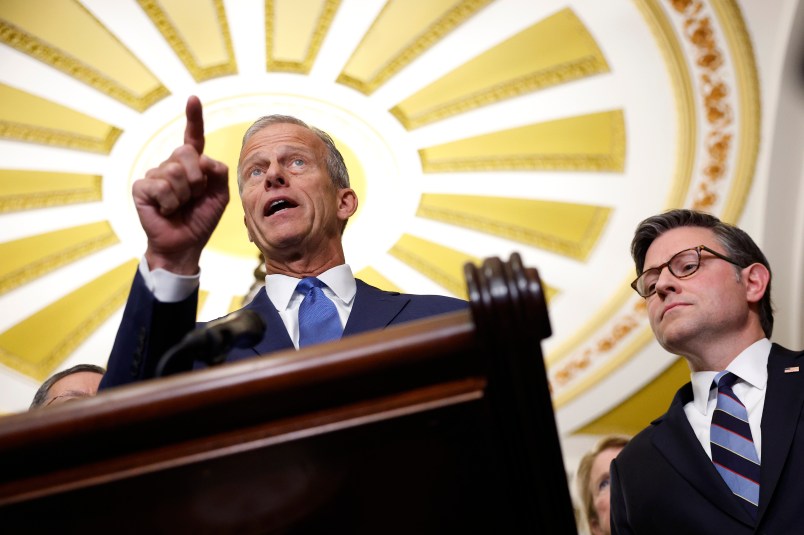
Last fall, we lived through the longest government shutdown in U.S. history. For 43 days, Democrats on Capitol Hill pushed for the extension of expiring Affordable Care Act credits, warning that failing to do so would send health care costs skyrocketing for millions of Americans. Congressional Republicans held firm, a handful of Senate Democrats eventually broke with their party to vote to reopen the government, and the shutdown ended on Nov. 12.
While discussions resumed after the holidays, they petered out with little fanfare. The ACA’s enhanced premium tax credits were sundowned. Those credits, created as part of the pandemic’s 2021 American Rescue Plan Act, significantly reduced monthly premiums — sometimes to $0 — for 22 million Americans. People making incomes anywhere between 100% and 400% of the federal poverty level ($32,150 for a family of four in 2025) saw reductions in their monthly premiums. After the enhanced credits were implemented, enrollment in ACA marketplace plans doubled, growing by over 12 million new enrollees.
With their elimination, many of the dire warnings from health care experts have come to pass. One million fewer Americans are enrolled in ACA marketplace plans, and that number is expected to keep climbing. Ethnic and racial minorities, kids, and other vulnerable communities are being disproportionately affected. And the patchwork plans offered up by President Trump and the GOP would provide individuals with one-off lump sumps that wouldn’t even cover the cost of one emergency visit — not exactly a substitute for actual health insurance coverage.
Below, we take a close look at the health care landscape now that subsidies are gone, and dig into how frustration over soaring health care costs could impact the 2026 midterms.
The subsidies are a priority for voters, even if they aren’t for members of Congress
During the 43-day government shutdown last fall, Republican leaders said they were open to extending the subsidies, but only once the shutdown was over. Following the shutdown, the Republican-controlled Senate voted down one such bill, and Republicans have shifted their focus towards alternatives to the ACA.
In January, a bill to extend the subsidies through 2028 passed the house, and has since been placed on the Senate calendar. But efforts to extend the subsidies — which attracted some Republican support in the House — have now largely “fizzled” according to Jennifer Snow, National Director of Government Relations and Policy at the National Alliance on Mental Illness (or NAMI), which has been mounting advocacy efforts at the Capitol.
The inaction over the expiring subsidies, and health care generally, is shaping up to be a critical issue in the 2026 midterms. An October KFF poll found that 78% of adults and 59% of Republicans wanted the subsidies extended. Some of the groups that are facing the biggest financial hit from monthly premium increases are key members of the Republican base, including older adults and rural Americans. Analyses from the Bipartisan Policy Center and the State Marketplace Network estimate that some older adults will now be paying between 25% and 30% of their annual income towards premiums.
At least 1 million fewer people are no longer insured through the ACA marketplace
Premiums have now increased 114% on average — in many cases, hundreds of dollars annually — for enrollees. Following this, enrollments in ACA marketplace plans are down by over 1 million people in 2026, but experts anticipate this number will only continue to grow as enrollees struggle to make premium payments. Faced with choosing between insurance coverage and other basic necessities, many may drop their plans later in the year.
“What we’re seeing so far in the early numbers is likely the tip of an iceberg,” said Paul Jacobs, Director of Modeling at the Johns Hopkins Center for Health Systems and Policy Modeling. “The question is, how large is the iceberg and how fast is it moving?”
Increased premiums aren’t the only new barrier to coverage — the 2025 Budget Reconciliation Act, also known as the One Big Beautiful Bill Act or OBBBA, added several new requirements for enrollees, ended auto-renewal (which was responsible for the enrollment of 10 million people in 2024), and shortened enrollment periods. Taken together, these added hurdles may contribute to more and more people failing to maintain enrollment from year to year. New proposals from the Centers for Medicare & Medicaid Services and the Health and Human Services department for 2027 and beyond are seeking to make premiums as cheap as possible — at the expense of meaningful coverage. The rising costs of silver and gold plans, which have lower deductibles but higher monthly premiums, may push more people towards risky high-deductible and catastrophic plans with “next to no coverage,” according to Jennifer Snow at NAMI.
Republicans’ proposed replacement for the ACA could leave major gaps for most enrollees
Trump and other Republican leaders have touted tax-advantaged health savings accounts, or HSAs, as the ultimate replacement for the ACA. The OBBBA expanded HSAs as an alternative to ACA coverage. In November Truth Social posts, Trump painted his populist vision for subsidies to go directly to consumers, rather than ACA marketplace insurance carriers. (The Kaiser Family Foundation has noted that the ACA subsidies are already paid to enrollees or are forwarded to insurance companies on behalf of that enrollee).
Trump further underlined this vision in his “Great Healthcare Plan,” announced in January, which claims to end the “scam” of ACA subsidies and “put extra money straight into the health care savings account in your name, and you go out and buy your own healthcare, and you’ll make a great deal, you’ll get better health care for less money.” Republican representatives introduced a smattering of bills in late 2025 and early 2026 that would also expand the usage of HSAs (sometimes referred to as “Trump Health Freedom Accounts”) in the ACA marketplace.
But re-directing the equivalent cash value of a given subsidy to an individual “is really not the same as providing health coverage,” said Elizabeth Fowler, also a researcher at the Johns Hopkins Bloomberg School of Public Health, in a January press briefing. While an HSA may suffice for some people, an annual reimbursement of $1,000 to $5,000 “will not come close to covering the cost of care” for those with more complex health needs, such as cancer treatment, routine surgeries, or chronic health conditions.
And for any individual, “One trip to the emergency room could exceed the amount provided,” Fowler said.
Minority groups will likely be most impacted by lost coverage
The loss of the enhanced tax credits won’t be felt evenly. In a recent study, Jacobs found that the COVID-era subsidies led to significant gains in enrollment specifically for historically disenfranchised and economically vulnerable groups — racial and ethnic minorities, children, part-time workers, and middle class families. Now, he fears that those are the people most at risk for losing coverage. “We’ve essentially re-erected affordability barriers that, prior to the ACA and prior to the ARPA enhanced credits, kept millions of people uninsured,” he said. “I really do fear that we may be going back towards something that is more unequal.”
In fact, Jacobs found that the enhanced premium tax credits leveled the playing field. “A Black American eligible for marketplace coverage had roughly a one in 10 chance of enrollment, whereas a white American had roughly one in four chance,” he said of the era before the enhanced tax credits. “After those subsidies were available, both groups had roughly an equal percentage.”
“That is really not a marginal improvement — it’s a structural shift in who can access the health insurance system.”
Downstream costs may outweigh short-term savings
Conservative think tanks have cited the enhanced premium tax credits’ 10-year $335 billion cost to the federal deficit as too costly to the American taxpayer to extend. But the lost subsidies will also have several unintended consequences for the struggling U.S. health care sector.
“The math, I think, is straightforward,” said Jacobs. “You know, you have millions of people potentially losing marketplace coverage. They don’t stop getting sick.”
“What is the cumulative effect of if you put off treatment for your mental health condition?” said Snow at NAMI. “Typically, it means things get worse, and you’re more likely to need more intensive and expensive services once you get to a breaking point.”
Rural hospitals and safety-net hospitals may take on the brunt of these costs as uninsured people wait until preventable problems become emergencies. Most U.S. hospitals are required by law to provide emergency care regardless of a patient’s ability to pay. As patients take on more medical debt without adequate insurance, the hospitals that treat them also make less revenue.
Over 1,000 rural hospitals are currently at risk of closing, according to the Commonwealth Fund, a private foundation that promotes health care equity. The Fund estimates that the expired tax credits will ultimately translate to a loss of $1.6 billion in uncompensated care and revenue for rural hospitals. While the Rural Health Transformation Program funds will offer some of those hospitals an infusion of cash, they will not be able to offset the costs of coverage cuts, as no more than 15% of a state’s total awarded funds can be used for direct provider payments.
Reduced enrollment and fewer patients may have other large-scale economic impacts. The Commonwealth Fund estimates conservatively that the expired enhanced credits will lead to a $40.7 billion reduction in state economies and a loss of nearly 340,000 jobs across multiple sectors, far outweighing what would have been spent to extend the credits.






Conservative think tanks have cited the enhanced premium tax credits’ 10-year $335 billion cost to the federal deficit as too costly to the American taxpayer to extend. But the lost subsidies will also have several unintended consequences for the struggling U.S. health care sector.
Like, seriously?
And revenues for a 50%, $500 billion/ year increase in the defence budget for a President who like to invade other countries was written into the tax law?
The subsidies are a priority for voters, even if they aren’t for members of Congress
Congress has their own Cadillac healthcare plan.
Not to mention someone has to pay for Trump’s ballroom, war and hundreds of lawsuits.
Look, we could extend subsidies to cover physical and mental health for all Americans, or we could channel that money into an illegal, unwinnable war to balm the bruised ego of a decaying, demented, narcissistic pedophile. All I’m saying is it’s a tough call.
Yeah, and insuring all those Americans will never fatten Dear Leader’s bank account the way tapping into Iranian oil revenues will.
HSAs are just savings accounts. Eligibility should be expanded, since nearly all plans include deductibles now and an HDHP doesn’t give the premium savings it used to. But it’s not a solution to this problem. It’s just giving people the “freedom” to put aside money they don’t have.
The ACA was and is great, but it’s just a band aid to avoid some level of universal healthcare access. You need to address the cost for care in a healthcare system distributed through insurance. Total claims need to be less than total premium. Focusing on premium oversimplifies the problem and just hides the speed that premiums are increasing to cover the cost of care.