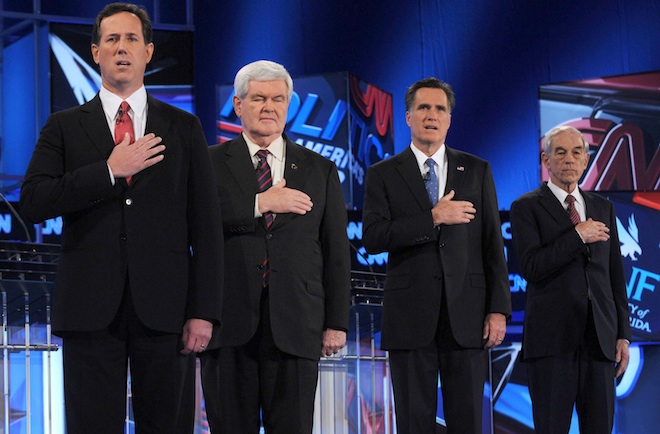
ZANESVILLE, OH — As Republicans prepare to hit the polls in 11 states to choose their presidential nominee, each candidates’ appeal is being stripped down to its absolute core. Newt Gingrich appeals to the head. Rick Santorum to the heart. And Mitt Romney to voters’ desire to beat President Obama.
The two leading anti-Romneys — Santorum and Gingrich — delivered dueling speeches to Ohio Republicans for a fundraising dinner at Bowling Green University on Saturday, giving voters a unique chance to hear their final messages back to back.Gingrich, who famously said on the trail that he “thinks grandiose thoughts,” has embraced that characterization by pushing out another large-scale, quickly assembled policy goal: $2.50-a-gallon gas. He devoted nearly his entire speech to his new initiative, which would consist of opening up federal lands to drilling, replacing the EPA with an “Environmental Solutions Agency” and generally boosting oil and gas at all times.
“Would you like $10 a gallon and algae?” he told the audience, referring to a bioefuel research program, “or would you like $2.50 a gallon and drilling?”
The rewards of implementing his idea, like those of a bustling moon hub for tourism and commerce, would be vast: Gingrich estimated Americans would see a whopping $16 trillion to $18 trillion in federal tax revenue from the energy explosion, wiping out the national debt in one fell swoop.
“I believe we can get well below $2 a gallon,” he said, upping his boast. “It was at $1.13 when I was speaker. It was $1.89 when Barack Obama was sworn in.”
Economists are highly skeptical of any president’s ability to influence oil prices, which are driven by complex market forces that often exist beyond government control. The low gas prices at the start of Obama’s first term, for example, were mostly due to an economic collapse that sharply reduced global demand.
Gingrich assured the crowd that he’ll be able to use his extensive knowledge to unmask the White House’s incompetent liberalism.
“In order to debate Barack Obama, I have to become the nominee,” he said.
Santorum, by contrast, offered almost no data, statistics or even broad policy prescriptions in his speech, outside of an extraordinarily unrealistic pledge to balance the budget within five years. Instead, he delivered a broad pep talk on the Founding Fathers, values, character and above all, “vision” — his favorite phrase.
“The debate is about the past,” he said turning the standard promise to usher in a brighter future on its head. “It’s about an effort by this administration and the left to redefine what America is.”
His voice raspy from a sore throat, lending him a “Mr. Smith Goes to Washington” quality, Santorum took care to provide at least some of the conservative red meat he’s best known for.
“I love it because the left says, ‘Equality, equality!'” he said. “Where does that concept come from? Does it come from Islam? Does it come from other cultures around the world? … No, it comes it comes from our culture and tradition, from the Judeo-Christian ethic.”
After Gingrich’s and Santorum’s dueling pitches at Bowling Green, two friends, William Herald, a Newt volunteer, and Tim Westhoven, sporting a large Santorum button, debated the speeches’ merits.
“Santorum has inspiration, but Gingrich has solutions,” Herald, a public policy Ph.D., argued. “He has big innovative ideas and the ability to articulate them.”
Westhoeven said he got “goosebumps” from Santorum’s talk about the nation’s values. He saw little distinction between talking about social issues and the economy.
“It’s important to be strong on family and values,” he said. “Poverty rates are much higher in single-parent households, but no one will talk about it because we’ve gotten so PC.”
Still, not everyone at the event was as psyched about Santorum’s forays into culture war territory, a case that Romney’s surrogates and conservative pundits have made in recent weeks.
“I’ve been disappointed we haven’t been pushing the budget and the deficit enough,” Terry Penner of Defiance, Ohio, said. “Surveys show that’s where people are interested.”
Santorum has embraced his role as the party’s premier social issues candidate in the final days even as he devotes most of his speeches to other topics. Speaking to voters late last week, he said the GOP “needs someone who is willing to talk about all of the issues confronting this country.” At another Ohio rally Monday in Westerville: “If we’re just the party of tax cuts, we’ll never win another election,” and insisting that the GOP has to stand against “the breakdown of the family.”
That last pitch resonated with Joane Gerube, a retired Granville resident who was undecided until she saw Santorum speak that day.
“I can see now he’s a good family man who would hopefully encourage people to return to the morals of their Founders,” she said.
Even Santorum’s attacks on Romney come from a moral perspective. At the same rally, Santorum said footage and op-eds from 2009 in which Romney supported a health care mandate demonstrate the former Massachusetts governor’s lack of honesty and character.
“We need a president and a nominee we can trust,” Santorum said. “Our honor is on the line.”
In addition to the nation’s moralizer in chief, Santorum is pitching himself as an underdog. He begins almost all his speeches with a riff on how unlikely his surge seemed just a couple of months ago, and unfailingly mentions Romney’s negative ads and the big money behind them. The GOP needs someone who will “not just pound their opponent into the ground, but lift up our country,” he said.
Romney, for his part, is returning to the core trait that’s made him the frontrunner since the early days of the race: electability. His campaign opened up a new front against Santorum this week, mocking his inability to clear low hurdles like getting on the ballot in Virginia or finding delegates for every district up for grabs in Ohio. The message is clear: Only Romney has a real presidential operation capable of going toe to toe with Obama.
After mixing it up with his opponents in recent contests, Romney has returned to his earlier strategy, focusing his attack lines on Obama and leaving his surrogates to deal with his GOP rivals. At his big election-eve rally in Zanesville, Ohio, Monday night, Romney delivered a truncated version of his stump speech — without alluding to Santorum or Gingrich even indirectly.
“I believe the president is leading this country on a path that would change the very nature of this country,” he said. “This man is out of ideas, he’s out of excuses, and in 2012 he’s going to be out of office.” In another oft-used attack line, he said “the president wants to turn us into something that’s more European than America.”
For Romney, who awkwardly waded into culture war territory in recent weeks to pile on the White House over regulations prohibiting religious employers from denying birth control coverage to workers, he’s closing out back in his comfort zone: the economy. Apart from a brief wade into tough-talking on foreign policy, he painted the same miserable image of struggling Americans that he has through nearly a year of campaigning.
“This is an election about liberty and economic freedom,” he said. “This is a question about whether the stresses on families will be alleviated, where you have a mom working a day shift and a dad working a night shift.”
It was a speech that could have just as easily been delivered in the fledgling days of the campaign. For all the twists and turns the race has taken, the candidates have ended up right where they began: an ideas man, a culture warrior and a front-running businessman.