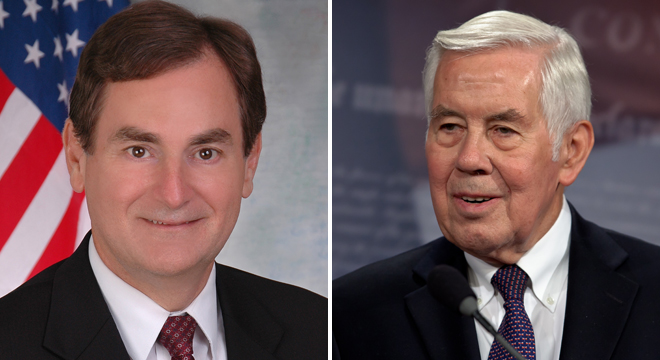
The new Howey Politics/DePauw University poll of Indiana has some big news: In the Republican primary for Senate next week, longtime incumbent Sen. Dick Lugar now trails his right-wing challenger, state Treasurer Richard Mourdock, by ten points.
The numbers: Mourdock 48%, Lugar 38%. The survey of likely primary voters was conducted April 30-May 1, and has a ±3.7% margin of error.
In the previous Howey/DePauw poll from late March, Lugar was ahead by 42%-35%.
The presumptive Democratic nominee is Rep. Joe Donnelly — with some Dems hopeful that a Mourdock win in the primary would open up this seat for a pickup.The TPM Poll Average for the primary has Mourdock ahead by 45.0%-41.0%.
Lugar was first elected to the Senate back in 1976, after having previously served as Mayor of Indianapolis, and after having run one unsuccessful Senate race in the Democratic wave year of 1974. He then defeated another Dem incumbent in 1976 by a landslide margin. He won a 54%-46% re-election in 1982, and in the 30 years since then he has never received less than 66% of the vote — indeed, in his last race in 2006, he didn’t have any Democratic opponent at all, wining by 87%-13% against a Libertarian candidate.
But this year, Mourdock is seeking to harness Tea Party ire against Lugar’s incumbency, and against a series of votes Lugar has taken over the years: For the TARP bailout, for the auto industry bailout, for President Obama’s Supreme Court appointees (which Lugar has said creates precedent for Democrats to vote for Republican appointees), for the START nuclear arms treaty with Russia, and others.
Lugar has also had to deal with challenges to his state residency: He lives mainly in northern Virginia, and has not owned a home in Indiana itself since 1977, the year after he was first elected to the Senate. The campaign has cited the Indiana constitution and the opinions of current and past state attorneys general to show that Lugar did not legally lose his residency when he left for Washington to serve the state as its senator decades ago. However, the campaign has also struggled with the appropriate public messaging — such as comparing his legal status to that of military service.