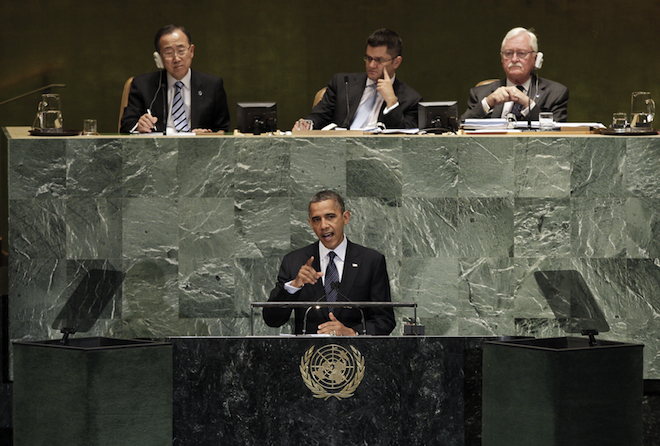
President Obama told the United Nations General Assembly that the deadly attack on the U.S. consulate in Libya should be a wake up call for the Muslim world to embrace democratic principles and renounce extremism of all kinds.
“Today, we must affirm that our future will be determined by people like Chris Stevens, and not by his killers,” Obama said. “Today, we must declare that this violence and intolerance has no place among our United Nations.”
Obama repeated his condemnation of the anti-Muslim YouTube clip produced in America that sparked recent protests and riots, saying it did not reflect the views of the United States government. But he paired that with a demand that Middle Eastern leaders not only recognize Americans’ right to free speech, but condemn intolerance against Christian, Jews, and Muslim sects within their own countries.
“The future must not belong to those who slander the prophet of Islam. Yet to be credible, those who condemn that slander must also condemn the hate we see when the image of Jesus Christ is desecrated, churches are destroyed, or the Holocaust is denied,” Obama said. “Let us condemn incitement against Sufi Muslims, and Shiite pilgrims. It is time to heed the words of Gandhi: ‘Intolerance is itself a form of violence and an obstacle to the growth of a true democratic spirit.'”
The president added that “Muslims have suffered the most at the hands of extremism,” citing multiple recent examples of terrorism against civilians in places like Afghanistan and Yemen.
“There are no words that excuse the killing of innocents,” he said. “There is no video that justifies an attack on an Embassy. There is no slander that provides an excuse for people to burn a restaurant in Lebanon, or destroy a school in Tunis, or cause death and destruction in Pakistan.”
Turning to broader conflicts, Obama called on the UN’s members to further pressure and isolate Iran over its nuclear program. Israel’s Prime Minister Benjamin Netanyahu has publicly sparred with the president in recent weeks over his demand that the White House set clear “red lines” after which Iran might face military action. Obama alluded to this debate in his speech without naming any such conditions.
“Let me be clear: America wants to resolve this issue through diplomacy, and we believe that there is still time and space to do so,” he said. “But that time is not unlimited.”
Obama also demanded Syrian dictator Bashar al-Assad, who has led a bloody military campaign against rebels in his country, step down in the wake of a popular revolt as other autocrats did during the Arab Spring protests.
He positioned America’s involvement in these and other Mideast conflicts as an extension of its citizens’ faith in democracy.
“We have taken these positions because we believe that freedom and self-determination are not unique to one culture,” he said. “These are not simply American values or Western values, they are universal values.”
Obama’s speech came shortly after Republican rival Mitt Romney delivered a Middle East speech of his own at Bill Clinton’s CGI conference in New York. Romney struck similar themes in his address, mourning the deaths in Libya and suggesting America take an active role in aiding the transition to democracy for Arab Spring countries.