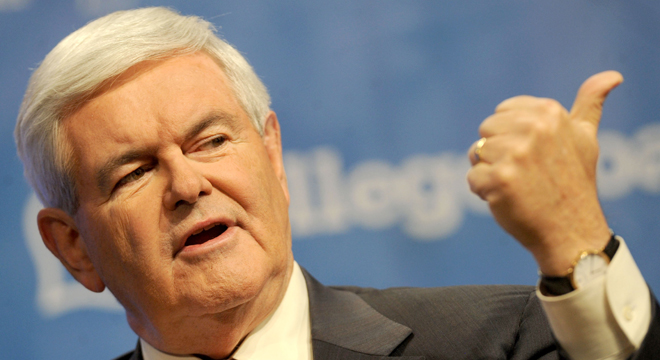
People might snicker when Newt Gingrich claims he’s a Washington outsider, but he’s not kidding that party elites really, really, really don’t want him to be the nominee. The GOP’s wise old men are pretty much united in hammering his campaign this week in the press, employing their most florid prose to convince voters that a Gingrich win would be a disaster.
George Will led the charge last week with a column calling on Republicans to give a second look to Jon Huntsman and Rick Perry rather than back Gingrich, who “embodies the vanity and rapacity that make modern Washington repulsive.”
Charles Krauthammer, also writing for the Washington Post, criticized both Romney and Gingrich for their conservative lapses but saved the worst of his fire for the latter, whom he writes is “possessed of an unbounded need for grand display that has already led him to unconservative places even he is at a loss to explain, and that as president would leave him in constant search of the out-of-box experience — the confoundedly brilliant Nixon-to-China flipperoo regarding his fancy of the day, be it health care, taxes, energy, foreign policy, whatever.”
David Brooks of the New York Times, generally considered one of the most prominent moderates in the party, informed readers that Gingrich is too big government even for him (“He has no Hayekian modesty to restrain his faith in statist endeavor”), pointing to his frequent calls for gigantic, unconventional, and ludicrously expensive space exploration projects.
“As nearly everyone who has ever worked with him knows, he would severely damage conservatism and the Republican Party if nominated,” Brooks wrote in his latest column, “The Gingrich Tragedy.”
Former George W. Bush speechwriter David Frum, writing for his site FrumForum.com, concurred with Brooks that Gingrich’s character ultimately mattered more than his platform.
“What presidents must inescapably do is respond to emergencies: eg, the financial crisis of 2008, the 9/11 terror attacks, the financial crises of 1997-98, the invasion of Kuwait, etc,” he wrote. “And there, what usually ends up mattering most is not the president’s philosophy, but his judgment, coolness and steadiness. Those are the grounds on which Romney reassures and Gingrich terrifies.”
In the Wall Street Journal, former Ronald Reagan speechwriter Peggy Noonan derided Gingrich as “a human hand grenade who walks around with his hand on the pin, saying, ‘Watch this!'” which pretty much describes his 1990s cartoon portrayal in Doonesbury.
Then there’s Karl Rove, who has recently taken to boosting Gingrich’s expectations in Iowa to the point that anything but a blowout victory should be interpreted as a disaster by his standards. He also appeared in the Wall Street Journal this week with a column evaluating both Romney and Gingrich that reserved almost all of its toughest lines for Newt.
“When a man of his self-confidence begins to feel on top of the world, bad things often happen,” Rove wrote.
The combined effect is clear: the GOP’s top minds may not be convinced Romney’s the best nominee, but they know Gingrich would be a disaster. The question now is whether they can get through to a conservative base that’s increasingly suspicious of its party’s intellectual wing.