






Hello, it’s the weekend. This is The Weekender ☕️
Finally, Pope Leo XIV has permission.
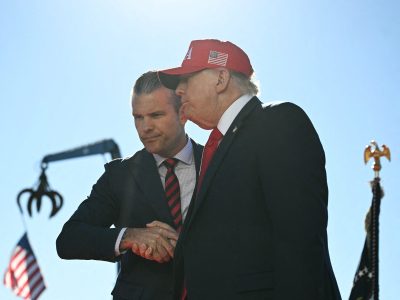
Secretary of Defense Pete Hegseth on Friday conceded some authority to the pope. “The pope’s gonna do his thing, that’s fine,” Hegseth said, answering a question about the pontiff’s criticism of the administration’s war on Iran. As far as temporal authority goes, Hegseth added, “We know what our mission is, we know what authority we have. The orders of the president — we’ve got lawyers all over the place.”
Of course, Hegseth has spent past several weeks justifying the war in divine terms. He cited “the providence of our almighty God” in an interview with 60 Minutes. At a monthly prayer service at the Pentagon in March, he called on God to “grant this task force clear and righteous targets for violence.”
“Snap the rod of the oppressor, frustrate the wicked plans and break the teeth of the ungodly. By the blast of your anger, let the evil perish,” Hegseth added. For Hegseth, this is as much theatrics as it is a product of the church to which he belongs. His pastor, Doug Wilson, runs a Christian sect that uses military language to describe its plans to convert as many people as possible. The church was founded by Wilson’s father, a Navy veteran who wrote a book that sought to apply military principles towards establishing a Christian America, calling it “strategic evangelism.”
Leo, who Trump famously dismissed as “weak on crime,” has denounced all of this. Hegseth, a Protestant, at least has a way to ignore the Vatican. That has been harder for Vice President JD Vance, a Catholic convert who urged his spiritual leader earlier this month to be “careful” if he was “going to opine on matters of theology.”
For Leo, it’s one of a few ways in which he’s distanced himself from the Trump administration. Last year, one pontiff-watcher noted, he likened our own era to that of the industrial revolution with Big Tech playing the role of 19th century robber barons. As far as Iran goes, there seems to be something of a truce: Leo denied last week that there were tensions between him and the administration. Vance, for his part, conceded as well that the pope is the pope.
—Josh Kovensky
Kash Incentives
In just over a year as FBI director, Kash Patel hasn’t had many wins. He reportedly bungled key aspects of the Charlie Kirk and Brown University shooter investigations and has mostly made headlines for things like using a private jet to watch his country music singer girlfriend perform and chugging Corona with the U.S. men’s hockey team. An article published last week in the Atlantic paints Patel as someone who drinks excessively, is frequently absent, makes impulsive decisions and is paranoid about losing his job. (Patel has filed a $250 million defamation lawsuit against the magazine and writer over the story, calling the reporting “all false.”) While he appears committed to seeing out Trump’s retribution agenda under the guise of reform, so far he’s failed to produce the type of high-profile arrests that would please his boss. In other words, he’s on the kind of losing streak that makes you disposable in the Trump administration.
On the day the Atlantic article was published, the prediction market Kalshi responded with a dramatic increase in the probability that Patel would be fired before June 1. If you’re unfamiliar with Kalshi or prediction markets, they are effectively gambling sites that have lobbied their way to a classification as commodities trading platforms where users can bet/trade on whether they think some future event will happen by purchasing a yes or no position. They are mainstream enough now that Planet Money and John Oliver both dedicated shows to them last week, and they are routinely in the headlines for offering seemingly gruesome markets — such as the ability to put money on when Ayatollah Khamenei will be “out as Supreme Leader?” — as well as ridiculous markets like “Will Jesus Christ return before 2027?” (4% chance). But mostly they are used for sports prop betting, which brings us back to Kash Patel.
Last October, Patel announced the arrest of current and former NBA players for alleged insider trading on NBA player prop bets. Without getting too into the weeds, the gist is that former NBA players and a current coach were, according to prosecutors, sharing non-public information about players with their associates (some of whom apparently had mafia ties) who would use that information to bet on props like how many points a player would score or how many minutes he would play. At the time of the arrest, Patel stated: “Using private information and positions of power to rig sports gambling outcomes is not only illegal, but destroys the integrity of the game and will never be tolerated. We will continue following the money to ensure gambling operations of all kinds stay within the law and bring to justice those who take advantage of innocent victims.” The innocent victims in this case appear to be the sports betting books and other gamblers.
While use of non-public information is illegal when gambling on sports, the legality of its use in prediction markets (which, remember, are theoretically not gambling sites, and are overseen by the CFCT) is a little less clear. In an interview with Axios last November, Polymarket CEO Shayne Coplan explained, “What’s cool about Polymarket is that it creates this financial incentive for people to go and divulge the information to the market and the market to change.” Seeming to give away the game, Coplan goes on to suggest that insider information produces greater accuracy for certain markets. Recently, both Kalshi and Polymarket have assumed a more anti-insider trading stance and have warned that offenders could face DOJ action. On Thursday, in fact, we saw what may be the first prosecution of that type, when the DOJ charged a U.S. Army soldier with a set of crimes for a bet he made, allegedly using insider information, on Maduro’s ouster. He made $400,000, the DOJ said.
Though this first case appears relatively clear-cut, the problem remains that when you create a platform where any kind of information can be a tradeable commodity, it can be hard to identify what makes someone an insider. For example, it would be hard not to draw a correlation between the Atlantic’s reporting and the fact that on Kalshi’s prediction market the probability of Patel being fired before June 1 jumped over 60% on the day it was published. With over $400,000 in volume currently trading, a jump of that kind could result in a reasonable financial gain. What seems significant here is not that anyone has been accused of illegally profiting off this reporting, but that the existence of these markets could, in theory, open up the possibility that any impactful reporting could be scrutinized by Trump’s DOJ on the basis of insider trading. Is the prospect of Patel floating an accusation of market manipulation against a publication that outrageous? Would you put the odds at greater than zero? Wanna bet?
— Derick Dirmaier
The Backlash Against AI Is Breaking Containment
“It’s our home, and once we give it up, we won’t get it back,” a south Florida resident said at a recent town hall meeting opposing the construction of a proposed data center.
The resident was talking specifically about the proposed Okee-One data center in Okeechobee, which is slated to be built near waterways connected to the Everglades and other environmentally sensitive sites. But the comment could be a slogan for the broader, accelerating anti-AI movement. A growing number of Americans are refusing to invite a technology that could be irreversibly destructive into our communities and government.
Brian Merchant, an indispensable voice on all things AI, has chronicled the mounting backlash against AI in his Blood in the Machine newsletter. In just the past weeks, Merchant notes, OpenAI CEO Sam Altman’s San Francisco mansion was hit by a molotov cocktail and gunfire in two separate instances; a councilman in Indianapolis said someone fired bullets at his home and left a note reading “No Data Centers”; Maine is slated to become the first state to ban the construction of new data centers and Monterey Park, California became the first California city to do the same.
“If you take at face value what the AI executives themselves have been saying for the last decade, that an AI powerful enough to make humans go extinct is nascent, then acting with force to stop it would be a rational action,” Merchant explains.
For months, the humming opposition to the technology has grown louder, cutting across partisan, regional and professional lines. Locals have staged protests against data centers from the Southwest to Northeast, in rural and urban areas alike. Journalists at ProPublica walked off the job in a one-day strike, partly because they want a say in how the company adopts AI. People are pissed about AI contributing to their soaring energy costs, taking their jobs, harming the environment, spreading misinformation, increasing surveillance, making us all dumber — you name it. A once abstract debate about how the technology could impact our lives has become very tangible, showing up in people’s literal backyards, and they’re not happy about it.
Those responsible for ushering in our new AI era don’t seem to grasp this, though. That was evidenced in a much-derided X thread recently put out by Palantir, the intelligence and defense software firm that has multibillion-dollar contracts with the U.S. Army, DHS, ICE, the Defense Department, and other federal agencies. The thread summarizes CEO Alex Karp’s book “The Technological Republic,” which calls for resisting “a vacant and hollow pluralism” and encourages the development of AI weapons, among other points. Critics disparaged his worldview, in which a small group of elites wield great military and economic power with little accountability, as “technofascism.”
For most of us, this isn’t a vision of the future that appeals.
— Allegra Kirkland
Top 5 Pope Feuds
With President Trump and Pope Leo fighting over issues like who is toughest on crime, TPM publisher and noted Catholic Joe Ragazzo decided that the time was finally right to break out his ranking of the Top 5 pope feuds on this week’s episode of The Social Club. Here’s Joe’s list, and you can watch the clip below to get his explanations. Check out the full episode here.
5. Henry VIII vs. Pope Clement VII
4. Martin Luther vs. Pope Leo X
3. Napoleon vs. Pope Pius VI
2. Pope Leo I vs. Attila the Hun
1. Popes vs. Popes (the Schism of 1378)
Honorable Mention: Hitler vs. Pope Pius XII
— Joe Ragazzo




Saturday’s Heather and Paul:
The Christianity espoused by Hegseth and his lot is based primarily on the old testament. My question is ARE they that stupid? Or do their supporters not care as long as ass kicking is the primary goal.
In today’s on line NYT Maureen Dowd’s column equates trump’s mess in Iran with “The Ransom of Red Chief”. Perfect metaphor.
Pope gotta pope.