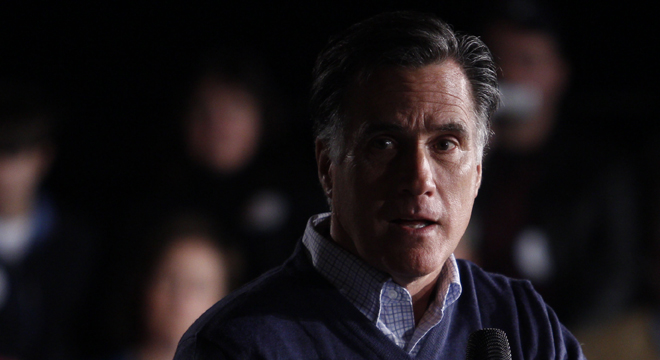
Mitt Romney emerged from Super Tuesday this week driving home one main message: he’s the inevitable nominee. On Sunday, fresh off Rick Santorum’s decisive win in Kansas, Romney’s rivals on the right and left ganged up on the frontrunner with a message of their own: not so fast.
“I think yesterday was instructive,” Obama campaign senior adviser Robert Gibbs said on CBS’s Face the Nation Sunday, referring to Santorum’s Kansas rout. “I think it shows you’ve got some — some real problems on the road to this nomination. So I think anything is still highly possible.” Noting the race would likely drag on for months, Gibbs wouldn’t rule out the possibility that the race lasts all the way to the convention.Gibbs’ motivation for bashing Romney as a weak candidate is obvious: team Obama feels the longer the race goes on, the weaker the GOP nominee will be in the fall. As he said in his next breath, “I know if you look at what these candidates have been saying, tearing each other apart with negative ads, it is a process that in many ways has torn each of them down, and I think has weakened them for a fall election.”
Rick Santorum and Newt Gingrich are hitting a similar note in painting Romney as a wobbly frontrunner who can still be knocked off course.
“The Mitt Romney camp has been trying to sell since last June that I should get out of the race and that Romney is inevitable,” Gingrich told Fox News Sunday host Chris Wallace. “But the fact is, Romney is probably weakest Republican frontrunner since Leonard Wood in 1920.” He added that “Wood lost on the 10th ballot” at the convention.
Gingrich envisioned a “60-day conversation about what’s going to happen” between the last primary in June and the convention. During which time, Gingrich argued, his “big ideas” will have sunk in and he will have slowly amassed more delegates.
Rick Santorum made a similar case Sunday, declaring on NBC’s Meet The Press that Romney needs 50% of the delegates from here on out when there are “a lot of states coming up that are…going to be great states for us.” Santorum also claimed that his own delegate count has been underestimated. Delegates from caucus states, unbound delegates, and superdelegates could alter the math going forward, he said.
Meanwhile Romney, still the presumptive nominee, has been working to project supreme confidence. Examples include the campaign telling reporters it would take an “act of God” for any of the other candidates to get the nomination, and the statement following Saturday’s primaries saying Romney “continued his momentum and path to getting the delegates.”
For Mitt Romney, some of his greatest assets as a candidate are the perceptions about his candidacy: that he’s electable, and that he’s inevitable. At this point in the race, his strategy is to seize upon his victories to portray the delegate math as immutably favorable to him. Though Romney’s rivals need to poke holes in the hardening viewpoint that Romney is the inevitable nominee in order to stay in the race, it’s not apparent that their alternate scenarios will prove their point.