


Conventional wisdom holds that a midterm election only fully comes into focus after Labor Day. That’s when a critical slice of the electorate starts focusing on the election and the choices before them. More or less in line with that, we’ve had a spray of polls out in the last few days showing the congressional generic ballot shifting decisively in Democrats’ favor. Looking only at generic ballots fielded entirely in September by pollsters the New York Times rates as trusted we have D+7, D+9, D+9 and D+11. If that trend or average is representative, it shows Democrats opening a big lead on this measure where the earlier average had been in the 5-7 point range. As Ron Brownstein notes here, history also tells us that in the final weeks of a campaign, this generic ballot measure will bend toward the president’s approval number. That appears to be happening. One of those, from the Times itself, was released today (D+9) with an accompanying write-up which, simply because it’s the Times, will probably draw attention to this trend even though the Times poll is only one of several.
Polls and trends can of course be wrong. But these numbers are extremely bad for the GOP, and if anything in this ballpark is accurate Republicans will likely lose the Senate as well as the House. Indeed, the variability in possible outcomes may be even higher in the Senate since it’s not amenable to gerrymandering. Even the Times, usually eager to find possible downsides for Democrats, frames their poll with declarative statements like this: “Voters see Republicans broadly as more extreme, more elitist and more corrupt than Democrats, according to the poll. And while voters continue to have doubts about both parties, they aligned more with the Democratic Party on both cultural and economic matters than the Republican Party in the survey.”
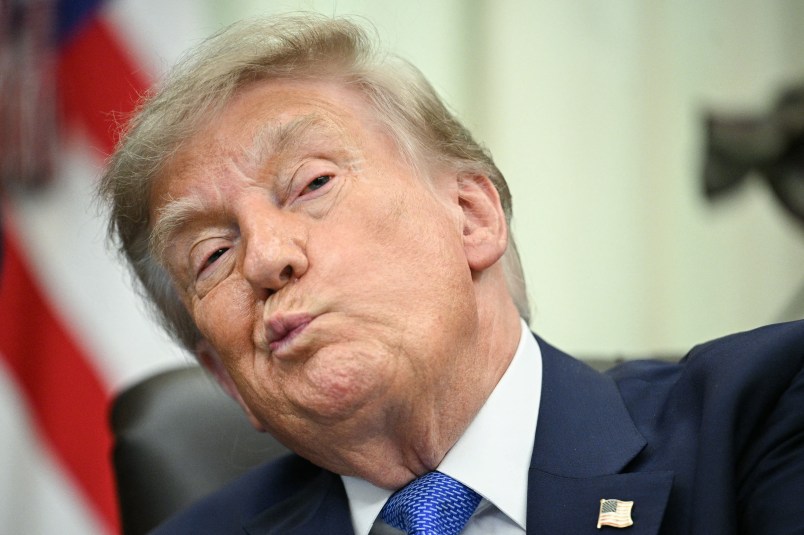
I’m generally very down on, even contemptuous of, the line that a party needs a positive message — what are you for, not just what are you against? This is a standard “conventional wisdom” type of … well, conventional wisdom. And recent history tells us it’s wrong. It’s still wrong. I stick to that. But there’s one point that is also clear in these polls. We’re in a period of tremendous public pessimism and uncertainty. And President Trump has done almost everything in his power to direct that anger, disappointment and dissatisfaction toward him. It’s very clear, just as it was for Republicans in 2010, just as it was for Democrats in 2006 and 2008, that opposition to Trump is the entire game here. It is now quite likely to drive a big electoral wave in November. All the positive agenda stuff is almost always just what people paid to have things to say come up with to say.
But there is one caveat here.
This mood of profound public anxiety, anger and dissolution isn’t entirely about Trump. To my lights, it’s heavily bound up with the society-cratering effects of the pandemic which we still only dimly understand. Even to the extent that a huge amount of public enervation and despair is tied up with all the destruction Trump has brought in his wake, it now goes beyond him. And Democrats, once in power — perhaps not entirely in 2027 (since Trump will still have most of the power) but certainly in 2029 — will have to point to some new way forward for the country, if not necessarily rapid and dramatic improvement, or the same anger and pessimism will again turn on them.
That’s not something to get down about. If you don’t have some clear idea of how to improve things for most people why are you even running for office? Why are any of us doing any of this? We should have some sense of how to put things broadly on a better course. And Trump may have done Democrats a critical favor that goes beyond his current unpopularity. Trump has made himself into what can only be called a kind of boiled down-distillation of everything that can be bad about a leader. Deeply corrupt and self-glorifying, wholly indifferent to what ordinary people care most about, and a mix of crazy and scary. If people’s biggest concern is about prices and inflation, it’s hard to know what more you could do to make things worse than starting a bunch of trade wars, starting a literal war to drive up energy prices, cutting public support for health care and appointing a soft-money Fed chair. This isn’t just me saying this, voicing what Trump’s opponents have always said about him. This tableau and perception comes through with increasing clarity in poll after poll. Trump’s personal corruption and the climate of corruption he’s created has become one of voters’ top issues — something that is very hard to make happen.
I’ve noted over the last year that I don’t think Washington or the national press has fully absorbed the depth of Trump’s unpopularity. They may be catching up now, fast.