


Trump: "They love African-American people. They love black people. MAGA loves the black people." pic.twitter.com/XFqoF0EK3D
— Josh Marshall (@joshtpm) May 30, 2020
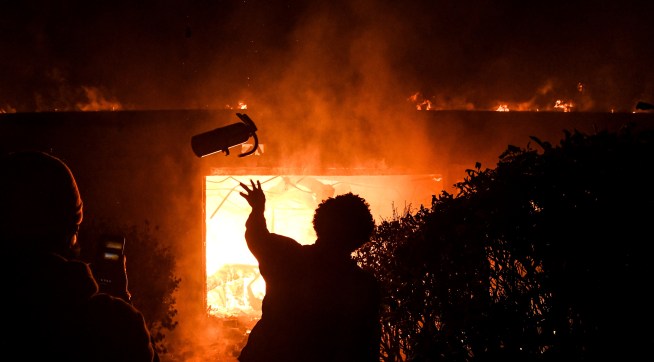
In the last 48 hours I’ve struggled to make sense of the totality of what is unfolding across the country. Social media is at its best and its worst, fanatically zooming in on the worst incidents or the occasionally the most inspiring, making it all but impossible to make sense of the larger picture. Yet conventional journalism manages to do little better. I think this is because everything actually does seem to be happening at once: civil rights protestors protesting and sometimes escalating into riot; white supremacists acting as agents provocateurs to goad on their fantasies of race war; white left radicals doing the same to advance their own vision of liberatory social violence. And then you have the police. I have no doubt many, most police are doing their best to do their job in this moment. But the novel technology of smart phones is capturing and magnifying numerous incidents around the country in which police officers are caught acting less like a civilian constabulary working to protect the peace, lives and property than something more like another gang, with its own political agenda, sometimes turning not only on protestors with excessive force but on the civilian population itself.
At its best and its worst, the refrain of protest – that the discrimination and abuse is systemic – is vindicated inasmuch as good or at least middling people are drawn along with bad or destructive actions.
Mentioned last week that the big hole in any reopening plan for New York City, the most hard hit region in the United States, is the city’s bus and subway system, without which the city simply can’t function. The Times has a story today about just this question. It’s a fascinating discussion of the mix of questions, risks, challenges and opportunities that go into this question. But what struck me about the article is the general assumption in the writing of it that the issue is convincing residents to use the subways and public transit again rather than whether it’s actually safe to do so.
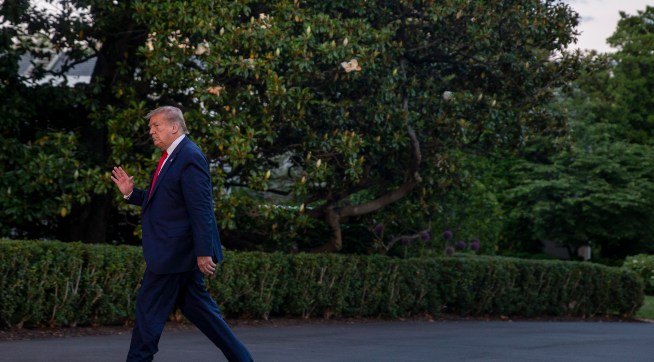
The irony.
Speaking to governors and other state officials from the Oval Office just now, President Trump suggested that most of those governors on the call were “weak” and urged state leaders to crack down on violence as protests erupt across the nation following the death of George Floyd last week.
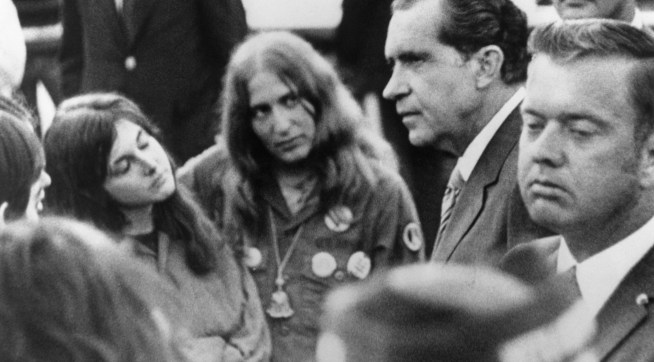
I’m always reluctant to criticize presidents for Secret Service protective measures. America has a successful and longstanding history of killing its presidents. More particularly, any president is hard-pressed to overrule his Secret Service detail. That’s not only because they’re protective professionals and he or she is not. But it’s a huge responsibility and second-guessing their actions only makes it harder. We can’t know just what thinking led the Secret Service to whisk the President into the White House’s underground bunker complex or turn off the lights at the White House. But the pregnant symbolism — whatever the underlying reality — matched what we’ve seen very immediately from the President himself. Much as he seemed to grow tired of the COVID epidemic he similarly seemed to lose interest in the wave of protests over the death of George Floyd or simply get bored. He spent the weekend first shifting gears to cleaning up the mess over his looting/shooting comments and then going to Florida to watch a space launch, which he said would be an emblem of his Presidency. Then he shifted back to more provocations and threats, including his nonsensical but inflammatory claim that he will declare “Antifa” a domestic terrorist organization.
A full recording of President Trump’s call with the nation’s governors has now been published. President Trump’s sometimes hysterical comments turn out not to be the most disturbing part. The Secretary of Defense, Mark Esper, and apparently also the Chairman of the Joint Chiefs, Gen. Mark Milley are heard on the recording using language that presumes mounting warfare against demonstrators in American cities. “I think the sooner that you mass and dominate the battlespace,” Esper tells Governors, “the quicker this dissipates and we can get back to the right normal.” This is the language of mechanized warfare and he’s describing American cities.
A really dramatic, wild scene unfolding as I write. Maybe you will have watched it live on TV. The President was first scheduled to do live remarks at 6:15 PM. Then it was 6:30 PM. Protestors have been in Lafayette Park all day but entirely peaceful. Police and military personnel from various agencies just about exactly at 6:30 started pressing a confrontation with what had been for the day an entirely peaceful crowd. They then started firing tear gas and flash bangs. It is impossible to believe that this overlapping timing was not intentional and intended to create a law and order tableau for President Trump to enter into.
Tear gas, flash bangs, apparently rubber bullets and mounted police heading into the crowd. This all looks not just one way but made for TV. By design.
Trump: "I will fight to protect you. I am your president of law and order and an ally of all peaceful protesters, but in recent days our nation has been gripped by professional anarchists, looters, criminals antifa and others." pic.twitter.com/e2e9d1eX48
— Josh Marshall (@joshtpm) June 1, 2020

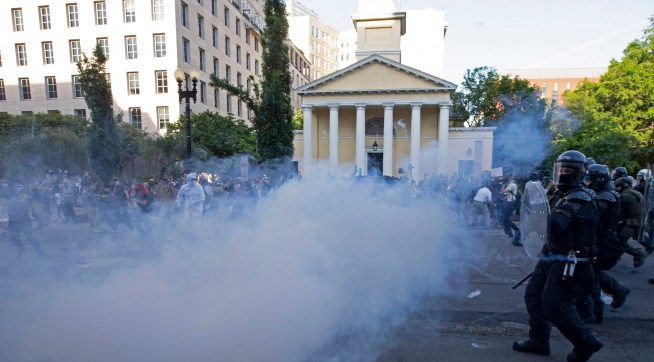
As much as anything else, the spectacle yesterday afternoon in front of the White House was a deliberate set-up. It’s a not-unknown stock in trade for bad actors to invite press to one kind of purported event and switch to something more ghastly on camera, forcing the press to become complicit in what unfolds.
Yesterday was a version of that.
Join
There’s a lot to digest already this afternoon, but here’s a friendly reminder that while the nation is grappling with social and racial unrest, all while still in the very real throngs of a global pandemic, 2020 elections are still happening.