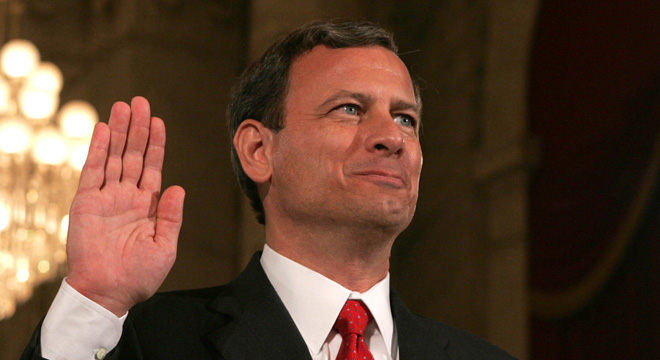
Why does the conservative rage at John Roberts run so deep? And why isn’t it going away any time soon? TPM Reader JB thinks he has the answers …
I think I understand the virulence of the reaction to Justice Roberts opinion on NFIB v. Sebelius, and the ease with which fairly implausible explanations (Roberts wanted to be liked by The New York Times!) for his upholding health care reform have been accepted by the most vocal conservatives.
The liberal slant of the federal judiciary has been an article of faith in conservative politics for at least half a century. Beginning with the Reagan administration, correcting perceived liberal bias by nominating relatively youthful, ideologically reliable judges has been something nearly all Republican candidates have pledged to support. Both the Reagan and the second Bush administration invested considerable effort in finding such judicial nominees, and with the confirmation of Samuel Alito the conservative dream of a Supreme Court willing to shoot down the most objectionable liberal legislation and precedents seemed to have become reality.
And now it’s been blown up. The absolute top political priority of Republicans in national politics — overturning the Obama administration’s signal domestic policy initiative — had its wheels taken off by a Bush nominee seen as the most reliable of conservatives on the bench. Conservatives who had been congratulating one another on conquering one of their movement’s very highest mountaintops now look like idiots. Moreover, unity among conservatives — the ability to represent their movement as speaking with one voice — took a heavy hit. John Roberts is not Chuck Hagel, Mickey Edwards or Colin Powell, conservative figures who spoke out against some aspect of the conservative movement after their careers in public office had ended. Roberts is Chief Justice of the Supreme Court, and just told every conservative in Washington and around the country that one of the most cherished conservative beliefs (that Obamacare is unconstitutional) is completely wrong. In doing so, he kicked the legs out from under the conservative campaign narrative that President Obama has been all talk, without any significant achievements to show for over three years in office.
Psychologically, this is a devastating blow. Among the surplus of commentators in old and new media there is some loud whistling past this graveyard, declarations that limiting the government’s powers under the Commerce Clause or Roberts having labeled the penalty for not buying health insurance a tax make the ruling in NFIB v. Sebelius a veiled conservative victory. I don’t think very many serious conservatives in politics actually believe this. Roberts’ ruling, to them, was a disaster and humiliation both on policy substance and in campaign politics. They’ll remember it, and him, for a very long time.