


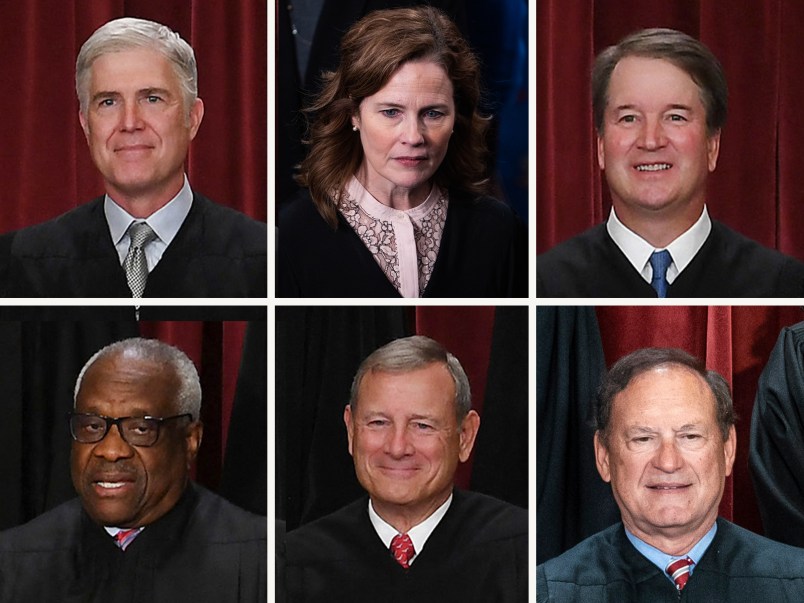
I read a group email from Capitol Hill yesterday essentially predicting the extinction of the Democratic Party after what is predicted to be a decision from the Supreme Court overturning what remains of the Voting Rights Act. A less apocalyptic but still daunting version of this argument appeared in an evening piece published by Nate Cohn in the Times. Before getting to the partisan and vote count implications, let’s first discuss what this means, which is essentially ending African-American political representation in the states of the old Confederacy. Most if not all majority-minority districts disappear and Republican state legislatures are free to draw up districts which spread/dilute African-American voters into safely Republican districts. Cohn thinks it’s plausible that Democrats could permanently lose (as much as anything can ever be permanent) 12 House seats. And this is on top of the strong-arm restricting happening in a number of states across the country. The overall scenario is one in which the House becomes an even bigger electoral challenge than the Senate, one that is possible to win but only in a generational wave style election.
Is this plausible? Is this true?
Let’s divide up the different levels of what we’re talking about. It’s been a given for a few years that the Court would return to limit or entirely overturn the Voting Rights Act. That’s not new and it’s entirely plausible.
The electoral implications are complicated, for reasons which Cohn discusses. You can’t fill up white Republican districts with African-American voters from majority-minority districts and not have some substantial impact on those Republican districts. This actually recalls an earlier generation within the Democratic Party and a reason why many Republicans were among the biggest fans of majority-minority districts. By creating majority African-American districts, state legislatures would create one or two districts that were overwhelmingly Democratic and represented by an African-American member. But the rest would be safely Republican. For Republicans back in the 1990s trying to build an enduring House majority, that was a great bargain. For present purposes, the salient point is that there’s an electoral fluidity and unpredictability to the implications of the constitutional monstrosity of overturning the Voting Rights Act. It allows a kind of gerrymandering that pushes up against the limits of the possible. Sure you’re going to abolish one or two Democratic seats but at the expense of making a lot of other seats less reliably Republican. Still, in electoral terms, the impact is stark.
What makes this especially dire for the future of civic democracy in the United States is that these are not ordinary times. This probable decision comes in the midst of an attempted autocratic takeover of the U.S. government in which elections are the only real recourse for the defenders of constitutional and democratic rule. The only way to set the course to a true constitutional recovery is for the opposition to achieve a trifecta and pass major legislation to reform the prime sources of unconstitutional rule, which starts with the Supreme Court.
I was asked about this last night and I had to respond in two ways. I’m temperamentally averse to claims of permanent majorities for either party into the indefinite or permanent future. It is, first, just a disempowering, self-womping way of looking at the world. It’s, second, just one that doesn’t square with my experience of how electoral history actually works, either during my lifetime or before it. I’ve heard of too many permanent majorities that flame out after one or two cycles. Coalitions are too fluid and the issues that matter to voters are too changing. It’s the most basic blindspot in human experience to project the current moment out into the indefinite future.
All of that said, these possibilities are real and daunting. And at least in the essence they’re not possibilities but probabilities. The Supreme Court is almost certainly going to overturn big parts of the Voting Rights Act. The only question is whether they leave a smidgen of it intact. That will free up one of the last remaining legal (if not in every case practical) restraints on extreme gerrymandering. And that will make beating back the scourge of autocracy and Trumpism even harder.
It also makes counter-gerrymandering like we’re seeing attempted right now in California essential for anything like majority rule to continue in the country. (A lot of what makes this so ominous is the assumption that Democrats simply won’t follow suit in states where they are consistently in the majority.) In fact, it’s not hard to imagine that we are moving toward a reality in which districts themselves become almost a polite fiction. You could gerrymander California in such a way that there were simply no Republican seats. It’s all a matter of how absurdly you want to draw the districts. You could do that in most reliable Blue or Red states. In that case, representation becomes mostly locked in, with minority party voters seldom getting the chance to be represented by an elected official of their own party. Change in that scenario only becomes possible in true wave elections. In the past this wasn’t really possible because there were simply too many contrary forces at work to make it possible — different factions in state politics, regional interests that cut against partisan interests. But when partisan polarization is strong enough it can override all those contrary factors.
I would be remiss if I didn’t again note that this entire story and possible set of developments is entirely attributable to the corruption of the current Supreme Court and its increasingly aggressive devotion to anti-constitutional rule. The through-line intent and plain language of the 14th and 15th Amendments to the Constitution are to protect the voting power and political rights of African-American voters. They were written to espouse and speak to broader principles about the rights and liberties of citizens of the United States. But they unquestionably aimed at this central and overriding purpose. The idea that they disallow legislation which protects the political rights of African-American voters is simply absurd. These decisions make the need for reforming the Supreme Court all the greater while also making the difficulty of achieving that end all the harder.
This certainly holds out the possibility that you have elections but elections that are essentially rigged in favor of the GOP and Donald Trump. I don’t think it will quite be that way. But it certainly adds new challenges to the opposition and the necessity of finding new ways to confront them.