


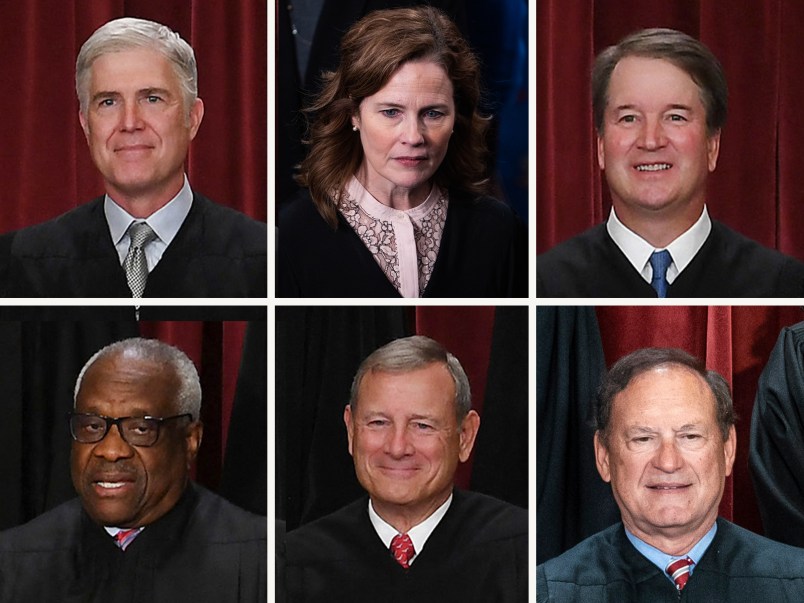
I’ve been beating the drums for years about reforming the Supreme Court to bring its corruption and anti-democracy to heal. In general I’ve avoided getting very detailed about what reform would look like for two reasons. First, there are technical details I lack knowledge about and which others are more able to address. Second, my focus is on building support for the premise, the necessity of reform. Getting too bound up or identified with really specific reforms can get in the way of that.
However, I get asked this a lot. So I wanted to explain the outline of the reform path that makes the most sense to me. I put this forward as a concept, with the understanding that some points might need fine tuning either for technical or constitutional reasons.
Let’s begin with the threshold issue. Regardless of the details of reform, I have seen no reform proposal that is at all serious which doesn’t include immediately adding new seats to the court. A total of 13 would have one justice per federal circuit court. There’s a logic and a history to that. But I’m not sure 13 is enough. In any case, there’s no serious reform that doesn’t first include adding justices because that is the only immediate way to break the corrupt power of the current majority.
The key additional reform would be to have cases heard by randomly selected panels of judges. So perhaps there are 20 justices on the Court and cases are heard by panels of seven. It’s a bit like how it works on the appellate courts, but there would be no en banc review.
Why would this be good? It’s critical to make the outcome of cases less predictable. At the moment, the right knows they’ve got five or six “sure thing” votes for basically anything they want that isn’t completely absurd on its face. Meanwhile, the corrupt justices know they are entirely insulated from any accountability. This uncertainty about who will hear a case reduces the incentive to game the process with concocted cases. More importantly, I think it creates an incentive for justices to render opinions which are at least facially reasonable and rooted in law and history. Otherwise a different panel might come back a year or two later and just undo your decision. Just as appellate judges don’t want to be overruled by the Supreme Court, I think this creates a similar incentive. If your decision is well-reasoned, responsive to Constitution and precedent, it’s more likely that future panels will at least operate within the structure of your decision even if they don’t simply rubber stamp it. On both fronts, these kind of randomly selected panels create a benign uncertainty and reduce the incentives for corrupt actions.
An additional advantage to this is that it reduces to at least an extent the problem with repeated Court expansions. If you’re dealing with panels of 7 or 9 or whatever number, it matters less if repeated expansions get the total number of justices to some crazy high number. I also think that this panel approach will be harder or less likely to undo. It goes without saying that a future Republican trifecta would likely add its own justices. I think the panels would be more likely to be enduring.
Two other reforms seem important. The first is some kind of term limit or mandatory retirement age. I’ve seen differing arguments about whether this is constitutional. This piece from The Brennan Center says the Court has already ruled that “senior status” for judges over a certain age is constitutional.
Finally, along with some sort of term limits or mandatory retirement age we should probably shift from a set number of justices to just every president (or perhaps every term since in rare cases two presidents can serve during one term) gets two Court seats. Combined with limits on the back end of service, this gets us out of the macabre and increasingly extreme death watch and 28-year-old justices system we’re currently in. It removes some of the randomness and game playing.
If you don’t begin with an immediate increase in the number of justices, it’s not serious. Because you end up with a reform which might have a meaningful impact in 10 or 20 years and might never even properly come into effect. That’s a non-starter in terms of time to wait and actual effectiveness. But some mix of all these reforms together gets you not only immediate relief from the Court’s out-of-control corruption but systemic changes that have a greater chance of being enduring. Just as important, you are decreasing the incentives to pack the Court in the way the Federalist Society and the GOP did and which got us here in the first place. Justices didn’t all used to stay on the Court until they died or saw the end coming. Many went on the Court and then left after five or six years. If you’re one of a couple dozen justices and you don’t sit on every case and you’re either term-limited or aged out after a while many won’t want to stay forever. There’s just less incentive. Today an Alito or a Thomas more or less runs the country. If you’re into power, why would you ever leave? The ultimate goal is to reduce the overweening power of the Court and the individual justices which make it up and thus reduce the incentives to corrupt it in the first place. There’s no perfect solution but these are a range of reforms which limit in significant ways the incentives for judicial corruption and abuses of power while providing immediate relief to the Court’s current corruption.
Second to last point: many politicians who say they support reform focus on Ethics Codes. Those are great. It would be good if the Court were given not simply a code but actually laws which would control justices’ behavior, barring cash bounties from billionaires, requiring disclosure and recusal. But none of this really touches the abuses of power which are the real current issue. Justice Thomas shouldn’t function as a kept justice with sugar daddies showering him down with goodies and cash. But those are just nice bonuses. He’d be just as corrupt if those judicial sugar daddies didn’t exist. So Ethics Codes and laws are great. But don’t be fooled into thinking they’re meaningful reform.
Final point: I’ve tried to sketch out broad brush reforms. People raise constitutional objections to one or more of them. That’s fine. Assume that I am anticipating fine-tuning these proposals to meet technical or constitutional concerns. I’m confident that they can be fine-tuned in ways to meet any substantive constitutional objections.