


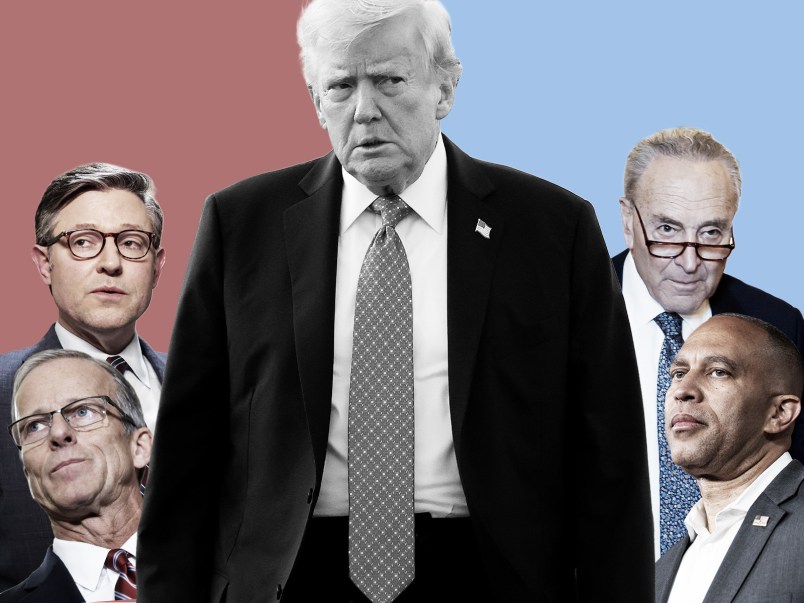
It’s always a complicated matter to say who is “winning” a shutdown fight. By one measure, no one “wins” since voters are unhappy with everyone and more generally the “system” for letting things get to such a point of dysfunction. Polls provide one of our most objective measures. But majority opinion isn’t always the terrain that one or both parties is playing to. What’s more, it may be fickle. If it doesn’t last until the next election, does it even matter? The real measure is who’s moving and who’s not, who is coming off their first positions, negotiating with themselves? By this measure — and in fact the others too — Democrats are pretty clearly winning the current shutdown fight.
Polls have been clear: more Americans blame Trump and the Republicans for the shutdown then Democrats. Every poll that I’m aware of has shown this. Republicans now say the latest polls show the blame divide narrowing in their favor. And it’s possible that’s true, though it could just as easily be noise in the polls. And in any case losing by slightly less isn’t exactly a big rallying cry. The real evidence is who is budging. The shutdown started with the White House saying it absolutely wouldn’t budge and threatening a big new round of layoffs to punish Democrats into submission. More and more evidence now shows that the firings threat was a bluff the White House feels unable to follow through on. As this has become more obvious, they’ve been forced to say that they’ve simply decided to delay the firings for no apparent reason. Even the elite media outlets which for days were passing on the White House threats as news are now, belatedly, seeing that it’s not happening, at least not yet. After failing to follow through on that threat, the White House and OMB moved to a new threat: no back pay. But that seems as empty a threat as the first one. In any negotiation or test of wills the failure to follow through on a threat always signals weakness. And these are no different.
But the clearest sign is on the core issue on which Democrats are making their fight: health care. As Jon Cohn notes, Democrats are winning this part of the fight hands down. The most eye-popping sign of that is that even Marjorie Taylor Greene has now endorsed their position on Obamacare subsidies. And it’s not just that. Republicans seem to have essentially no position on the merits of the health care question other than yelling about the shutdown itself. The extension of Obamacare subsidies extension is so popular that Trump himself has now twice gone off the handle and said he wants to cut a deal extending them or providing more health care coverage only to be reined in by White House staff or congressional Republicans.
Democratic leaders in the Congress have two constituencies here. They want to win the fight over public opinion. But they are also trying to recover credibility with their voters that was crushed in March. So they might have reasons to hold out, at least for a while, even if they were losing the broader public opinion war. But all signs are they’re not. And if anything, they’re upping the ante rather than squeezing their own demands to bring the fight to a halt.
For anyone who has eyes to see it, it’s Democrats who have the stronger hand here. The Trump White House doesn’t seem to have a clear card to play after they failed to compel Democrats to respond to their threats and then were unable to follow through on those threats. This is something so basic even grade schoolers know this story from the school yard. If you’re going to make a threat, you need to be ready to follow through. Or else you’re all talk and no one takes you seriously.
What we’re seeing here is something very basic to the first months of the second Trump presidency. President Trump has gotten very used to being all-powerful. He’s mainly operating in the domains in which a mix of executive power and judicial corruption/compliance have made him all-powerful. That is in the control over the payment of federal monies and to a somewhat lesser, but still real, extension of the domestic use of the military and ICE. He’s not all powerful here. And they seem to have gotten out of practice over how to handle a situation when that’s not the case. Once Democrats didn’t give way to Trump’s threats and showed the threats were hollow, what’s the next card? Maybe public opinion will turn against Democrats. As I said, there’s some possible early evidence of this. But it’s just as likely to be poll noisiness. And the challenge for the White House on that front is the public overwhelmingly favors Democrats on the health care position they’re fighting on.
There’s an additional dimension of this that we should pay close attention to. There’s an odd pattern you can see in this political moment. To the extent the outcome of a political question or fight is pre-determined, politics and news coverage of it ceases to exist. Or if it doesn’t cease to exist, it loses the vast amount of its electricity and impact. We see this most clearly in 2025 public corruption stories. There are countless public corruption stories out there right now. But do they matter? Are you as a reporter going to really dig deep into one and is your editor going to give you a lot of running room when it is an absolute certainty there will never be an investigation by the Trump DOJ? The Tom Homan story is almost the exception that proves the rule. The Feds already basically caught him totally dead to rights. And yes, this case is so totally bonkers that reporters are kind of razzing Trump and AG Pam Bondi and Press Secretary Karoline Leavitt about it. But even here, reporting is constrained by the iron reality that Homan won’t lose his job, let alone face any legal consequences.
This dimension of politics applies in legislative and DC politics as well. As long as the outcome is foreordained, the gas just drains out of the politics tank. This is why the Epstein story caught hold like wild fire during the summer. It really wasn’t the inherently shocking and provocative nature of the crimes. It was that people could see that it wasn’t clear the White House could control it. Then politics and media coverage, which to a real degree were in a sort of months-long coma, began to flicker to life.
That’s the same issue here. It’s easy to look all-powerful when you are in fact … well, all-powerful. Blue America and all its commentators and consultants and campaign gurus have never been sufficiently attuned to how Trump’s constant performances of power create this aura of invincibility around him which in turn makes him seem uncrossable. The Kimmel fight — despite being about a late-night talk show — began to pierce some of that bubble. The trillion dollars of health care cuts weren’t popular when they passed this summer either. But as long as the outcome was guaranteed, it was never going to get sufficient attention. No one wastes time watching a rigged prize fight. All political contest and all the news coverage that swirls around it are based on uncertainty and the fact that there’s always the new detail to be known. This is a big part of why this fight, regardless of the outcome, was so important. Democrats don’t just seem to be winning this political fight, at least for the moment. They’re bringing actual politics — contests of power and public opinion about which the outcome is unknown — out of its coma. And that makes everything look very different.