


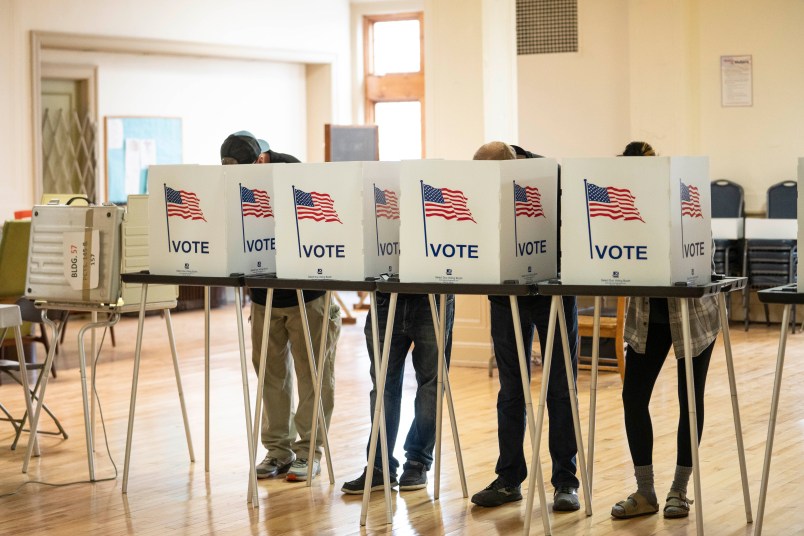
Last week, I read an article about the special primary election to replace the late Rep. Gerry Connolly (D-VA). The Post said the race was “animated by growing frustrations with the party establishment” and called the race “an early test of antiestablishment sentiment at the ballot box as the Democratic Party is caught in a tailspin over its approach to Trump.” (Emphasis added.) As it happens, I hadn’t known this primary was being held last weekend. (No excuses, just so much else going on and it was run as a so-called “firehouse primary” on an expedited basis.) The first I heard about it was from a handful of TPM Readers who wrote in to tell me about the surprising levels of energy and turnout they’d seen when they showed up to vote. This contrast caught my attention because it’s one that keeps showing up, paradoxically unremarked upon in almost all the election coverage we see.
On the one hand, the Democratic Party is “floundering,” “directionless,” “lost.” It’s approval numbers are bleak. And then, often in the same articles, you have all this evidence of voter intensity. Turnout. New activism. Lots of new people running for office. What seems like an apparent contradiction resolves itself if you get your terms right. I don’t think the Democratic Party is in a tailspin or floundering at all. In many cases, the elected leadership of the party is. But the elected leadership is not the Democratic Party. The Democratic Party is its voters. Especially it’s primary voters. This is just a signal understanding of what a party is and what constitutes its health or disfunction. I saw a headline a few days ago that was roughly, The Dems’ Latest Nightmare: Primaries As Far As The Eye Can See.
But that’s not a nightmare. Certainly not for the party. It may be a nightmare for some incumbents. But again, they are not the party, not in the most meaningful sense. They are most properly seen as the employees of the party. Or perhaps the executive leadership, which is accountable to a board. And the raft of primaries and threats of primaries show clearly that the bosses have, in that icily awkward phrase, decided to go in another direction.
As far as I’m concerned, the more primaries the better. A primary against a presidential incumbent can be damaging. The idea that it strengthens that candidate is, empirically speaking, nonsense. But the dynamics are different with congressional primaries, especially when it’s a general election in which the party will almost certainly have a strong electoral environment.
Of course, the danger with primaries is that you can end up saddled with candidates who are too extreme or ideological to win. But I don’t see a lot of evidence of that in the primaries that are coming into view or the candidates who are gaining momentum in fights for open seats. Voters in New Jersey and Virginia just chose two strong and electable candidates for governor. As I and many others have expressed in recent months, the hunger is not primarily for more ideological or left-wing candidates but for those who are willing to fight Trumpism and have the creativity to come up with novel ways to do that — fight! — in the current environment. That’s the anger in the Democratic Party. What are you doing? Why aren’t you fighting? Why aren’t you thinking outside the box more? Why are you overthinking norms and institutionalisms that have been yesterday’s news for a decade or maybe 25 years?
I’ve of course noted a few times my disagreements with Zohran Mamdani’s history of anti-Israel activism. And as I’ve written, I think it makes sense for him as a candidate to reassure Jewish voters who are troubled by that since New York City still has a pretty huge Jewish population. It’s purely practical: nuts and bolts. But none of that changes the fact that the campaign Mamdani ran had nothing to do with Israel or Zionism. It was basically 100% about cost of living issues. It was really effective. It turned out massive numbers of young voters (pull up the charts, it’s wild). He ran an extremely effective social media campaign.
There’s a huge amount that national Democrats can learn from his campaign. Of course, you can’t just take the model intact and drop it into other parts of the country. New York City is a very sui generis place. It’s a pretty left-wing city. Its demographics are very unique — not just almost every kind of people, but a huge percentage of them foreign born. It’s just very different in its basic political makeup from any other part of the country. But there are still really important lessons to learn from it. As I think Bernie Sanders said, the Democratic Party has spent the last six months saying “oh, how can we get young men and disaffected young voters to like us again?” Well, this guy just did that. Learn those lessons. I’m dubious about some of Mamdani’s proposed policies. But whatever. Tumult is good. One of the best things about America’s federalized system is that cities and states can be laboratories for change. Try it out. See what you can get through the City Council. See what works. Lots of things that were once seen as pie-in-the-sky and unworkable are now taken for granted. Experiment. Try new things. The focus on this one issue (Israel), which certainly has been flogged enough after yesterday’s Sunday Shows, shouldn’t distract from the actual campaign he ran and what Democrats can learn from it.
Through the Spring, there’s been a lot of frustration that congressional Democrats haven’t been able to figure out how to oppose Trump, how to focus attention on all the terrible things he’s doing, how to galvanize opposition. I’ve participated in a lot of this complaining myself, and rightly so. But wave elections don’t happen because the opposition party had great slogans. They’re almost always because of an interlocking series of structural factors — the election cycle — especially the first presidential midterm, the state of the economy and the public’s reaction to what the party in power is doing. Believe me, I want a more effective and more fighting Democratic Party as much as you do. But what we’ve seen from a range of different kinds of evidence — polls, town halls, protests, campaign activism — is that the public is deciding for themselves that they really don’t like what they’re seeing. Elected Democrats may not be doing enough to help that process. But voters are jumping into the breach and doing it themselves.
When things aren’t working right, you need tumult, even if it comes with some messiness. A lot of the weirdness of press coverage of the current Democratic Party, its goals, its abilities and its future get resolved if you have a clear set of definitions about who and what the Democratic Party actually is. The more primaries, the better. Basically every poll you see with the public standing of the Democratic Party at an historic low is based on Democrats and Democratic-leaning independents who are fed up with the party because they see it as ineffective and weak. That is about the elected leadership. And that anger and realization is a good thing, not a bad thing, because it shows that voters aren’t satisfied with the current party, the current elected leadership. They are, as they say, looking to go in another direction. And that’s great.