


On Saturday, watching the President’s birthday celebration/Army parade, I commented that it seemed like it was going so poorly and Trump seemed so grumbly that I was afraid he might occupy a few more cities with the tantrum he was going to throw as a result. Of course, “going poorly” can mean a lot of different things. I didn’t watch a lot of the parade. But the moments I did catch gave me some reason for confidence in the durability of the America I know. The soldiers manning the tanks trundling down the city streets were all smiles, waving at the admittedly sparse crowd, saying “hi” to kids. I don’t think that’s the kind of parade Trump wanted. That’s not what a strongman’s military parade looks like. The soldiers are impassive. Their eyes are fixed on El Jefe. This wasn’t that.
And I wasn’t wrong about the tantrum.
On Sunday night, Trump — or rather “Trump,” since the post was very clearly not written by him — posted a lengthy “Great Replacement” message pledging to intensify and expand “efforts to detain and deport Illegal Aliens in America’s largest Cities, such as Los Angeles, Chicago, and New York where Millions upon Millions of Illegal Aliens reside.” These cities, he went on, “are the core of the Democrat Power Center, where they use Illegal Aliens to expand their Voter Base, cheat in Elections, and grow the Welfare State.” From there, he went on to go after the “Radical Left Democrats” who are “sick of mind, hate our Country.” It’s all of a piece with Kristi Noem’s claim that she and the White House have brought the National Guard and Marines to Los Angeles to “liberate” it from the sovereignty of its own citizens.
This leads me to the point I want to make about our ability to hold two things in our heads at once. These are horrid, degenerate comments, a pledge of domestic war against America’s own great cities and their right to govern themselves. But Trump is also losing this fight in the one forum that matters, the battle over public opinion. That’s the reason for the tantrum, trying to control the narrative by upping the ante and drowning out all the signs he and his corrupt actions are being rejected by the public.
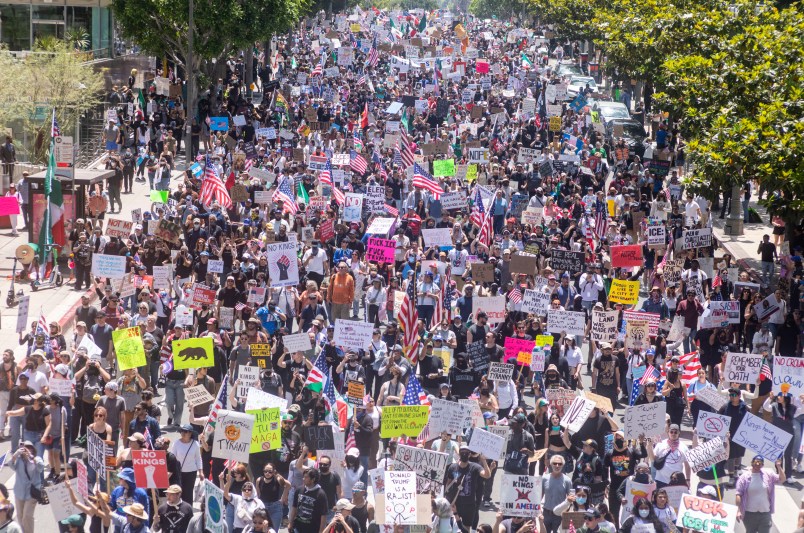
It’s hard to quite capture the scale of the “No Kings” protests over the weekend. Current, conservative estimates put the turnout at between 4 million and 6 million people, decentralized and actually avoiding any effort at the center of the action in Washington, DC. It wasn’t just overwhelmingly peaceful but generally buoyant. And it’s not just demonstrators, who in theory might amount to a tiny but extremely motivated minority. Polls show the President’s support tanking in a way that is comparable to the nadir of voter panic over his tariffs.
Notably, Trump’s support is falling specifically on his deportation policy. This has shown up in a number of polls over the last week. But I wanted to focus on a poll that came out this morning from G. Elliott Morris’ Strength in Numbers site. The poll shows Democrats with an 8 point lead on the generic ballot and Trump at 40% public approval (56% disapproval). On specific issues he’s underwater basically everywhere. But I wanted to focus in on immigration because it’s a catchall that tends to obscure more than it illuminates. When Stephen Miller first pushed ICE to dramatically up the pace and intensity of its raids, many argued that this was perilous ground for Democrats since Trump is typically strong on “immigration.” But the details, again, are revealing. On “Border Security” he remains popular: 53% support to 42%. But on “immigration” he’s underwater by 3 points and on “deportations” he’s underwater by 4 points, 46% to 50%. This poll doesn’t look specifically at Trump’s militarization orders. But other polls I’ve noted show the military deployments in Los Angeles are distinctly unpopular. The American public is down on everything we’ve seen over the last ten days.
A lot of the public conversation among Trump critics has gotten hung up in this dichotomy about how to respond to his provocations. If we downplay them, are we “not listening” to what his real plans are, remaining oblivious, caught in happy talk, not recognizing the direness of the crisis we are in? What the idea amounts to is that we are not taking him seriously if we are noting his failures, his declining public standing, the rejection of his pretensions and, in many cases, his cowering in the face of public pressure. That can’t be right. It’s an understandable, or perhaps well-meaning impulse but it amounts to a perverse enlistment in Trump’s own domestic propaganda campaign. There is plenty of danger and awfulness around for anyone who wants to dig into the harrowing situation the country is in without going down that route. Barring some wildly unexpected event, we won’t be free of Trump for years. Even with a shattering midterm rebuke Trump will remain with his awesome bundle of executive powers for more than three more years. But the public rejection of both his tactics and his goals is very clear. And that is the variable — public opinion — that is currently in play.