


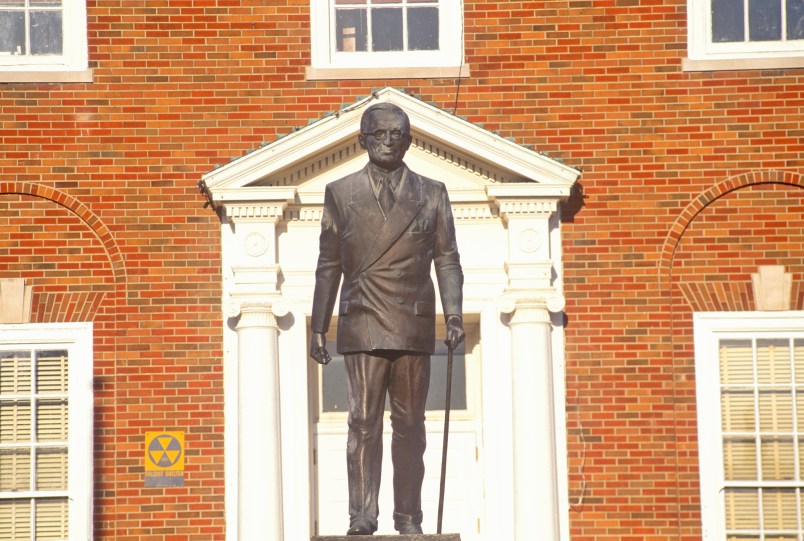
As you can see in my most recent post, yesterday evening TPM Reader BC flagged this news out of Independence, Missouri, best known as the hometown of Harry Truman. A city councilman, John Perkins, got canned in a recall election over a data center and by a massive margin: 68% of the town’s residents voted to end Perkin’s term immediately. It’s all backlash from the town’s approval of a major hyperscale AI data center on which construction is now already well underway.
While this is just one city council race, the broader metastory and this particular development sounds like one of the ur-stories of the 2026 midterm cycle. It coincides with and is related to the backlash against Donald Trump and all his corruption and wrongdoing over the last 18 months. But it’s only in the last three or four months that the AI data center story has fully broken into the national headlines. For all these reasons, I wanted to dig in and find out a bit more of the details. It’s really quite storybook in a kind of made-for-TV-movie dystopian kind of way.
Here’s the story as I understand it.
Back in 2022, Independence made an agreement with a commercial real estate developer, NorthPoint Development, to build what sounds like a pretty unremarkable mixed-use industrial park. Then, sometime in the second half of 2025, a Dutch data center company called Nebius, which itself was spun off in 2024 from a big Russian tech conglomerate, started negotiating with the city council over building a data center. There appears to have been a significant period of time, maybe six or more months, when the city councilors were negotiating with Nebius without any public notice about what was going on. In December 2025, Nebius bought 400 acres inside the industrial park from NorthPoint Development. Since that was within the already zoned area, Nebius didn’t need any public input on that. It was just that the industrial park, which had been conceived as housing numerous small operations, now had one big operation, Nebius. (I’m getting a lot of this timeline from this article in the Kansas City Defender.)
The city announced all of this in December 2025 just after Nebius purchased the land from NorthPoint; pretty quickly it generated significant opposition. But remember, this is almost a year ago. There was opposition brewing in various communities. But there wasn’t a lot of general awareness that similar things were happening in lots of communities across the country. Critically, the city was planning to use a Missouri state program and its own municipal agreement with Nebius to give the company a 90% tax abatement to build the facility — a benefit of roughly $6.26 billion in forgiven taxes for Nebius over 20 years. On the plus side, according to the city’s estimates, the facility is expected to create about 130 permanent jobs and about 1,300 during construction. In May, town councilor Cody Atkinson said: “At full build out, this project is expected to bring in about $30 to $50 million for the city on an annual basis. That would be, on the higher end, a 60% increase in our budget and revenue.”
There are various reports of city residents first finding out about the project when a fleet of trucks and earth-moving vehicles rolled into the city. So there’s a lot of atmospherics around this that felt like all the big decisions had been made before residents even found out what was going on. If I’m understanding this right, Nebius didn’t need any approvals to bring in the heavy machinery because they were just building their facility in the industrial park.
It’s hard to put it all in context based on the publicly available reporting. But basic concerns about where all the power is going to come from do sound a bit TBD. This passage in the February Defender article caught my attention (emphasis added) …
To power the Nebius data center, the Dutch company will be working with Independence Power and Light to reopen a power plant at the site of the decommissioned Blue Valley Power Plant, which was closed in 2020. When Blue Valley was operational, it could generate up to 90 MW of energy, so changes will need to be made so it can handle the needs of the data center, which are more than tenfold.
In construction terms, I would say “changes will need to be made” is a heavy-load-bearing phrase in this context.
In any case, here the timeline gets very interesting and illustrative.
The big decision for the city was approving the massive tax abatement. Nebius made clear: no tax abatement, no deal. That was the key approval and the city council approved that, already in the face of significant opposition, on March 2, 2026. A month later, two city councillors lost their seats over the data center. Bridget McCandless was running for mayor, considered a shoe-in and lost. Jared Fears was running for reelection to his council seat and also lost. City residents tried to hold a referendum on the deal but a judged rejected the referendum idea. In July, the city council voted 7-0 to pause data centers in the city for six months. This seems like it was probably pretty symbolic. It didn’t apply to the Nebius data center where construction was well underway. And presumably this pretty small city (just over 120,000 residents) wasn’t going to build another $150 billion data center any time soon. But the message was pretty clear: data centers were kryptonite in Independence. That brings us down to last night when Perkins, the third of the five councilors who approved the Nebius project as recently as March, got booted.
And that, as far as I can tell, is where this all stands. It’s a fascinating microcosm for the larger data center story. If a city’s annual budget is going to increase by 60%, possibly, that’s not nothing. What I haven’t focused on as much here are the transformational changes to the city itself and the range of environmental questions and dangers it raises. While looking into this, one thing that occurs to me — and this certainly is a throughline in much of the broader data center story — is the mismatch between the size of these industrial concerns and the pretty small, often part-time city governments making the decisions. That can sound patronizing and maybe it is. And with this now a big national story, maybe it will lead to too-hasty decisions in the other direction. But the mismatch is palpable, with the money, resources, international heft on one side and, like I said, a part-time city or town government on the other. Certainly before data centers became a big national story, you can see how a lot of deals got rushed through with pretty limited guardrails or even much clarity over what those should be.