


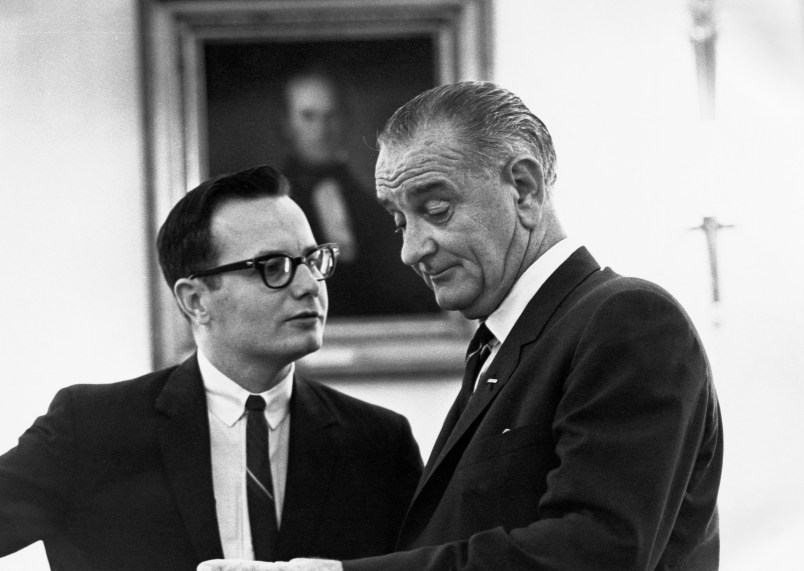
Bill Moyers died last week at the age of 91. TPM Executive Editor John Light worked for Bill for a number of years and has written this remembrance of him which I recommend to you. I wanted to share some additional thoughts about Bill and how his life affected my own and the life of this site.
The first thing I want to mention is two documentaries Bill produced in the late 80s. Joseph Campbell and the Power of Myth is a series of six one-hour interviews with Campbell, who died shortly after the interviews were completed. The second is Amazing Grace, his documentary about the history and life of this song, so embedded into the cultural and spiritual life of the Anglophone world. College is a time of promise, adventure and challenge for many people. And I encountered the first of these at a moment of particular challenge in the summer of 1988. Amazing Grace debuted in 1990. I haven’t watched either in many years, though I own a copy of Amazing Grace. They explore common themes from very different directions. Both showcased Bill’s ability to bring fascinating, human issues to life in ways that are both sophisticated and accessible to a mass audience.
The first time Bill impacted my life in any direct way came about a decade later when he would have had only a passing familiarity with me at most. At the beginning of 1998, I started a job at The American Prospect, briefly as a writing fellow and then as associate editor, a challenging but formative three-year introduction to political journalism. Bill’s long success in television journalism must have made him a wealthy man — but not, as far as I know, philanthropic donor-levels of wealthy. What he did have, however, was the guiding hand at a major philanthropic foundation, which allowed him to direct substantial sums to projects and causes he deemed worthwhile.
Sometime not long after I started at the Prospect, co-editor and co-founder Bob Kuttner had begun talking to Bill about what turned out to be a major, multi-year, multi-million dollar series of grants which was to be used to overhaul our operation. We were to go from (if memory serves) a 10 issues-per-year, Cambridge-based small political magazine to a biweekly publication with a DC office, larger budgets, and more visible place in the national political news conversation. (Kuttner and Moyers seemed to have been friends of longstanding.) That was the chain of events that brought me to Washington, DC in 1999 and in an important way made TPM possible. That multi-year plan didn’t live up to expectations and the Prospect was eventually forced to retrench. But history is long. And I think it’s fair to say that the Prospect is more influential today than it has probably ever been.
I didn’t cross Bill’s path again for eight years. I don’t think I ever had any interaction with him when I was at the Prospect. He did an episode of his show about new media featuring interviews with Jon Stewart and me. I had remembered this happening back in 2002 or 2003. So much for memory. It happened in 2007 and was in response to the US Attorney firing scandal. Bill’s validation and appreciation was very important to me. I had remembered this happening at a much earlier stage in the site’s history, as I said about five years earlier when the site was much less well-established. I may have telescoped in my memory just where my head was about the whole operation at that time.
That began a handful of occasional conversations that stretched over almost 20 years. A key thing that made Bill such a resonant documentarian and TV journalist was that his manner embodied a geniality and openness of mind and spirit that communicated transparency and good faith. He was that same on-camera person in every interaction that I had with him.
We had various conversations about working together over the years. There are legal and ethical ways for a charitable foundation to work for a for-profit company. As opposed to a grant you contract to do a certain kind of work, just as a foundation might contract for other services. But both Bill and I from our own respective perches were always focused on it not only being legit but structured in such a way to address any possible concerns. Purer than Caesar’s wife and all that. Put that together with the other questions of just what we wanted to work on together and nothing ever came of it.
The most serious discussion of it was back in 2018. This was back when we were throwing everything — and I mean everything — into our transition from an advertising-based business model to a subscription-based business model. Really “transition” makes it sound far too considered and bloodless. It was a “transition” in the sense of building a new jet engine from spare parts at 40,000 feet because the current engine is stalling and disintegrating and you’re losing altitude fast. Bill proposed the idea, but when he finally brought it to his board they decided that the legal issues it raised were complicated and they’d want to do more research and legal work to make sure everything was done just right; basically, it was more work than it was worth. When Bill told me this, I told him, quite honestly, that I was disappointed of course but also at least as much relieved. Like him, I didn’t want to do anything that there could be the slightest question about. Lots of for-profit companies abuse captive nonprofits, and while what we had in mind was nothing like that, I was not entirely comfortable needing to explain why it was different. I explained this to Bill, and thanked him for proposing the idea. He replied with a note that meant a great deal to me. “Thank you for those generous words. I noticed long ago that you bring a generous spirit to your work, to your take on the world (despite seeing it for what it is), and the people around you. You have chosen a herculean task – to succeed financially with independent and serious online journalism, and so many of us wish you well.”
I’ll take it!
There was one thing I didn’t mention and I’m not sure I had connected the dots in my own mind. But Bill had played a paradoxical and indirect role in TPM being a for-profit company in the first place. My time at the Prospect was jarring as well as being very formative and educational. But one thing I took from it was being very viscerally skeptical of nonprofit journalism. I want to be clear that nonprofit journalism has had an efflorescence and a necessary one in the years since. There are lots of vital nonprofit newsrooms today doing incredible work. So don’t take this as casting aspersions on a whole business model. This was a certain kind of nonprofit journalism in a specific place and time (quite different from the present one) and one young aspiring journalist’s impressions and reactions to it. That experience was that it reduced our reliance on our readers. They weren’t our real customers. The foundations and the foundation grants we received to fund the operation were our real customers. To be clear, I don’t mean that in any inappropriate or corrupt way. But those foundations were interested in supporting certain kinds of journalism, journalism on certain really important topics. It was all God’s work and really legit. But I wanted to do something different. I wanted big headlines that would sock readers between the eyes and be impossible not to read. I wanted to publish things that were fast-paced and addictive. The validation was reader interest. If they weren’t interested, it wasn’t above them. It was boring. I didn’t want to be boring.
I did hear from Bill one last time, on October 18 of last year, three weeks before the election. Seemingly in response to this post, he wrote: “JOSH: Do you have the budget to do what you want to do between now and the election?” It was very Bill. I learned something else in this exchange over several emails. He mentioned matter of factly and almost offhandedly multiple visits to Sloan Kettering and to an emergency room which delayed emails or explained what was occupying him. So I knew he must be in poor health and perhaps coming to the end of his life. I told him: “Hi Bill, First, wonderful to hear from you. I never want to say no to more funds. Since it’s like nectar from the gods. But I’m skeptical that we can absorb more money to put to good use pre-election. But given the stakes lemme mull for a few hours and I will circle back. Josh”
As I figured, nothing came of this new suggestion. But as I said, it was very Bill. Very old. I assume likely very enfeebled and very sick and yet still plugged into current events, brainstorming, seeing what might be possible, what could be done as the tsunami approached. The last time I heard from Bill was two days after the November election. After an update about another hospital visit and some other particulars he signed off with: “Let the offer stand for now and we will regroup.”
It was a pleasure knowing Bill for all the reasons I note above — that was both for his stature and role in the politics and journalism of the late 20th and early 21st centuries and also his connection to history, which to me was a background and wisdom that radiated through everything. He was literally there right at the center of power as Lyndon B. Johnson built the Great Society, tried to fight the Vietnam War, all the epochal moments of the mid-60s, and that was after being a top staffer when Johnson was Senate Majority Leader in the 1950s. He knew and was a confidante of all these people who we now only know walking on the pages of history, a connection to so much history and tumult. He knew all of them. He was part of those decisions and that action. His confidence in what we do at TPM mattered way more to me than any project we might have worked on together.