


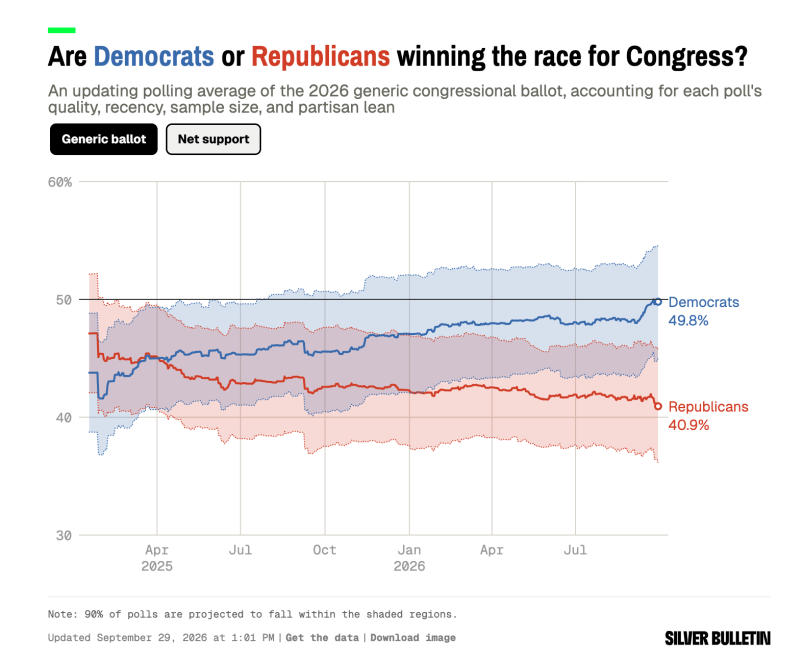
As I noted a week ago, we can’t know whether the current polls will be predictive of the November election results. But the polls themselves are at least speaking with a clear voice. I want to note two things that appear to be moving in unison: consumer confidence and the Republican position on the national generic ballot.
Here’s the trend line from Nate Silver’s Silver Bulletin …
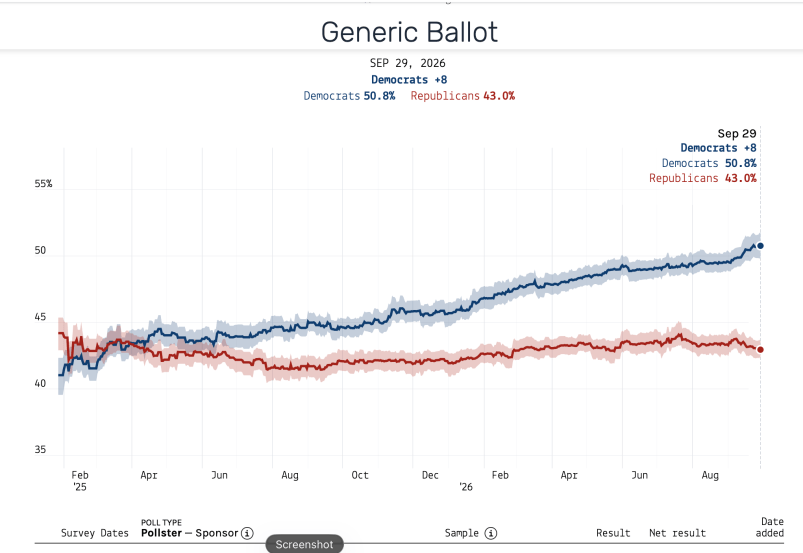
This is from G. Elliott Morris’s FiftyPlusOne site. The smoothing is different and the shift less stark. But it’s there too.
That shift happens right around Labor Day. Like almost to the day, around Sept. 8. The Conference Board’s consumer confidence survey came out on Tuesday and showed a sharp drop in September. It’s been trending down, with some significant blips, since the beginning of the pandemic. So that is not new. But the steep shift, in electoral politics terms, looks like a disaster for the GOP. That, along with parallel election indicators, are certainly what shifted Republicans into a panic starting a couple weeks ago. And it’s hard to ignore how closely the two measures things line up.
Of course, we know that it’s not solely consumer confidence that drives political opinion. Political opinion can drive consumer confidence. Notwithstanding the downward trend, confidence picked after the 2020 and 2024 elections, only to start right back down. In a way, it’s an act of condescension to think that for it to be “real,” consumer confidence has to be separate from politics. If you’re a sane person watching what’s happened over the last 20 months, your view of the economic future isn’t going to be limited to your own employment status and what you see yourself about price stability. It’s also true though that there is a human, cognitive need to keep political sentiment somewhat in line with economic reality. Conventional wisdom states that it’s only around Labor Day that a big chunk of the population really starts to focus on a national election, especially a midterm election. (There’s more sustained attention during a presidential year.) If you’re a floating voter, who voted for Trump in 2024 but isn’t terribly attached to him, perhaps you gave the whole thing a good think over the last few weeks and just decided: This isn’t working. I’m voting a straight Democratic ticket. That might sour your assumptions about the economic future. Your need to think that Trump is doing something right just disappeared.
But let me suggest a more economics-tied explanation.
The general argument going back to the early post-pandemic is that the economy is actually doing quite well (near full employment, steady if not remarkable growth). A colleague just pointed that if you look at labor force participation rather than the headline number, the story looks pretty different. But let’s set that aside. This goes back to the issue of AI. Needless to say, the illegal and economically crazy tariffs plus the Iran war have put lots of upward pressure on inflation, especially things like fuel costs. But there’s also the AI boom. The AI boom is essentially running the economy hot. It’s creating general upward pressure on prices with particular pressure on computer hardware, electricity and other commodities. But that economic heat isn’t showing up in wages. It’s creating vast amounts of wealth. But that wealth, because it’s in the equities markets, is heavily, heavily tilted to the wealthy.
It’s been a constant refrain on the left and also center-left for a long time that the benchmark economic indicators no longer line up with the real state of the economy for regular people. That tends to ebb and flow with who is in power at the particular moment. But the AI boom looks like a particularly apt example of that, running the economy hot, putting upward pressure on prices, but in a way that generates very little upside for the great majority of the population. And even though “jobless due to AI” doesn’t show up that clearly in statistical terms, a whole generation of people under 35 have been told pretty convincingly (whether it’s true or not) that there’s no career option that won’t be hit by massive job losses in the near future. And if that’s not enough, we’ve just had a month-plus of saturation coverage about AI and human extinction. If humans are extinct, let’s just say that’s a huge hit to the economy. So I don’t think it takes a lot of imagination to think that AI — both as a lived economic reality and a prediction — is weighing down consumer sentiment a lot.
Of course, these points are speculative. Whether they explain very near-term shifts is questionable. Perhaps this sharp downward shift in sentiment — about the economy and Republicans — is overwhelmingly or entirely about that series of interlocking factors that led gas and diesel prices to surge which began in late August (again, coinciding perfectly) and continued through September. In political terms, what’s relevant is that the political winds shifted or intensified right at the worst time for the GOP.