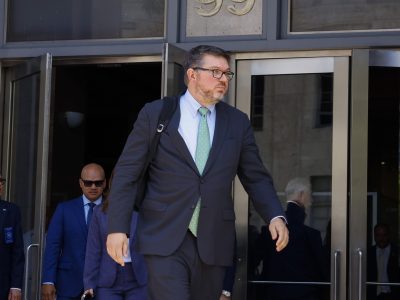

This morning the full D.C. Circuit Court of Appeals heard oral arguments on whether the Trump administration will be subject to a contempt of court inquiry for not stopping and turning around the deportation flights in the original Alien Enemies Act case, which began way back in March 2025, when the Trump administration sent more than 200 Venezuelan men to El Salvador’s CECOT prison.
Each side — the Trump DOJ and the ACLU — was given 30 minutes, but the oral arguments ended up lasting nearly three hours.
The top line: The en banc court is likely to rule against the Trump administration and allow U.S. District Judge James Boasberg to proceed with a contempt of court inquiry.
That would represent a dramatic about-face from an earlier 2-1 decision by a three-judge panel of the appeals court, in which two Trump-appointed judges shut Boasberg’s inquiry down hard. It would represent a vindication, albeit very belated, of the rule of the law. For that reason, litigation stemming from the CECOT deportations has been among the most closely watched of what is now hundreds of decisions across dozens of cases that were defied or violated by the Trump administration. Most but not all of them came in challenges to Trump’s mass deportation operation.
The most compelling part of the oral argument came when the ACLU’s capable attorney, Lee Gelernt, recounted the panicked and harried events of the weekend of March 14-16, 2025. Word began trickling in that Venezuelan nationals in ICE custody were being moved without notice. Rumors began flying that an Alien Enemies Act proclamation from President Trump was imminent.
There were some nods and winks but no confirmation from the administration — and in fact some active misdirection from administration officials and lawyers, too. The proclamation, it would turn out, was signed a full day before it was made public. We know now Emil Bove, the DOJ’s acting No. 3, was telling department lawyers that the planes would be taking off no matter what and they might have tell the courts “fuck you.”
ACLU lawyers began hearing reports that deportation flights for the AEA detainees were or would soon be underway. During a critical emergency hearing in front of Judge Boasberg in the late afternoon that Saturday, Gelernt recounted, the reports of the flights departing became more urgent.
It was against this backdrop that today’s oral argument zeroed in on the Trump DOJ’s flimsy, implausible, and unreasonable arguments for why Judge Boasberg can’t hold the administration to account for refusing to turn around the planes: That his oral orders didn’t count; that his written order was ambiguous; that his orders weren’t violated by the administration; that he doesn’t have the inherent power to investigate the administration’s conduct; that he must take administration officials’ bare denials at face value; and so on.
The two Trump judges on the panel who originally blocked the contempt of court inquiry — Neomi Rao and Justin Walker — sat for today’s full court hearing. Rao, in particular, did a lot of clean up for the administration and was the hardest on Gelernt. But the hope all along has been that the seven Democratic-appointed judges sitting today would overwhelm the four Republican appointees.
The only thing the two sides agreed on was that the appeals court should rule not just on whether Judge Boasberg has the authority to conduct a contempt inquiry but also on whether his orders were clear and unambiguous (the earlier Rao-Walker panel held that they were not). At least in that way, the case wouldn’t have to come back to the appeals court yet again for a separate ruling on that question.
And yet … justice delayed is justice denied, and in many respects the moment for vindicating the rule of law in this case has already passed.
The D.C. Circuit has hamstrung Judge Boasberg for the better part of 17 months. In addition to overruling him, it has taken its own sweet time slow-rolling the case, ping-ponged it back to him, and failed to have his back even as the Trump administration has used the case to undermine the judicial branch and threaten the constitutional order.
In an alternate universe where the appeals court rose to the moment in the Alien Enemies Act case, its timely and decisive intervention might have headed off a year and half of executive branch defiance of the judiciary. Because this case was the early marker for Trump’s rampage, it could have drawn a line in the sand. Other judges in other courts could have used the precedent in this case to hold that line.
In this counterfactual, the administration’s contemptuous behavior would have been called out, addressed, and rebuked before it it engaged in contempt across a range of other cases, especially in habeas cases that flooded the federal courts when the mass deportation operation zeroed in on Los Angeles, Chicago, and the Twin Cities.
Its misconduct would have been on the record, documented, and already serving as a strike against it, like a prior conviction at sentencing. Instead, judge after judge in court after court for months and months gave the administration the benefit of the doubt until finally their patience began to wear out from the sheer scale and relentlessness of the transgressions.
Back in the real world, the calendar is unforgiving. Kristi Noem is long gone as DHS secretary. Bove now sits on the Third Circuit Court of Appeals. The Venezuelans shipped to El Salvador’s CECOT and eventually repatriated have scattered to the winds. Even if the full appeals court ships the case back to Judge Boasberg to pursue a contempt of inquiry, nearly half of Trump’s second term will have elapsed before the real accountability even starts.