


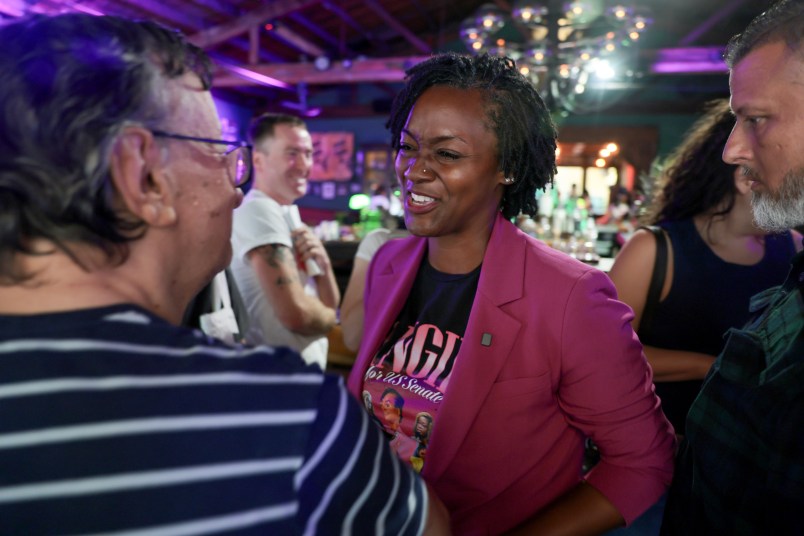
I want to flag this poll for you. It’s a poll of the Florida Senate race by St. Pete Polls, a mid-tier regional pollster. It shows appointed incumbent Senator Ashley Moody (R) and Democratic nominee Angie Nixon tied at roughly 45% of the vote. There’s not much polling of this race. There are two other recent polls, one by Change Research a respected but generally Democratic-aligned pollster, and another from Quantus Insights, a GOP-aligned pollster with an iffy reputation. Change Research had a tied race a week ago. Quantus had Moody up by eight points a bit less than a week ago.
I want to be clear that I am not predicting or expecting Nixon to win this race. What I do expect is that Republicans will likely need to fight to hold it. And that is significant in itself. There are other signs that Republicans are facing a rough political environment in Florida this year, at least one that looks very different from where Florida has been trending since 2018-20 when the state went from a GOP-tilting purple state to something approximating bright red. Yesterday, Nicole LaFond highlighted the video put out by South Florida Rep. María Elvira Salazar (R-FL) which basically had Salazar telling Donald Trump: We didn’t know you meant mass deportation when you promised us mass deportation.
We can joke about the the substance of Salazar’s video but it speaks for itself as a measure of the political climate in the state.
A few more points.
One is that if you haven’t seen much of Nixon, she’s a really strong candidate. That’s not the same as being a match for the state. Certainly no establishment Democrats in Washington would have thought a left-leaning state lawmaker who recently joined the DSA was who they wanted as their candidate. But watching her in various TV interviews over the last month or so, I would say she is far and away the most able of the whole crop of DSA member or DSA-adjacent Senate candidates this year. That’s a mix of not pinning herself to equivocating about the national DSA’s really unpopular positions — the way any good politician is able to not get bogged down discussing their less popular positions — but also explaining her positions and goals in ways that resonate with a broad cross-section of the electorate. So that is an important part of the equation.
The other question: is Florida changing its political stripes? The simple or quick answer I’d go for is certainly not. But even really conservative states will shift off their electoral baselines in a Democratic wave type environment. Even states like Kansas and Nebraska and even possibly Mississippi are looking like they might conceivably be in play. Obviously we’re not thinking these states are trending blue. That’s just what happens when Republicans are in a terrible cycle. Water pours over the standard levees and even the tall ones can give way.
Still, we should remember that some of the shifts in Florida are very recent and involve decisive shifts in what were heretofore pretty strongly Democratic parts of the state like South Florida — big shifts in non-Cuban Hispanic voters, young voters. Most people have assumed those represent an enduring realignment. But that’s never been that clear. At a national level, there was a huge amount of commentary after the 2024 election about how Hispanics, young Black voters and young voters generally were moving to the right. That was always highly questionable. It looked a lot more like dynamics specific to the 2024 election. Recent polling suggests those demographics have not only snapped back, but done so in a way that can be distinguished from Trump’s general unpopularity which is affecting almost every demographic.
I’m no expert on Florida politics. These latter points are speculative. I suspect the general trend in Florida will remain. But in this cycle, we seem to be looking at much more competitive statewide races than most people expected. It’s best to just think of that as the reality of the political moment where Trump and everyone connected to him is carrying a really heavy political burden. It’s no surprise that would happen in a state like Florida which had become consistently Republican (GOPs winning the statewide races consistently) but never deeply Republican (winning by big margins.)
I think we should put the Florida race in the not-impossible category — the kind of contest that becomes possible in a real tsunami scenario.
This is an unpaid cross promotion from our friends at Popular Information: Are you curious about what politicians are funded by major corporations? Would you like to know how money impacts important policy decisions? Would you like to peek behind the curtain of DC’s influence game? If you answered yes to any of these questions, we recommend signing up for Popular Information, an independent newsletter dedicated to accountability journalism.