


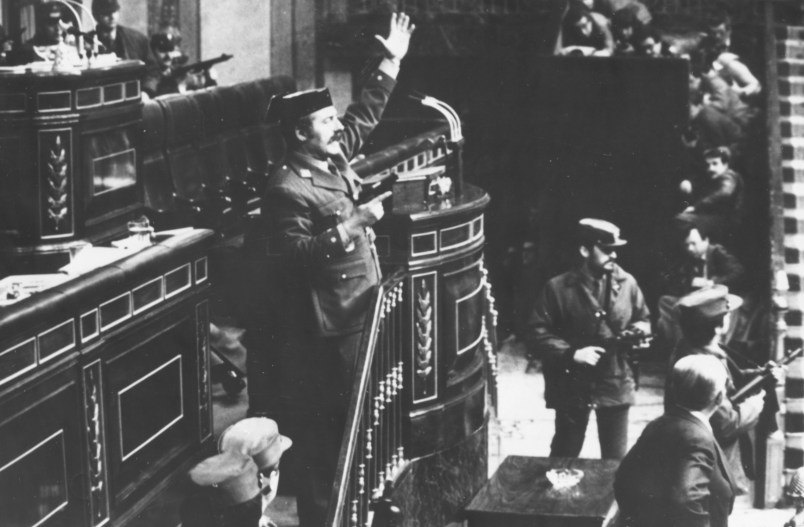
Yesterday I was kind of randomly rereading some details about Spain’s transition to democracy after the death of Francisco Franco in 1975, as one does. And I noticed that Spain had finally released the last classified documents tied to the attempted coup of 1981. The non-disclosure of these documents had helped maintain various conspiracy theories and counter-narratives about whether King Juan Carlos played quite the heroic role history has assigned him. In brief, Franco groomed Juan Carlos to succeed him believing he would maintain the Franco-ist dictatorship. But Juan Carlos quickly set about putting Spain on a path to democracy and when Francoist dead-enders in the army mounted a coup in 1981, Juan Carlos famously went on television, denounced the coup, thus leading to its total collapse. The counter-argument or claim is that Juan Carlos knew about the coup or perhaps even supported it and only pulled the plug when it looked like it was failing.
The release of the documents was just this last February. And they basically confirmed the established story, that there was no reason to believe Juan Carlos knew about the coup in advance and acted decisively to undermine and bring it to an end. But it was a small note in the Times article I read about this that got my attention: one of the reasons for the release, overseen by Spain’s current center-left government, was to combat historical revisionism and growing nostalgia for Franco among young men.
Sound familiar?
This points us back to a reality which gets too little attention but which also requires a dual approach that is challenging to get just right. We hear a lot about how Democrats need to have podcasts to appeal to young men, how their brand is toxic across rural America. In 2024 the story, as noted in the previous post, was that Democrats were even losing ground with Hispanic voters, to, of all people, Donald Trump. These points are all true, though the point about Hispanic voters was likely premature. But the general explanation is that the leading Democrats are hapless, that the party is in the thrall of the mercenary consultant class or a bunch of other explanations. But again and again we see that the same basic patterns are cropping up all over the world.
What this means pretty clearly is — while Chuck Schumer and the consultants may suck, it’s probably not really about them. It’s about something more fundamental, a crisis of liberal democracy which we have to try to solve even though we only dimly understand it. Yes of course there are theories and one or the other of them are probably partly right. But this isn’t about criticizing theorists. It’s about living in history, when the things really driving change are seldom that clear to those living amidst the change.
The danger here is that we collectively fall into a kind of self-disgust which I see all the time. Our leaders suck. We suck. We’re weak and hapless. The political faction or movement I belong to sucks. These all flow rather naturally from most of the mainstream media narratives about whatever challenges Democrats are facing at a given moment. And this is of course enervating. Or it can be. And it can promote conflict which is not necessarily productive conflict.
And yet just because it’s happening in Spain and in countless other similarly situated countries doesn’t mean we can say, “Welp, it’s bigger than us. That’s just how it is. Nothing we can do about it.” Obviously the challenge is still the same for any of us who believe in liberal democracy, in freedom and general human flourishing. In fact the challenge is probably greater because it’s not just some incidental thing that’s going to be solved in time for the next election — better consultants, no politicians over 65, politicians who will fight. It’s big and goes beyond any single person’s mistakes or individual excellence. And this is what I mean by a dual approach, the necessity of not falling into a kind of cheap and demoralizing self-critique while also recognizing that it is very much our responsibility to have the creativity, forcefulness and resilience to do something about it. In a way it requires us to understand our situation both from outside of history, looking at it from the long view, and also very much inside it, in the moment, with every action and option on the table, with every decision mattering because we don’t know how the future turns out.