


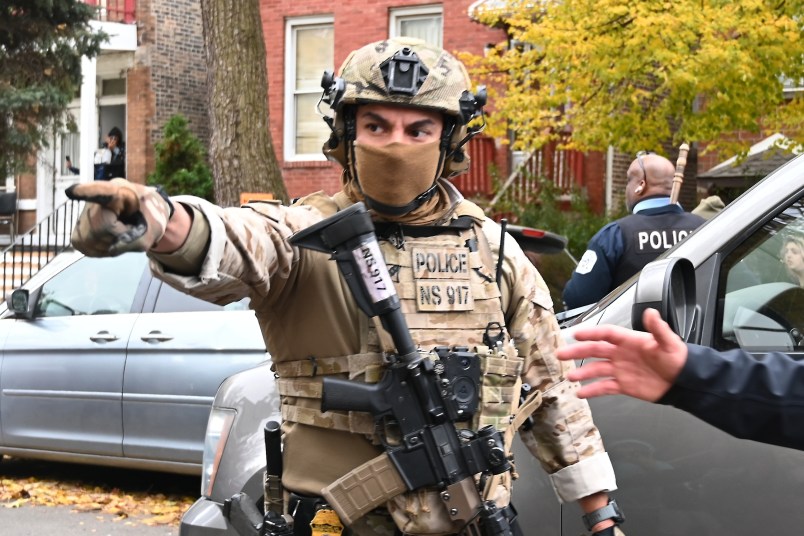
Masks have become the central symbol of the Immigration and Customs Enforcement wilding sprees across America in 2025. They are emblems of a secret police. Their gaiters and balaclavas convey menace. But their central justification is the idea that the agents themselves are endangered by their work, that their identities must be kept secret because they are endangered by the very public they menace while at least notionally working to serve and protect. The general argument is that ICE and Customs and Border Protection agents risk being “doxxed,” being identified and having their private information and home addresses made public. But the word has been the subject to an absurd expansion. Earlier this week I heard an anecdote about a group of ICE agents who were eating at a Minneapolis restaurant. A right-wing account said the agents were then “doxxed,” which in this case meant that activists saw them and sent out word to other activists who then started protesting outside the restaurant.
It’s remarkable how accepted this purported need for anonymity has become. Retiring Sen. Thom Tillis (R-NC) has become increasingly outspoken about ICE and called for DHS Secretary Kristi Noem to lose her job. But he still thinks ICE agents should remain masked because of this fear of “doxxing.” A bunch of the country seems to have forgotten that even the most abusive of metropolitan departments require their officers to show their faces and wear name tags as a matter of course.
In this post I want to dig more into that rationale: that the people who are entrusted with the power to wield legitimate violence to serve the public need special protection, special rights to privacy and anonymity in order to do so. What is implicit in this claim is that ICE needs to do its work in a highly abusive manner, or perhaps even that its work is to be as abusive as possible. Why else do they need to be more anonymous than your average beat cop? If they’re going to get a lot of people mad, it just follows that they need some additional protection from the consequences of generating that kind of anger.
Needless to say this argument treads a pretty slippery slope.
To me it feels similar to something I first wrote about in my “brittle grip” series from the early 2010s. In the third post in that series I wrote about the way that Citizens United and other Supreme Court decisions loosening the reins on high-dollar campaign donations had triggered a demand that high givers get special, additional rights to privacy.
It was treated as a given for more than half a century that, over token amounts, political giving must be disclosed. The post-Citizens United argument for mega-donors went something like this: If I give $5,000 I can disclose my donation. No problem. Lots of people do that. But if I give $5,000,000 people are going to notice that and focus on that and some of them are going to be mad. So I don’t feel like I can disclose that. I need to be able to do that privately because I should be able to exercise my court-given rights to give unlimited amounts without getting blowback from people who might be upset that I wield so much power or unhappy with just how I wield it. So in other words, that person needs not only a crazy amount of power but additional rights to shield them from the repercussions of having that much power. It’s one of those arguments you can momentarily be lulled into the logic of before you step back and think, WTF? That’s absurd. You don’t get special rights because you have all the power in the first place.
ICE masking and the need for billionaire anonymity certainly aren’t the same argument. But I don’t think I’m far out on a limb in thinking that they share a common DNA. The people with all the power need to be insulated from the effects of wielding that kind of power. It’s a whole framework of anti-accountability that has infiltrated our civic discourse. The people with all the power need to have even more power to protect them from the effects of being so powerful in the first place. Or with ICE, you can hardly expect people to abuse their policing authority quite so aggressively if you’re not going to allow them to do it anonymously.
I got to thinking about this this morning when I noticed this comments from journalist Radley Balko, who has focused on police abuses and abuses of state power since long before it was so central to the mainstream political conversation. He flagged the horrifying case of Marimar Martinez, whose case we’ve written about at TPM and I’ve discussed on the podcast. ICE agents cornered her, shot her five times and then cooked up a series of lies about how she’d led an ambush against them. They then charged her with assault before the whole case fell apart. She somehow managed not only to survive five close-range gunshot wounds but, at least outwardly, recover pretty quickly. Now the government is pressing to keep some of the bodycam evidence of this travesty secret to protect the “privacy interests” of one of the guys responsible for what happened.
Again we see that same richly articulated politics of anti-accountability: an officer who is at least notionally supposed to serve the public has some purported individual and private “privacy interest” in not having his wrongdoing or criminal conduct known to the public he is notionally charged with serving. You might call it the right to privacy, fascism edition.
It’s worth considering how upside-down this whole logic is and how oddly pervasive it has become. With great power comes great responsibility. This is usually considered a truism. But here we have a logic by which those with the power need special protections, some special rights to evade accountability for actions that seem to flow so freely from their untrammeled power itself. It’s a logic simultaneously seductive and perverse.