


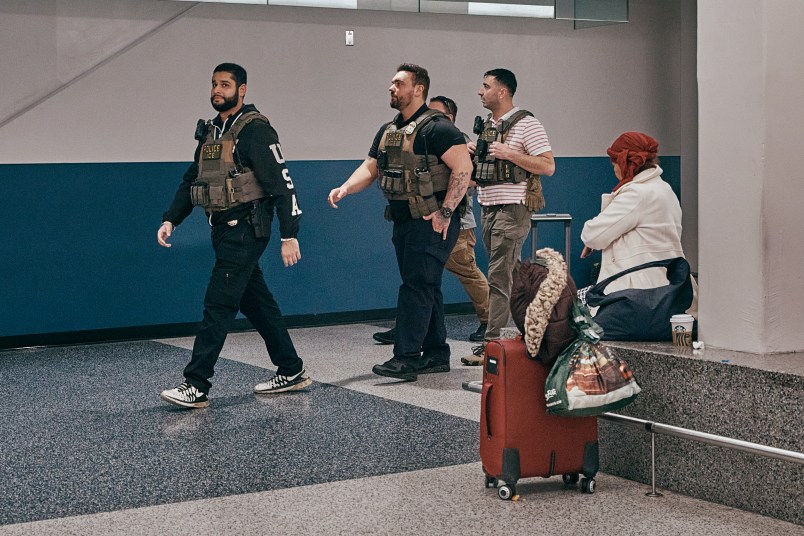
In recent weeks there’s been a recurring story, albeit with different players. This or that DHS or White House official gets asked about sending ICE to the polls in November. Will they disavow it, promise it won’t happen? The general answer has been no comment, no answer. It’s Tom Homan, or Kristi Noem or Stephen Miller. Yesterday, it was Todd Blanche at DOJ. There’s a general mood of a drip, drip, drip story, with all the vibes of looming danger and the hammer-fall of that danger being in the other guy’s hands. This is all a mistake. It’s a Trumpian sort of conditioning that is being perpetuated even though Trump himself, as far as I can tell, hasn’t addressed this particular question in some time. It’s a kind of watchful waiting in which all the power is being ceded to the hands of the White House when that is not necessary at all.
Being in a reactive mode, having the other guy holding the cards and waiting to know what they’re going to do and reacting when they do it is enervating, demoralizing, even paralyzing. And that’s always Trump’s personal angle: ‘I 100% can do it. Everyone agrees I can do it. But we’ll see what I decide,’ is more or less what he’s said about countless future crimes he’s dangled in front of an often-cowering opposition over the last decade.
This is a cardinal mistake. Democrats need to push the issue to the top of the news conversation and start taking concrete actions to block, impede or stymie whatever Trump and his White House toadies might have in mind. They need to start doing that right now.
Now, you may be saying, this isn’t all about having a positive attitude, Josh. He runs ICE. He runs DOJ. He owns the corrupt Supreme Court. What are Democrats supposed to do exactly?
Well, there are plenty of things they can do. Both Democrats generally and, even more, state authorities under Democratic control.
One key is to understand that actions drive news. Whining does not. In fact, it drives demoralization. So concrete actions are necessary both for the direct and literal results of those actions but also how they shape the production of news and public attitudes.
Free states and subsidiary jurisdictions within those states should be passing laws to prevent intimidation by ICE or any similar forces at the polling places. There are various ways to come at this, not least of which is barring police with masks, armed federal agents, ICE itself within certain distances of the polling places. The precise details of how to structure these laws don’t need to concern us here. Nor should federal supremacy. We are already in an extra-constitutional period in American history, one in which it is essential for the states to lean into their separate, non-contiguous sovereign power to protect their citizens from criminal, corrupt and anti-constitutional abuse by a rogue executive. It is incumbent on the states to protect citizens from criminal harassment by that rogue president or federal militias operating at his command. If the federal government or Markwayne Mullin want to go to court and litigate them under the supremacy clause to ensure the power to harass voters in Wisconsin or Pennsylvania or New York, great. Bring it on. Bring the actions and intentions behind them right to the forefront.
But it is also an elementary and correct principle that the president cannot take control of elections through the fig leaf of immigration enforcement when he is barred from doing so directly. Litigate, litigate, litigate — force the federal government to respond to the filing the lawsuits. There are lots of ways to craft laws to stymie these actions; there are lots of ways to get into court now rather than waiting till later. Do it now.
Oppositionists in Congress should be doing the same, using all the tools available to them. But this is a case where the parties with the power are the governments of the Free States. They have executive power. They can take actions, within their states’ actually quite expansive sovereign power, and have others react to them, not complain feebly on the margins in legislative chambers in which they can’t even schedule votes. There are real things Democrats in Congress can do now. But it’s important to recognize which players have the most important power. And it’s not them.
Candidates too. Every candidate in anything remotely like a swing district should be baiting his or her opponent on whether they will demand that no ICE agents or other federal law enforcement be sent to polling places in their districts. If their state passes a law barring ICE electoral intimidation, do they support it? And here’s something that applies across the board. Don’t ask. Say. You assume it as a given until they categorically say otherwise that any Republican candidate for Congress supports ICE intimidation at the polls. Because of course they do. They support Trump and are loyal to whatever he demands. They support it. Period. Will the White House do this? Of course they will, until they’re stopped. Take the initiative and don’t give it back. Never let your own tolerance for quibbling allow a guy like Trump to keep things fuzzy and opaque until he decides to show his cards through action.
Some people argue that this is all a mistake because it may raise the specter and fear of going to vote on Election Day, thus doing the White House’s work for it. Or perhaps they say that it’s a bad idea to push these questions into court now because that might generate bad case law and backfire. People who say these things are very dumb and you should not listen to them. Any case law to be made or fear to be sown will be made or sown at some later point by the White House, at a time and in a manner of its choosing, to its own maximum advantage. There’s no military theory or really any kind of competition where the established wisdom is to cede the initiative to your opponent and then react to whatever they decide to do. This is obvious, and anyone who doesn’t grasp that is a fool.
Action also shapes the political context in which you operate. It sends a signal of power and command which emboldens supporters and puts opponents in a defensive posture. As I have expressed in various posts over the last year, I’m cautiously optimistic that we will have a free and fair election in which the will of the voters is translated into legitimate election results. Of course the White House will try to put its thumb on the scales. But I also think the opposition will be vigilant and, critically, law and constitution are so heavily on the opposition’s side that I don’t think the White House will make much headway. But again, we don’t have to be predicting or hoping or teasing out hypotheticals. There’s plenty of ground on which to act. So start now.