


I’ve been in a conversation over the last few weeks about a possible piece I might write for another publication about Democrats and the politics of masculinity and power, particularly how this relates to how young men have shifted to the right in the Trump era. I mostly think that this is an issue that affects Democrats generally, and is not just narrowly about this or that demographic group. This has been a theme in lots of conversations at TPM over the last 20 months when it comes to the extra-ideological division among Democrats between “fight” and accommodation and civility. Going back even further, to late 2004, I’ve been writing about what I call “dominance politics,” or, originally, “bitch slap politics.”
I thought of this this weekend because there was a blip of attention to comments from David Brooks on The Newshour. “The insinuations that El-Sayed is involved in terrorism because he’s Muslim, ridiculous. Jon Ossoff, my advice to him is, if you start calling your political opponents Nazis, maybe it’s time to shut up. That’s just not what we do here in this country.” There are a slew of problems with this. Not least of which are false equivalence and appeals to ethnic hatred and bigotry. Ossoff didn’t call Mike Collins a Nazi. What Brooks is referring to is Ossoff’s debate swipe when he told Collins, “You’ve hired half the Third Reich to staff your congressional office and you have promoted neo-Nazi content online.” This isn’t some random swipe. It’s been one of the biggest stories of the campaign season that week after week reporters keep finding members of Collins campaign, political operation or family who are associated with far-right or neo-Nazi individuals and organizations or who distribute anti-Semitic propaganda. This is merely an aggressive statement of facts that are unambiguously in the public record. But it’s not the specifics of Ossoff’s attack or Brooks’ tut-tutting I want to focus on here. It’s the more general and more important issue of tut-tutting, elite gatekeeping and how this relates to how Democrats operate in the public sphere.
The premise of “dominance politics”/”bitch slap politics” is that in 21st century American politics and in some ways for much longer, the issues or public policy bundle a candidate brings into a campaign is only a thin part of the electoral equation. What really drives campaigns is a series of competitive performances of dominance and power. In opera terms, think of it as the difference between the libretto and the score, with the former operating at a surface level and the latter packing the real driving energy and motive force. Most specifically these focus on leveling attacks that your opponent is either unwilling or unable to defend themselves against, which is to say dominance. You demonstrate your power and the other guy’s or gal’s weakness. You set the terms and they react.
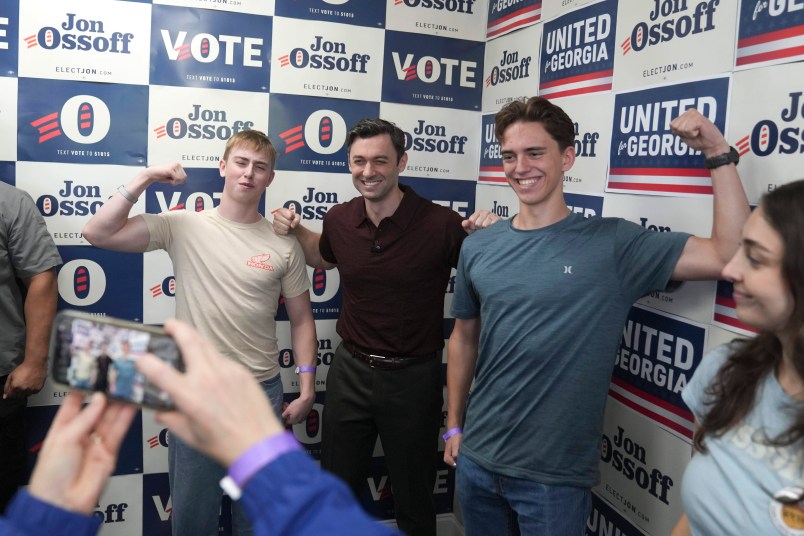
Ossoff has stood out over the last year or so, and especially over the last three or four months, as a Democratic candidate operating in this mode. It’s not primarily visual. 2026 Dems have a number of T-shirt-wearing, gym-hitting candidates and Ossoff isn’t one of those. If anything he’s more in the Obama mode — well-dressed, more cerebral, coded as educated and cosmopolitan. He’s not aping an influencer or a podcaster. What he’s doing is controlling the terms of the campaign, focusing on a few key themes and prosecuting it aggressively. He’s also including the mixture of taunts and attacks that hold the initiative in the campaign. His campaign speech aside about Natalie Harp was a prime example: “He wants to build his ballroom and travel with Natalie on their apparently defenseless flying palace gifted by the Emir of Qatar.” Off-hand, open to countless interpretations, chosen to cut not at one of Trump’s countless offenses or even just one of his vulnerabilities but against his weakness, hapless grasping and deterioration. It triggered an outburst of squealing complaint from the White House which Ossoff promptly made fun of: “It’s been amazing to watch this White House melt down over this all week.” Most importantly, he didn’t back down. Which made the storm of criticism orchestrated by the White House look more like hurt and grievance — in a word, whining.
The “Natalie” comment was from a public speech. But it wouldn’t have gotten a lot of attention if Ossoff’s campaign team hadn’t clipped it and distributed it as a viral video. In this sense it was highly orchestrated. I was curious whether he’d operate in the same mode in a less controlled setting. And that’s where the “Third Reich” comment came, in a debate with Collins on Friday night. Note that again the comment comes in a fusillade of other attacks and as a kind of offhand aside and the tone is not one of censure or outrage so much as mockery. Note Ossoff’s words and the body language of the two men in this clip, especially how Collins seems to crumble in response and can’t even look at Ossoff or even the camera by the time the exchange is done.
To be realistic about expectations, it is important to remember that it is easier to dominate when you’re winning. Nothing signals power like being ahead. And nothing signals weakness like failing and trying everything you can to stop failing and not having anything work. But what we’re describing in Ossoff isn’t simply a reflection of the state of the campaign. It’s a significant part of why Ossoff, who was supposed to be the most endangered Democratic incumbent, appears to be one of two races where Democrats have a solid, outside the margin of error lead. And the way he’s running his campaign, the way his campaign is focused on signaling dominance and power, is not only visibly different from how Democratic campaigns usually operate but is distinct even in the context of the 2026 cycle, where others are operating in this lane, landing more aggressive, cannier attacks in a way that feels novel.
Obviously how the public sees a candidate depends not only on what they do in a campaign but what they do in office if they win. One of the revolutions that has or is in the process of taking place over the last two years is the kind of popular revolt among Democrats (and Democratic-adjacent independents or occasional voters) at what they see as the weakness of the party’s leaders. Sometimes this reads as characterological. Sometimes it reads as the willingness to be both a participant in political battles and what amounts to the referee, or more pointedly the perpetual custodian of a political order your opponent has already destroyed. What this all amounts to is that Ossoff’s campaign mode and the mode a few other Democratic candidates are leaning towards is both a reaction to the last two years and also will have to be followed by a different kind of political action in office. Because performances of dominance and power work because they are powerful descriptions and implicit promises about how you will exercise political power when you have it.
When I saw people reacting to Brooks’ tut-tutting comments about Ossoff’s remark (“That’s just not what we do here in this country”) I saw many saying some version of “Well, that’s Brooks’ job, brushing Democrats back, keeping them in line.” There’s something to that but I think less than it might seem. Gatekeepers usually have about as much power as you give them, certainly in cases like these where the power of voters is arrayed against elite opinion, and largely elite opinion as it is expressed in social and cultural spaces dominated by people who vote mostly for Democrats — news media generally and certainly The Newshour. The relationship with these kinds of gatekeepers tends to be much more symbiotic.
Before the Trump Era it used to be common for White Houses to host off-the-record meetings where presidents would meet with ten or a dozen opinion columnists or opinion leaders to discuss the news of the day. I would get invited to some of these during the Obama years. I remember one of these from relatively early in Obama’s presidency when the hunt still felt live for a so-called “grand bargain” on deficit-cutting. In the course of the conversation I was struck by the way that Obama’s interaction with Brooks was of a different character than his interactions with basically everyone else there. I may definitionally not be part of “mainstream” discourse, but almost everybody else there was definitionally within it. Also, in this pre-Trump era, Brooks was more clearly still a Republican in this kind of context. It was clear that the rest of us there were people Obama knew generally, whose opinions he wanted to hear and who he of course also wanted to influence. But with Brooks this was just one get-together in an ongoing and pretty extensive conversation. Brooks had a hold on Obama and perhaps vice versa.
That’s a choice.
To be clear, that was a different era and I don’t say this to criticize anyone. Elite opinion and discourse slightly above the fray of partisan combat still existed in a way that is simply no longer the case. So there was at least some logic in trying to cultivate it. I note it here simply to explain that elite opinion is embedded and longstanding and largely something that exists within Democrats, not something that David Brooks or anyone else is imposing on them. The relevant point is simply that Brooks’ is bad advice. The mode Ossoff is campaigning in is manifestly working. Brooks’ comment that, “that’s just not what we do here in this country,” is manifestly false, though that’s the least important thing to focus on.
Dominance politics exists in different forms and flavors. One of the things that made Trump’s meteoric rise possible was that dominance politics is his native language. He never needed to learn it, try it on for size, adapt it to his own needs. And he spoke it with all its predatory and gendered dimensions turned up to 11 if not higher, something that allowed him to pick the lock of Republican politics as it had evolved over the 20 years prior to 2015. A Democrat could never do that. It conflicts with too many Democratic values. It is also the party of women, at least disproportionately so, and the political vehicle of those who care about women’s empowerment and rights. But none of this obviates the need to speak the language in which American political campaigns are now conducted. But, as I noted, dominance politics exists in different forms and flavors. It can be readily adapted to Democratic aesthetics and sensibilities. It’s also why, while everyone’s entitled to their own sartorial choices, there’s probably no need or wisdom to rebranding every Democratic male candidate as a ripped he-man stressing his kidneys by maxxing out on protein powder. Performances of power are fundamentally about learning about how political power works and how it doesn’t, how to communicate it, how to do things in the political realm which grow from it.