


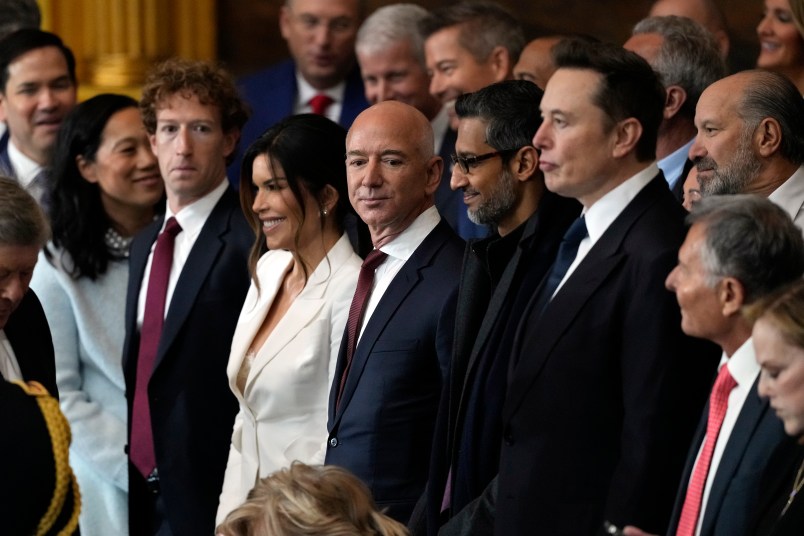
I mentioned the other day that the insider D.C. sheets are helpful guides to when a new idea or bit of news is breaking into the elite D.C. conversation. I saw another example of that today, and it’s a window onto a critical topic, a critical part of the restoring democracy to-do list in the coming years. Semafor’s Liz Hoffman has a piece on the shifting “political pendulum.” What she’s referring to in this context is all those corporations who moved decisively in 2025 to get on the MAGA bandwagon. We think mostly about the tech monopolies. Their leaderships are high profile. In many cases, their structure ensures that the founder maintains total control over the corporations, despite being a public company. So when Mark Zuckerberg starts showing up a UFC matches with Trump or Don Jr. you know where Facebook is placing its bets. But for anyone paying close attention, this corporate shift goes way beyond the highly personalized leadership of the tech monopolies.
And yet now, as Hoffman points out, lots of corporations are starting to realize that these moves are probably not going to age well at all in 2026. There’s a major public backlash brewing, and there’s a very good chance that at least the House will fall to Democrats and the Senate is now more than the theoretical possibility it seemed a year ago. This is of course why corporate America, particularly the big diversified and largely de-personalized mega corporations, has always tried to steer clear of being too identified with either party. There’s political giving. But what we’ve seen over the last year goes far, far beyond that. Lots of big corporations have aggressively competed to be part of Trump’s corporation, in some ways that are not precisely illegal and in many that clearly are … as soon as there’s a functioning Justice Department back on the beat.
Hoffman links to an important overnight tweet from Sen. Ruben Gallego (D-AZ) in which he says this: “All the mergers approved under the Trump administration need to be undone. Big business has to understand there are consequences when they team up with corrupt government.” In its own way, what Gallego is calling for and committing to is almost more important than criminal accountability for those most guilty of criminal conduct in the administration itself. There’s a reason corporations generally steer clear of aggressive and visible political involvement. Because the tide turns. It’s better to be on at least reasonably good terms with both parties than to seek extreme advantage when one or the other is in power. 2025 went well beyond that with numerous corporations diving into the Trumpian corruption, allowing the president to build subservient media empires and more. Behind the scenes I have had explained to me the kind of transparent cash transactions that titans of corporate America are now ponying up to stay on Trump’s good side. Only public, visible and lasting consequences can reestablish deterrence against participation in these kinds of plots against the American republic. It’s not just creating consequences for criminality in public office. That criminality can only flourish if other major societal stakeholders go along with it, try to participate in it. And corporate America has done so — because of a mix of carrots and sticks — in a way that is almost unprecedented in American history.
Many of these deals were made because companies wanted to avoid trouble. What else could they do? Maybe they’re like the shopkeeper who doesn’t want to be involved with the mob but has to buy into a protection racket because they have no choice. But as long as there are only consequences on one side of the ledger, corruption will always be the obvious choice. Does that point semi-innocent bystanders in a tough spot? Probably so. But saving a republic is complicated and kinetic. Participation with Trump’s corruption isn’t ordinary criminality, though it falls under various clear criminal statutes. It also amounts to making war on the American republic itself.
We’ve discussed before the ways in which a political opposition needs forms of activism which provide an experience, a confidence of forward motion into the future. If the law is on hiatus, that doesn’t mean it’s gone. But an opposition and the public needs visual symbols of the law’s perseverance, its continuity beyond the present moment. There are countless corrupt deals, corrupt mergers, cash payoffs and more that an opposition Congress needs to get to the bottom of. It’s essential. It’s just. It’s absolutely necessary.