


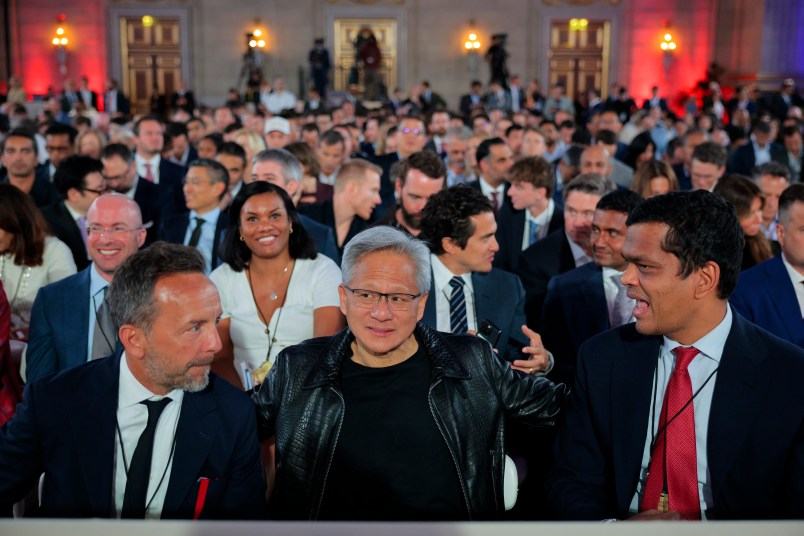
The Information is reporting (paywall) that regardless of what multiple investigations unearth about NVIDIA CEO Jensen Huang’s affair with a suspected Chinese spy, the scandal is likely to spur Congress to impose tighter export controls on the advanced processors used in AI data centers. There’s been a big bipartisan push for this in Congress for a while but it’s largely been headed off by White House resistance. That resistance seems to center on Trump himself and the small coterie of Silicon Valley advisors who run AI policy at the White House. As I noted in this post, the argument for tight export controls seems pretty strong to me, certainly if we’re operating on the premise that US superiority in AI development is a critical national security interest.
When I say “to me” I’m noting the fact that tech export control policy is way outside any area of expertise for me. So I’m leaving open the possibility that there are good arguments I’m not considering. But I’m at least skeptical. The Information article notes that NVIDIA’s arguments against tighter restrictions is that blocking China from using these advanced chips will drive them to develop their own advanced chips and that future export of those chips to other countries will mean a lot of global AI doesn’t run on US hardware and standards. With the same caveat that I’m new to this topic, that at least sounds a lot more like an argument for defending NVIDIA’s global market share than safeguarding US security interests.
One additional point on this which goes to assumptions and premises. We’re told that AI development poses severe – and at least to some people, existential – dangers to society, economy, maybe even the species. But a major argument against any slowdown on development is that slowing down AI development in the US means risking that China will catch up to or surpass the US.
I don’t see how you can have this both ways.
If it’s such a big deal that we’re willing to run additional risks of major or catastrophic societal harms to stay on top I don’t see how there can be any good argument against very tight export controls on the hardware that is the basis of a lot of that US superiority. Am I missing something? Could be. But it seems hard to figure. And given the mix of cravenness and corruption that operates in this administration, Huang’s apparently very close relationship with Trump and the fact that administration resistance to export controls seems to come down from Trump himself … well, it all sounds pretty iffy to me.
When I say iffy I’m not suggesting that Huang himself is compromised in some way or under some foreign influence throught this suspected Chinese spy. It’s just that the NVIDIA’s commercial interests seem pretty obviously in tension with US national security interests. Add to that that Trump is corrupt and an ingenuous moron when cash is involved and this all requires a much closer look.


