


By now a significant number of us have experienced the self-imposed hardship and uncertainty of being sick but unsure if it’s the rona. TPM Reader DS writes in from Seattle:
Hi Josh. I was just reading your piece about testing, and thought to contribute a personal anecdote about what widespread testing would mean for people and families with relatively mild cases.
Read More
President Trump says he hopes to have the country back to normal operation by Easter – which is less than three weeks away. He also says his insistence on doing so is helping push up the stock market.
Prez Trump says stock market rising because he insists on reopening the country. Says he expects to go back to normal in two weeks. pic.twitter.com/VmEUHC6oL6
— Josh Marshall (@joshtpm) March 24, 2020
We’re back to that familiar place: President Trump introduces a claim or argument or policy so absurd it risks crowding out an actual critical question. Here that question is how to balance the public health crisis and our efforts to contain it with damage to the economy over time. The simple reality is that the cost in human lives and the economic damage will both be vast. Nor are they a zero sum. The economy wouldn’t keep humming along amidst a public health catastrophe even if we all managed to be totally indifferent – individually and collectively – to the threat we faced by going about business as usual. It is also true that economic privation has predictable costs in human lives – unemployment, stress-driven ailments, family breakdown, suicide.
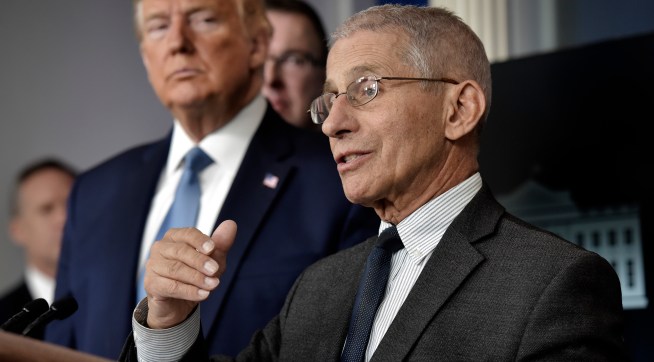
This is how it typically goes when President Trump is growing tired of you.
Gov. Cuomo of New York is holding his press conference this morning and is practically begging the federal government to mobilize. He seems genuinely not to understand why it’s not happening. There’s the Federal Defense Procurement Act to order companies to start making ventilators. There’s also a federal emergency stockpile of ventilators. Cuomo says there are 20,000 in that stockpile.
TPM Reader RS is a physician in California …
At my hospital, it feels like the proverbial calm before the storm – we have not seen many COVID-19 cases yet, but the numbers are increasing and we are watching the news from Seattle and NYC with grim anticipation. All our effort is focused on preparation right now – sorting out testing challenges, developing diagnostic algorithms, building staffing models, and trying to calm the fears and anxieties of patients, families, staff, and colleagues.
I will try to graph this later. But a quick point I wanted to flag. There is some possible – I stress possible, not at all certain – that the horrific outbreak in Italy is starting to slow down. Over the last three days the number of new infections have tracked down from 6,557 > 5,660 > 4,789. The fatality numbers have tracked 794 > 651 > 601. If the 21st was the peak day, that would be 13 days after the lockdown in Lombardy on March 8th (followed by a national lockdown a day later.)
This is notable because the number days between the lockdown of Wuhan and the peak day of new infections in China was 12 days.
We’ve heard a lot of conflicting and confusing information in recent days about testing. Public officials in different areas have announced that the time for testing has passed and in some areas efforts at mass testing – drive through testing, and such – is being scaled back. This comes after a couple weeks when rapidly expanding testing was the central focus of preparedness, containment and mitigation efforts. On Sunday longtime TPM Reader BB wrote in that he “can’t quite get my head around what we think wider testing is going to accomplish” and then listed a series of critical reasons why officials in hot zones are now in some cases moving to limit testing.
Let me try to answer this by ‘answer’ here I am simply trying to synthesize as best I can the thinking and arguments of public health experts and clinicians whose reports and commentary I am following as closely as I can.
You’ve likely heard the story about how the Peace Corps has not only withdrawn its more than 7,300 volunteers from countries around the world but also fired them. All of them. Immediately. Evacuation was probably inevitable and wise – though it seems reasonable to ask whether some volunteers may have been safer remaining in country than returning to the US. The decision to fire them all summarily was callous, gratuitous and inane.
But I wanted to TPM Reader MA’s story of his son’s rushed evacuation from Peru.
So I am a long time reader and member at TPM, and I thought I would share my son’s crazy story of getting out of Peru as a Peace Corps Volunteer.
As you know Peru went on total lock down this week. Before that my son and other PCV personnel had traveled to Lima from their home sites to hold their Completion of Service (CoS) ceremonies. My son’s last day in the Peace Corp was slated to be May 22nd. So, they had their ceremony and then last Saturday night before they were to head back to their sites, they got an email from their local director that they should stand pat; no one was going to travel until further notice. Inadvertently my son also got an email of a screenshot between some higher ups that that an evacuation order was coming worldwide.
Just this week’s reminder that all of our COVID-19 Crisis coverage is outside the Prime paywall. We will continue this for the duration.