


If you follow polling you know that over the last couple weeks President Trump’s approval numbers have been trending up. The differences are small. But even small differences measured in aggregate make a difference. If the President is at 43% approval on election day and gets near around that number he’s defeated. If it’s 46% or 47% victory is possible and even likely. Small differences over time count.
538’s composite average has notched up a couple points over the second half of January and this morning Gallup released the highest approval rating of Trump’s presidency: 49%.
Why is this happening?
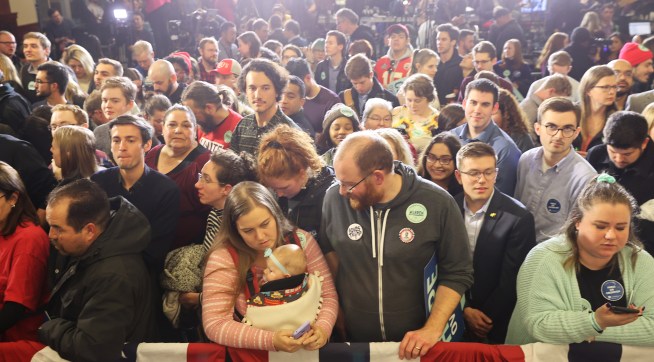

I wanted to share TPM Reader RB’s more positive take on the Iowa Caucus, if not this particular execution of it. And that prompts me to add this slight qualification of my condemnation. These are great participatory civic exercises. You can see that watching them. They’re just not substitutes for elections. That may be a sort of impossible answer since if they don’t “count” people wouldn’t participate in the same way. But both can be true. We have expectations of elections. And the key one is that everyone gets a voice, an equal voice, at least on the foundational act of voting. Not just everyone in the sense of people who can’t necessarily spend a whole evening out doing this — covering differences in class, having children, working night jobs. That also means people who simply do not want to publicly announce their political beliefs or get hassled by neighbors or strangers about changing their votes.
With that, TPM Reader RB …
JoinIowa shouldn’t matter. It’s a small state that looks very different from the national Democratic electorate. In 2016 it voted Republican. This state’s outsized impact on the presidential nominating process rests somewhere between absurd and scandalous. But this debacle tonight is difficult to process.
Obviously this is a pretty big debacle regardless of what the ultimate explanation is. But I want to note one thing. The state Democratic party has put out a series of statements which say that they found inconsistencies among the three separate tallies of data they planned to report and that they were thus rescrutinizing or rechecking the data to make sure everything was right. They were clear that it wasn’t a problem with the results. It was a delay in the reporting. They also said that the app that precincts were supposed to use to report the data did not break down.
But there have been a number of interviews with precinct captains (one example below) who say that the app simply failed or that people couldn’t get it to work. They were then told to call in the results but they faced long holds or couldn’t get through at all.
Both explanations sound plausible. But they don’t seem consistent. Perhaps it’s a bit of each. So it’s not that one explanation is necessarily false. But they are at least in significant tension.
Here’s a precinct head or caucus-runner explaining what happened to CNN. Best explanation I’ve seen of what happened.
STOP EVERYTHING and listen to this. You'll understand exactly what the problem is (not kidding). pic.twitter.com/w3sL0a1d1u
— Josh Marshall (@joshtpm) February 4, 2020
We keep hearing about doing “quality control” that is causing the delay in caucus reporting tonight. There are scattered reports of Iowa Democratic party officials talking about widespread technical difficulties with the app that was supposed to handle reporting. It seems like something went wrong with the reporting and party officials are either trying to reconstruct the results or perhaps re-canvass the results without the app. That part is speculation. What is not speculation is that something clearly went wrong. The only good I can see coming from this is perhaps this will be the last caucus in the American political system. It’s a terrible system when it works right. Make it more complicated, multilayered and totally different from how we run real elections and perhaps you get this.
Before we get started and start seeing results let’s remember that the “modern” caucus system is absurd, anti-democratic and shouldn’t exist. It’s basically voter suppression for well-meaning Democrats. There have been some reforms this cycle, in response to the primary controversies of 2016. But it’s still just retooling a system basically designed to exclude people.
Don’t miss Rick Hasen on how President Trump’s epic effort to propagandize the right-wing voter fraud myth went up in flames.
As I’ve noted before I seldom read books about contemporary politics or current affairs. When I open a virtual or physical book it’s almost always history and generally in the distant past. But I’ve been devoting a lot of time recently to reading a number of recent books for a project I’m planning. One of those I just finished is Ronan Farrow’s Catch and Kill.
I wanted to recommend it to you because I found it exceptionally good.