


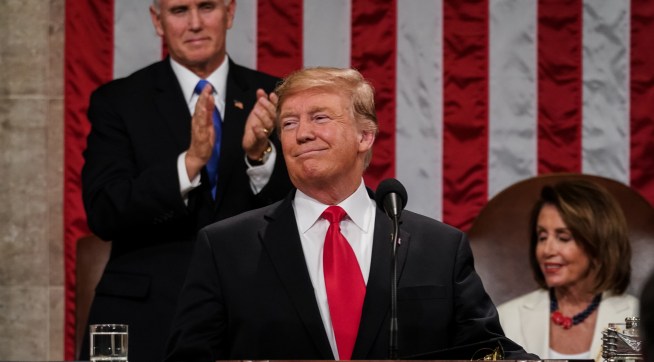
All things considered, for Trump, this struck me as a fairly anodyne speech. It was fairly long for a State of the Union address. Trump hit his key bloodthirsty points, portraying undocumented immigrants as a tide of murderers threatening the country. He bragged on his supposed accomplishments – some real, most pretended. But overall, it tended to emphasize national unity, regardless of how empty that charge may be coming from what is certainly the most intentionally divisive President in modern American history. He even had some genuinely touching moments, such as the stories at the end of the liberation of the Dachau concentration camp, with US soldiers who were the liberators and inmates who were there that day. Read More
9:56 PM: “You weren’t supposed to do that.”
"You weren't supposed to do that." hahahaha didn't see that comin' pic.twitter.com/TTJGEDo2YA
— Josh Marshall (@joshtpm) February 6, 2019
9:42 PM: Always important to note in these moments that immigrants – legal and undocumented – commit crimes at significantly lower rates than native-born Americans. If safety was the issue it would be better to toss a bunch of citizens and replace them with undocumented immigrants.
9:37 PM: How long til the story about the Mexicans busing caravaners up to parts of the border without a wall falls apart?
9:19 PM: Some fun.
Nancy catching up on paperwork like a boss. pic.twitter.com/0r0m4MN18P
— Josh Marshall (@joshtpm) February 6, 2019
9:15 PM: All incredibly anodyne so far.
9:08 PM: I didn’t see a single Democrat shake the President’s hand as he walked down the aisle. It’s a little hard to see. So I can’t say definitely. But it didn’t look like it … Jennifer Bendery of Huffpo tells me via Twitter that Jim McGovern, Bobby Rush, Jim Langevin did.
9:03 PM: Alright let’s get this over with.
Do the Democrats care if President is more ‘aggressive’ or ‘fiery’ as early reports suggest? I don’t really see why.
For TPM members, our reporters and editors — some on Capitol Hill, some following along at our offices in D.C. and New York — will have a sort of live blog of quick reactions to the State of the Union. Follow along here.
Give this a read. Cameron Joseph has some important context as we go into the State of the Union. Mitch McConnell really wants Trump to back off his Wall demand and clearly doesn’t want the President to take the “national emergency” shortcut. Part of the reason is that Congress might actually overrule his emergency declaration.
This one is important.
As close readers know, I’ve long been interested in the role of Tom Barrack, Trump confidante and billionaire real estate developer who keeps showing up at critical junctures in the Russia story and yet seems largely to have escaped much scrutiny or legal jeopardy. That may be changing. Read this memo, which goes directly to his role running the Inauguration Committee and points to connections to other parts of the Russia probe.
Gavin McInnes, founder of the Proud Boys, the paramilitary group with ties to white supremacists, is suing the Southern Poverty Law Center for labeling his group a hate group.
Here’s a quietly remarkable story out of Utah, getting fairly little attention nationally because of all the fireworks in D.C. Last November Utahns voted by a clear if not overwhelming majority for Medicaid expansion in their state. That was Proposition 3. The state’s legislature is in the process of simply overruling that decision, passing a plan that actually costs more than Medicaid expansion and automatically voids itself if the federal government doesn’t issue Utah a waiver that the state seems unlikely to get. Read More
To the surprise of I hope absolutely no one, the bogus “evidence” of widespread non-citizen voting in Texas, pushed by state Republicans, continues to collapse.
In our recent Inside briefings we’ve had a running conversation about the ins and outs of congressional oversight, how it’s properly done, its scope, what it can and can’t do. We’re going to continue this conversation next week with former Representative Henry Waxman (D-CA), who is widely seen as the most accomplished and capable congressional overseer and investigator of the post-Watergate era. Read More