After weeks of withering criticism of the White House’s delayed response in Libya, as well as his decision to authorize air strikes, President Obama is beginning to articulate his philosophy for the use of military force overseas.
The President plans to lay out the strategy behind his foreign policy decisions in Libya in a prime-time address to the nation Monday night at 7:30 ET, something his critics say he should have done before missile launches began in the North African country last Friday.
Obama has shown an aversion to making remarks from a chair in the empty Oval Office so instead will play to a more dynamic audience at the National Defense University, which is located at Ft. McNair in Washington. The crowd will be filled with generals and top military brass so Obama can avoid the spectacle of having to spell out his rationale for the use of force to an audience hostile to any U.S. military action overseas.
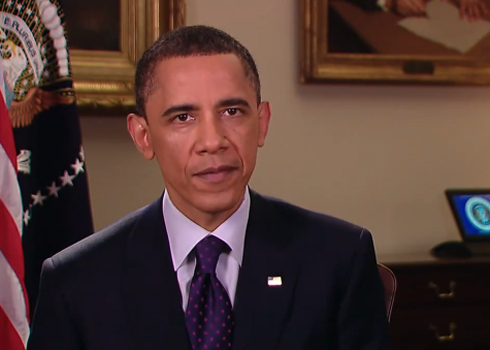
Obama’s weekly address to the nation Saturday provided some hints of what would come Monday night. The President repeatedly touted his ability to win “broad, international” support, including Arab partners like Qatar and the United Arab Emirates, for air strikes in Libya aimed at enforcing a no-fly zone and stressed that U.S. involvement would remain limited.
“And as agreed this week, responsibility for this operation is being transferred from the United States to our NATO allies and partners,” he said. “This is how the international community should work — more nations, not just the United States, bearing the responsibility and cost of upholding peace and security.”
For Americans accustomed to U.S. presidents, especially George W. Bush, making decisions about war and peace unilaterally and weary of the results of that approach in Afghanistan and Iraq, the difference is stark.
After 9/11, Bush talked loudly and carried a big stick, famously threatening to catch Osama bin Laden and bring him back “dead or alive,” with no results after nearly a decade, and selling the public on a doctrine of preemption in Iraq even though years later the administration still could not prove there was ever a real threat.
Obama appears to be embracing almost the opposite approach. In Libya, he was content to take cautious, behind-the-scenes steps that led to eventual international support — even if it meant weeks of delay and potentially worse conditions on the ground. As he struggles to find a way to pull U.S. troops out of Afghanistan and continue to stabilize Iraq, he is extremely leery of committing ground troops anywhere else and he firmly pledged not to do so in Libya.
The Bush wars were so long and costly, that many Americans and their representatives in Washington are wary of committing the U.S. military in any additional conflicts. The consternation over the decision to dedicate U.S. forces to Libya cuts across traditional ideological boundaries. Democrats and Republicans of all political strips have questioned his decision to intervene in Libya against the government of the notorious Muammar Qaddafi while leaving other dictators with records of crushing democratic rebellions free.
Obama has tried to make the case that helping innocent people escape brutal governments is the right thing to do — but only if and when the international community can provide some backup.
“I firmly believe that when innocent people are being brutalized; when someone like Qaddafi threatens a bloodbath that could destabilize an entire region; and when the international community is prepared to come together to save many thousands of lives–then it’s in our national interest to act,” he said in his weekly address. “And it’s our responsibility.then it’s in our national interest to act. And it’s our responsibility.”
Defense Secretary Robert Gates told CBS’s Face the Nation that Libya itself didn’t pose a direct national interest to the United States, but he said it’s tied to many of America’s vital interests, including relationships across the Middle East and with Europe. Other nations, such as Syria, Yemen or the Ivory Coast, where governments are brutalizing their own people, are different. In Libya, Qaddafi was involved in a wide-scale military campaign against its own people instead of trying to crush protesters in public squares.
The President also took a few moments on Saturday to point to initial signs of success of his decision to slowly build support among NATO allies and others before sending the U.S. military into harm’s way. He brushed aside criticism about the delays, arguing instead that the international community acted more quickly than ever before.
“We’re succeeding in our mission. We’ve taken out Libya’s air defenses,” he said. “Qaddafi’s forces are no longer advancing across Libya.”
“So make no mistake, because we acted quickly, a humanitarian catastrophe has been avoided and the lives of countless civilians — innocent men, women and children — have been saved.”