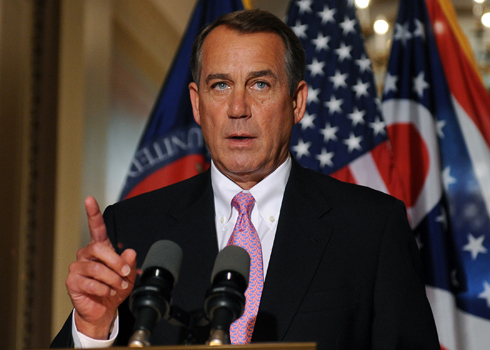
Reflecting the GOP leadership’s new kinder, gentler, less partisan rhetorical tone, House Speaker John Boehner (R-OH) says he appreciates President Obama’s new jobs legislation, despite continuing policy differences between the parties. Obama’s not being quite so gentle, barnstorming the country and seizing the airwaves demanding Congress “pass this bill.” The GOP can’t just sweep the bill into the dustbin under such circumstances, so the question is how exactly will they operate the sausage maker.
Boehner’s statement offers some clues. “[W]e appreciate the President’s pledge to transmit legislation to Congress and will immediately request that it be scored by the Congressional Budget Office,” Boehner said. “Once we receive CBO’s analysis, we can begin the important work of reviewing the various elements of his proposal.”
This is a far cry from the “hell no you can’t!” days of health care reform. But there are booby traps.
At a cost of over $400 billion, the White House says the American Jobs Act is fully paid for. But the way they’ve paid for it, according to Obama, is by asking the new fiscal Super Committee to reduce the deficit by more than the $1.2 trillion the debt limit law requires of them. The White House expects it to be scored as “deficit neutral” and is saying it’s paid for in ways that won’t affect the national debt. However, If the offsets (tax increases, spending cuts and savings, or both) are contained entirely in separate legislation then the CBO could tell Boehner that the jobs bill blows up the deficit. That would be a big political hurdle for the bill in a deficit-averse Capitol.
Whatever CBO says, though, Boehner echoes House Majority Leader Eric Cantor (R-VA) by calling on Congress to examine each proposal in the bill individually, instead of as a unit. Republicans have big political incentive not to pass the bill as a whole with Democratic help. At the same time, the public demand for jobs is probably too great for Republicans to cavalierly shelve the whole thing. So the GOP will more likely move on the tax cut proposals in the bill, and sit on or demand major changes to its infrastructure spending and direct hiring programs.
So while Obama’s demanding Congress “pass this bill right away,” Boehner’s saying, gently, “we’ll get to parts of it, soonish.”