


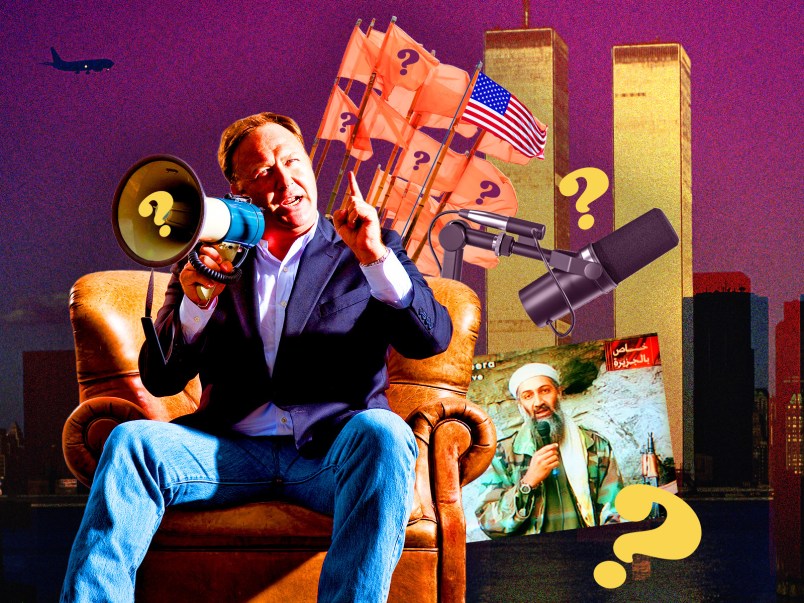
In Rough Edges, Mike Rothschild writes about fringe groups, conspiracy theories and how the Internet broke our brains. This column is part of TPM Cafe, TPM’s home for opinion and news analysis.
The Sept. 11 attacks came during a boom time for conspiracy theories. A vast industry of radio talkers, book writers, and cranks was finding new audiences on the nascent internet and using new technology to spread their messages faster and farther.
This was a new generation of media savvy personalities who knew how to tap into the fears of white evangelicals, revenge-seeking militia members, anti-tax activists, libertarians, Clinton haters, and paranoids on both the far left and far right. Many believed a traumatic event, whether real or “false flag,” was imminent. Some even claimed that the government would perpetrate it, then blame a convenient figure around whom the country could rally its bloodlust and need for revenge.
When it finally happened, though, they were just as baffled and desperate for answers as the rest of us. And they turned to the gurus helping them shape their world views — who were also baffled.
Three major figures in the conspiracy theory world broadcast live on the radio in those first hours after the Twin Towers went down. They started to solidify narratives that would drive the next two decades of conspiracy theories and myths about the attacks — even as basic facts about what had happened were hard to come by.
Bill Cooper, Alex Jones, and Art Bell were probably the three biggest names in fringe discourse in America in 2001. While they mostly disliked each other, they all essentially had the same audience and the same approach. They had huge audiences, their shows ran on hundreds of affiliates, and they had well-oiled monetization vectors – books, gold, supplements, radio advertisers.
Bell was a foundational figure in conspiracy theorist circles thanks to his long-running late night show Coast to Coast AM, where his callers and guests explored everything from looming martial law to past lives to whether there was a human face carved into Mars. Meanwhile, Jones’s attention-getting stunts transformed him from an Austin, Texas public television curiosity into a national broadcaster in just a few years. And Cooper had spent the ‘90s as an almost prophetic figure in the U.S. militia movement, whose own dark journey had taken him to a looming crossroads with federal law enforcement that would cost him his life .
Their reactions to the attacks, the theories they endorsed, and the influence they had over how the event was perceived in those first hours are a critical window into how the conditions for the 9/11 Truth movement were set, and predicted America’s descent into the reflexive belief that any event, no matter how traumatic, was staged by the personal enemies of the believer.
And in an ironic twist of fate, September 2001 was one of the only times all three were broadcasting at the same time in the 21st century.
And so, on Sept. 11, as confusion reigned about how many people had died and what would happen next, the conspiracy theories that would become the drivers of a massive movement that crossed political and cultural lines around the world took form. It didn’t take months or days. It took minutes. And they didn’t start on obscure message boards or dank bookstores, they started on radio outlets with millions of listeners, minutes after the planes hit the Towers.
Bill Cooper had been on the air for hours by the afternoon of Sept. 11, 2001. He was desperate for real information, not something someone saw in a fax or forwarded email. And he was losing his cool with both callers and cable TV talking heads. He was, to use a word that might not have existed then, hangry.
Cooper was the biggest star in a loud, hostile movement that mashed up anti-government militias and UFO believers. That movement’s bible was Cooper’s 1991 book Behold a Pale Horse. Massively popular and never out of print, Horse became a secret history of the recent past that, despite being almost unreadable and heavily plagiarized from other sources, has sold hundreds of thousands of copies.
Shortly after Pale Horse came out, Cooper launched his shortwave program The Hour of the Time. He would spend the next decade blasting conspiracy theories of every kind to the 100,000-watt transmitter at Nashville’s WWCR — World Wide Christian Radio — which in turn, transmitted Cooper all over the world.
Cooper’s shows began with an anxiety-inducing barrage of barking dogs and blaring sirens, and were an encyclopedia of Clinton-era paranoia. Every night, Cooper would pontificate about Waco, the Oklahoma City bombing, government coverups, black helicopters dropping federal jackbooted thugs on your property, the illegality of taxes and the Federal Reserve, and Biblical end times prophecy.
Cooper’s style was both annoyingly pompous and deeply personal. Sometimes he sounded so depressed it was a wonder he got out of bed, while other times he happily chit-chatted live with his young daughter. He was often clearly drunk on the air, and would spend hours on rants about his own personal grievances, which were often deeply racist. Other times, he’d pass the minutes singing oldies, or just reminiscing. It was an unedited window into a very chaotic mind.
But if Cooper’s shows could be erratic and vaguely terrifying, his performance on 9/11 could be described with another word: herculean.
Starting at about 9:30 a.m. in Arizona, an audibly stunned Cooper would spend the next 10 hours on the air, supposedly at the request of WWCR executives. At the start, he sounds as shocked as everyone else. But he soon gets into his usual rhythm, firing off accusations, arguing with callers, spinning out conspiracy theories, and trying to claim that he knew this was coming. At times he screams into the microphone, other times he dips out completely, spending long stretches playing CSPAN and the BBC on the air — while making it clear that they’re lying.
It was, Cooper declared a few minutes into the show, “probably the worst day in the history of the entire world.” After today, “freedom will no longer mean what it used to mean after this day, rights are going to disappear” — and this would be the first giant step toward the world totalitarian socialist government that Cooper had spent a decade warning about. It would mean the obliteration of the Constitution, drastically restricted personal liberty, cameras on every street corner, endless war, and a global police state from now until the end of time.
Even as he churned out speculation, Cooper didn’t want to hear speculation. “I don’t want to hear any rumors or anything unsubstantiated,” he cautioned. “Don’t report anything you hear from Alex Jones or his ilk.” He frantically tried to tamp down conspiracy theories about more hijackings and bombs going off at the Supreme Court, while simultaneously spreading them about the imminent declaration of martial law and massive explosions bringing the towers down.
But his callers didn’t seem to get the memo. Anxious Cooper fans told of bomb threats, children being pulled out of school, state roads closed down, mass looting, the U.S. sealing its borders, explosions in lower Manhattan, and the military already attacking Kabul.
Everything from the Sandy Hook truth movement to QAnon to COVID denialism to “stop the steal” has its roots in the conspiracism that 9/11 unlocked.
Cooper seemed to know a lot for someone complaining he didn’t know anything. Just 40 minutes into his first hour on the air, Cooper declared that whatever the media and government will say about the Towers will be a lie. The buildings could not have collapsed solely due to being hit by a 737. He knew, without a doubt, that the government did it and would pin it on someone else, because it was the same thing that happened in Oklahoma City in 1995 — an act he claimed was carried out by the FBI and pinned on the innocent members of the militia movement, as an excuse to arrest and purge them.
And more than anything, he knew it because it was obvious to anyone with a brain.
“The core of the building being blown out” could have only happened thanks to shaped charges that were “placed on the main structural members” of the buildings, Cooper announced, referencing the steel reinforced concrete pillars holding the building together that never could have simply crumbled.
“Airplanes didn’t bring those buildings down,” Cooper thundered. “And if you think they did, you have air between your ears.”
As the show dragged on, Cooper seemed to be running out of steam, and got more exhausted and angrier. He demanded his “research assistant” get him lunch, and audibly devoured a submarine sandwich from Arby’s in between arguments. Cooper’s final few hours were essentially a long-running sparring match with callers bringing him outlandish nonsense to pick over. Some calls devolved into arguments about the minutiae of how rebar and steel-reinforced concrete are made, or whether Cooper used too much profanity on the air. Others took a much darker tone, declaring that mass culling of the population was about to start. Both Cooper and several of his listeners declared they won’t be taken away “to the internment camps,” or at least not taken alive — a statement that would soon prove prophetic for Cooper.
After nearly 11 hours on the air, Cooper declared he’s going to “call it quits” at 8 p.m. There’s nothing left to discuss at this point, he reasoned. And he might have been right. After half a day of rage, conspiracy theories, pompous self-congratulation, fearmongering, heartbreak, fast food breaks, and yelling at bonkers callers, tomorrow would be a new day with fresh horrors.
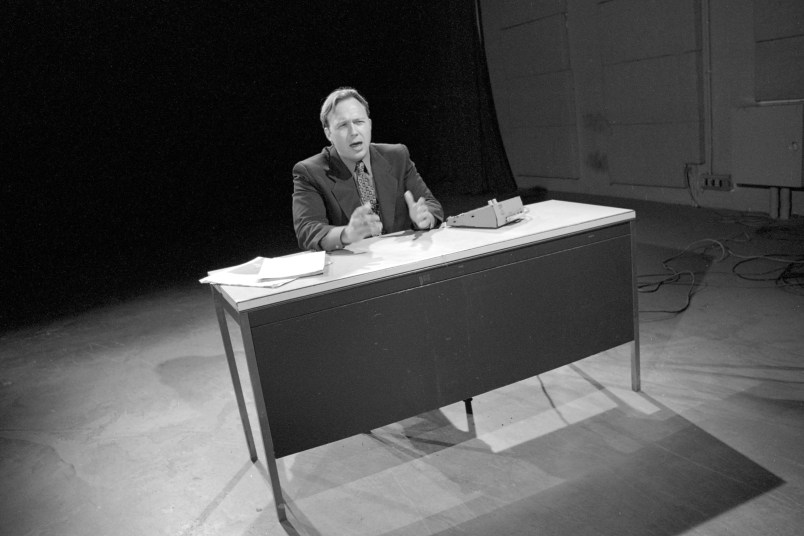
Alex Jones went on the air around the same time as his frenemy Cooper. Despite their public battles, the two were much more alike than either likely would want to admit. Just like Cooper, it took Jones just minutes to declare that he’d predicted what would happen, and that he already knew exactly who did it. In fact, the entire “made it happen vs. let it happen” debate of the next decade came from Jones right out of the gate.
To Jones, there was a “98% chance this was a government-orchestrated controlled bombing.”
“All the terrorism that we’ve looked at from the World Trade Center of Oklahoma City to Waco has been government actions,” Jones continued at the top of his broadcast. “They need this as a pretext to bring you and your family martial law. They’re either using provocateur Arabs and allowing them to do it, or this is full complicity with the federal government. The evidence is overwhelming.”
How could the evidence for something that had literally just happened be “overwhelming?” Over the next three hours that morning, and another few hours that night, Jones threw out countless guesses as to various culprits for the attacks, conspiracy theories about what their real plot was, how various other attacks and disasters were trial runs for the World Trade Center, and fearmongering about tyrannical actions the government was about to take.
Jones made an uncountable number of dubious claims, such as that the false flag plan had already been revealed in the form of a Baltimore Sun article from April of that year, or that Iraq was behind the attacks and needed to be “nuked immediately,” or that the attacks were part of an elaborate devil worship scheme. He sounded positively giddy over the destruction at times, and cynically detached from the carnage at others. And he seemed almost disturbingly focused on ways for listeners to protect themselves and their money.
It’s that last part that seemed to preoccupy Jones and his guests more than anything.
Almost all of his interview guests in the morning were fellow hosts on his longtime radio syndicator, the Genesis Communications Network (GCN). The insularity and informercial-esque tone give the distinct impression of a media figure who stepped into a big story, didn’t know how to handle it, and settled on doing what made him the most money. In this case, it was shilling for his boss, gold broker Ted Anderson — the founder of GCN and a regular on his show.
“Well, obviously, Alex, a major concern right now is for the people that are sitting there in the paper [money] wondering what’s going to happen,” Anderson calmly declared as if the only people with any concerns were those staring down a paper money apocalypse. “They’ve got their life savings tied up, and here you have chaos, and hopefully the markets stay stable, and they can get out with reasonable cost.”
“Yeah, I’m told that there are already giant lines forming at the banks,” Jones interjected — falsely, as there were no bank runs or significant demands for cash currency by either banks or the public on 9/11.
Of course, being InfoWars, Jones and his guests can’t help but do everything possible to make their listeners even more fearful and depressed than they likely already were. Jones and his GCN cronies traded theories that U.S. planes carrying armed atomic warheads were in the air, Chinese troops were seizing the Panama Canal, the northern and southern borders were sealed, food distribution would be dependent on biometric thumb scans, housewives were being pulled out of cars at hastily-erected checkpoints, and in general that the end times were upon us.
Ultimately, as Jones signed off for the morning, he was still not fully locked into an answer of who did it or why. Nobody was, at that point. But being Alex Jones, he definitely knew one thing: it wasn’t bin Laden. Or as he put it near the end of the show, “sand people could not pull this off.”
Jones returned to the air that night for another three-hour broadcast, dedicated mostly to his soon-to-be-discarded theory that the buildings were “blown up” with charges set under the orders of “Europe.” Even as news was starting to break that Osama bin Laden had been behind the attacks, Jones simply would not believe that the most likely suspect for taking down the World Trade Center was the terrorist mastermind who had already tried to take down the World Trade Center. For him, it was the New World Order, even if the particulars kept changing.
Not content to merely spread conspiracy theories, Jones also mocked the passengers on the doomed planes for not fighting back against the hijackers as he would have done. Then he went into graphic descriptions of “burning bodies” at the scene, and even theorized about the planes that hit the towers being remote controlled.
Over an hour of the episode is given over to Jones doing a rambling interview with comedian and future podcast royalty Joe Rogan that eventually devolves into the two entertainers loudly arguing over who was behind the attack — an exchange in which Rogan sounds measured and skeptical, and Jones sputters to keep up.
After more callers and paranoia, he ended his sixth and final hour on the air declaring simply “God bless you all. I told you this would happen.”
West Coast listeners tuning into Jones’s second go-round on the air would have had a slightly more soothing and less argumentative alternative way to process the day’s events: Coast to Coast AM with America’s highest-rated late-night radio talk show host, Art Bell.
Bell reimagined late-night talk radio not as a one-way conversation, but as an open forum for the special breed of people who spend their nights listening to talk radio. Bell’s unscreened “open lines” shows gave voice to a motley crew of night owls, truckers, paranoids, militia nuts, doomsday preachers, paranormal believers, and lonely people with nobody else to talk to.
It was a winning formula that propelled Coast to Coast AM into its status as the highest-rated overnight radio show in America. And although the show is much more outwardly right-leaning and militaristic in its current iteration, it was Bell’s sympathy toward people battling delusions and dark forces that made him the perfect person to help America into the new dawn of Sept. 12. His show the evening of the attacks is a master class in simply letting people talk and being okay with what they have to say.
An audibly exhausted Bell starts off by telling his audience that he has no idea what to discuss, but that he doesn’t intend to “outexpert” the major networks. And he didn’t. For the next four hours, Bell simply opened his phone lines up to callers from around the world to process, vent, mourn, and talk about what was on their minds. He spoke calmly and with compassion, leaning into the shock that everyone felt. Many callers were from around the world, with Bell taking care to ask how those countries were processing the attacks — and the support for America was unanimous.
Some of his regular guests called in as well, like UFO maven and Communion author Whitley Strieber, and “remote viewing” pioneer Ed Dames — who claimed psychic soldiers at a high-level intelligence think tank saw that the attack was plotted in an underground bunker in Kandahar, Afghanistan (it was not.)
One question was top of mind for Bell, and it was in many ways the same thing his counterparts had been groping for answers about: how would the attacks change America? Bell feared there would be more infringements on personal freedom, and many of his callers expressed their belief that war was imminent.
Bell even got in a joke about the deluge of conspiracy theories that had already started, reminding listeners that “there will be an element that will say that it was all orchestrated to limit the freedoms we now cherish.”
“I haven’t heard from that group yet,” Bell continued, “but given enough open lines, I’m sure we will.”
Eventually, he did. But even those calls lacked the dark edge found on InfoWars or The Hour of the Time. Some callers focused on the supposed prophecies of Nostradamus, another caller claimed to be psychic, which Bell responds to by asking why they didn’t warn about the attacks. Some made vague proclamations that the CIA or other government organs were responsible.
As night turned into day, news started to trickle in that U.S. intelligence was close to making a formal call that the attacks were carried out under the direction of bin Laden. And the shock began to curdle into anger. Bell attempted to calm his audience with patriotism — no matter who did it, Americans are going to get up, dust themselves off, and kick some terrorist ass, which will happen in due time. For many middle-of-the-night Bell callers, that time was now.
Late in the program, Bell took a call from a young man who tearfully told Bell that he was probably going to join the military the next day, and another call from an ex-service member who spoke calmly of the “shock” that comes from killing someone at close range. Another caller calmly advocated for feeding captured Islamic terrorists to pigs. Things were ugly by the last few minutes, and an exhausted Bell eventually signed off with a note of uncertainty about the future.
He’d give the rest of the week of shows over to listener reactions, and the rage ratcheted up every night as the reality began to set in. Soon, it made its way to the streets — in threats and violence against Arab-Americans or anyone perceived as either Muslim or simply disloyal to America.
In many ways, the shows of America’s radio fringe overlords predicted everything that would come over the next decades. The shock and disbelief turning into bloodlust; the certainty that everything we were being told about the attack was a lie; and the creeping fear of both infringement on personal freedom and toxic belief that the attack should be punished by any means necessary — all could be heard in the rage of Bill Cooper, the shamelessness of Alex Jones, and the grief of Art Bell.
Jones in particular would gain international fame based on his theories about Sept. 11 being, as the subtitle of his 2002 film about the attacks put it, the “road to tyranny.” While Bell’s show soon returned to its usual pre-9/11 topics like demonology and time travel, hardly a day went by that Jones didn’t expound on his initial idea that the attacks were staged, that bin Laden was a globalist patsy, and all of it was done to line the pockets of the defense industry. And Cooper’s post 9/11 shows continued to be full of unhinged rants and threats about impending nuclear war, mixed in with fearmongering about NATO invading the U.S.
But the landscape of fringe radio was also about to change, and the three broadcasters would be on the air together for just a few more weeks.
True to the many times Cooper claimed “they” would never take him alive, he was shot and killed by Apache County, Arizona deputies on Nov. 5, 2001, when an attempt to serve him with a warrant turned into a gunfight.
After several short-lived retirements in the ‘90s, Bell retired again in December 2002, this time giving up his nightly broadcasts for nearly a decade. And Jones would become the standard bearer for the movement of people “just asking questions” about “what they don’t want us to know” before his empire collapsed in a blizzard of lawsuits.
Despite their infighting and divergent paths, America’s three conspiracy radio gurus set the stage for the paranoia that would become almost unremarkably common in American life. Hardly a conversation about 9/11 in the next quarter-century could happen without someone calling the attacks an inside job, claiming they had secret knowledge about who did it, or musing about whether the U.S. or the UN allowed it to happen.
9/11 conspiracy theories provided a jumping off point for countless other theorized schemes and plots, radicalizing many through social media and videos into believing that a vast cabal of elites was pulling the strings on every possible world event — and only a chosen few could stop them. Everything from the Sandy Hook truth movement to QAnon to COVID denialism to “stop the steal” has its roots in the conspiracism that 9/11 unlocked. It continues to impact our politics, commerce, culture, and discourse.
And that descent into paranoia started even as the Towers were still burning.



It actually started much earlier than that with the removal of enforcement of the Equal Time rule and dropping of the Fairness Doctrine by the FCC which began in the late 1980’s. That allowed the advent of right wing hate radio which used fear and racism in the early 90’s to manipulate listeners. Limbaugh and others laid the initial groundwork, hijacking their listener’s amygdala’s (the part of the brain involved in fight or flight response). Once hijacked those listeners were primed to believe anything. 9/11 allowed them to expand their audience. By Obama’s time the Tea Party astroturf orgs created by the billionaires used racism to begin disabling democracy. In 2010 with the Citizen’s United ruling by the conservatives on SCOTUS gave the billionaires the ability to directly influence voting by throwing huge amounts of money into the arena. In 2024 Musk directly and openly manipulated young men using fake contests to buy votes. That leads us to today. There isn’t a single Republican advertisement that isn’t using lies, AI generated or manipulated images, and fear to try to get voters to vote against their own interests.
Thanks for this reporting, real Gonzo. This cogent article proves the real America is alive and you only have to turn over a few rocks to find it. Jefferson said he would rather have a country without government than newspapers but with the internet and cable TV, now we can have both no newspapers and no government.
Bush II tended to skip his Daily Morning Briefing, NSA Chief Condoleezza Rice read it but decided the warning that Bin Laden would strike the USA, with airplanes, was not actionable information. Maybe a conspiracy?
“Sidney Blumenthal and Sean Wilentz speak with the authors of “Why Postliberalism Failed,” James M. Patterson of the University of Tennessee and Thomas D. Howe of Princeton, on why the new right now hates Reagan, its dark history, and why JD Vance will turn on Trump.”
I caught this podcast and it revived my interest in the Bavarian Illuminati, Freemasons and the Catholic/Fascist connection. For quantity of conspiracy theories the internet wins but for quality the Church is in contention.
Conspiratorial drivel from the Right began long before 911. Rash Humbug got a Medal of Freedom for it from the Manchurean Cataloupe
Morton Downey Junior, Wally George, Bob Grant…hell, even Paul Harvey.
(Carson’s Floyd R. Turbo didn’t just appear from nowhere in the 1970s.)
The OG conspiracy theorists got to work blaming everything on the CIA. First they claimed the CIA was behind the overthrow of Mosaddegh in Iran in 1952, then they said the CIA had DRC President Lumumba murdered for business interests, of course there is that old saw the CIA orchestrated the coup in Chile killing President Allende- very coincidentally on 9/11/1973-what rubbish. There is this other crazy conspiracy theory that Israel has multiple nuclear bombs. It is simply outlandish what people will believe. I have heard other doozies too, such as the CIA overthrew the Guatemalan government for a fruit consortium & that Israel funded the nuclear bomb development in apartheid South Africa. It is unfathomable what people believe.
Was it merely a coincidence that most of the 9/11 hijackers were from Saudi Arabia & Iraq had magically disappearing WMD’s? I think so. We simply got to believe what we have been told- evidence be damned.