

This article is part of TPM Cafe, TPM’s home for opinion and news analysis. It was originally published at Balls and Strikes.
On October 15, the Supreme Court will hear oral argument in Louisiana v. Callais and Robinson v. Callais, a pair of consolidated cases that threaten what little remains of the federal government’s ability to protect voters from racial gerrymandering under the Voting Rights Act.
The VRA is the 1965 federal law that finally effectuated the Fifteenth Amendment’s guarantee that the government would not deny or abridge the right to vote on account of race. President Lyndon B. Johnson signed the act following years of advocacy from civil rights activists, and decades of violent repression of those rights by white supremacists. Without exaggeration, the VRA allowed the United States to make its first plausible claim to being a multiracial democracy.
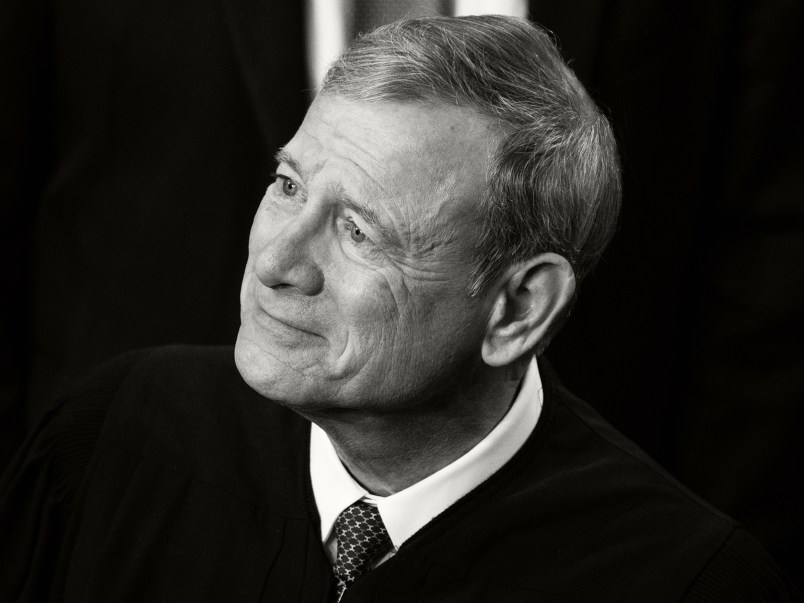
Opponents of multiracial democracy, led by Chief Justice John Roberts, have fought against the VRA ever since, misconstruing the act’s substantive protections and making them impossible to enforce. Callais is the conservative legal movement’s latest vehicle to persuade the Court to render the greatest triumph of the Civil Rights Movement a nullity nationwide.
In 2022, Louisiana Republican lawmakers enacted a congressional map that “packed” Black Louisianans into one district and “cracked” them across five others. This means out of six districts, only one is majority-Black, even though 1 in 3 Louisianans are Black.
Under the Voting Rights Act, voters of color must have an equal opportunity to elect candidates of their choice. But voting in Louisiana is racially polarized, meaning that white majorities persistently vote as a bloc to defeat candidates whom Black voters prefer: To date, the state has never had a Black senator, and hasn’t elected a Black governor since Reconstruction, and no Louisiana congressional district other than the single majority-Black district has elected a Black representative. Thus, the only way Black Louisianans would have the equal opportunity the Voting Rights Act requires is if Louisiana were to create a second district in which Black Louisianans make up a majority.
Black voters in Louisiana sued, and federal courts determined that the map indeed violates Section 2 of the VRA, and ordered lawmakers to redraw the map and add a second majority-Black district. But then, a group of self-described “non-African American voters” sued to challenge that map, arguing that a map drawn to remedy an illegal racial gerrymander is itself an illegal racial gerrymander. If the Supreme Court agrees that there is no legal distinction between causing and curing race-based harm, Callais would rob actual victims of discrimination of the legal tools to do anything about it.
The Court heard oral argument in Callais for the first time in March 2025, and considered two main questions: first, whether Louisiana lawmakers let racial considerations “predominate” when they drew the second map, and if so, whether they had a good reason for doing so. Under existing law, these are easy questions to answer: Even if Louisiana lawmakers drew the second map based on race, Supreme Court precedent confirms that “courts told us to fix our illegal racist map” is a damn good reason to do so.
But the Republican justices on the Court do not like the existing law. And now, they are rehearing the cases so they can have the chance to change it. Back in June, the Supreme Court unexpectedly ended its term without deciding Callais, and instead issued an unexplained order putting the cases back on the calendar for reargument.
Justice Clarence Thomas dissented, but only because he didn’t want to wait any longer to hold that the VRA does not “justify” the practice of “race-based districting” under circumstances that are “utterly divorced” from “specific, identified instances of past discrimination.” Basically, in Thomas’s view, any effort to repair racial harm is impermissible unless it is neatly crafted to address a particular instance of 1960s-style racism.
As usual, Thomas was out ahead of his colleagues: On August 1, the Court directed the Callais parties to file supplemental briefing on the question of whether the intentional creation of a second majority-Black district—as Louisiana lawmakers did here, in response to a court order—violates the Fourteenth or Fifteenth Amendments. Louisiana Attorney General Elizabeth Murrill, a Republican, recognized this new framing for the gift that it is, and filed a brief on August 27 declining to defend the second map at all. Instead, she argued that the Voting Rights Act imposes an unconstitutional race-based mandate, and that the Constitution is “colorblind,” which apparently means “unwilling to recognize harm done to people of color.”
If the Court agrees, the result would compound the disempowerment of Black people across the country. With no check against racial gerrymandering, a system in which voters ostensibly pick their elected officials would become one in which elected officials are freer than ever to pick their voters, leaving Black voters with even fewer legal avenues to secure fair representation.
The Fourteenth and Fifteenth Amendments were expressly crafted to grant Black people equal rights as citizens in a democratic society. The Court is preparing to use those very Amendments to deny those rights instead.




Hey, we’ve solved that pesky racism problem. I mean Barack Obama, Michael Jordan, Beyonce…c’mon, it’s over. Time to stop making white boys feel bad about themselves; that’s the real racism.
“If all politics is local, then in the South all politics is racial”, former Georgia Senator Max Cleland.
In 1984 I was living in New Orleans and had a job that caused me to travel throughout much of Louisiana. While it had been less then 20 years since Blacks had actually gained the right to vote in Louisiana, they also gained some other rights and benefits, like jobs as bus drivers, police men, teachers, et al. The White people had not accepted these changes easily and were still complaining about them and would often say how much better were White bus drivers.
While I was not very much involved in politics, it was also striking that while all the White people, men and women, in Louisiana knew how Ronald Reagan was screwing them but loved Reagan because “he is screwing Black people worse”.
For full disclosure, “he is screwing Black people worse” is not a direct quote because the White people of Louisiana never said “Black people”.
The point is RACE is still the major axis of our politics and especially in the old confederacy. The South, the poorest region of the country that benefits most from Democratic policies and is hurt most by Republican policies is the base of the Republican Party because the majority of White voters are willing to pay a heavy price to hurt Black people.
Rev Dr. Martin Luther King fought and died for the voting rights act, his number one request of President Johnson to insure equal rights for all minorities. What a sad time to be alive with the likes of John Roberts making decisions for our democracy.
What is sure to be one major factor in this case, as it was in previous Voting Rights Act cases, is the distinction between racial gerrymandering and partisan political gerrymandering. While SCOTUS has held that racial gerrymandering violates the Voting Rights Act, it has also held that partisan political gerrymandering does not, nor does it violate the 14th Amendment. Those accused of racial gerrymandering consistently insist that it was done for political, not racial reasons. As a practical matter, there’s little to no difference between the outcomes of racial and political gerrymandering, and to date, this SCOTUS has accepted the bogus claims that there is a difference in order to vindicate the racist/political election rigging.
As a matter of law, both forms of gerrymandering violate the Constitution’s provision that the states are guaranteed a republican form of government, in which a state’s government and Congressional representation will accurately reflect the state’s population. Gerrymandering of any sort eliminates that requirement and prevents republican government. Any SCOTUS devoted to enforcing the Constitution would invalidate all gerrymandering at once. Instead, this SCOTUS continues to operate in a blatantly partisan manner, continuing the corruption of elections first initiated by Massachusetts Governor Elbridge Gerry in our nations earliest days. One would hope that SCOTUS would, for once, use its disdain for precedent to put an end to this pernicious behavior. One does not, however, expect that to happen.
Or Clarence f’ing Thomas. My god.