

This article is part of TPM Cafe, TPM’s home for opinion and news analysis. It was originally published at Balls and Strikes.
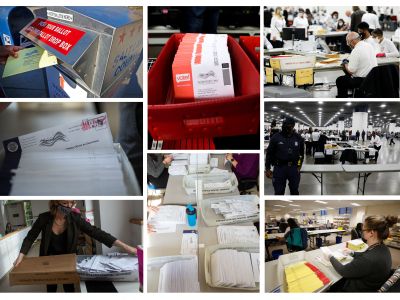
Earlier this year, President Donald Trump issued an executive order directing the Postal Service to overhaul mail voting in a way that threatens to disenfranchise tens of millions of Americans in the upcoming election.
Federal courts have repeatedly issued orders blocking this election interference. But the Supreme Court has swooped in to lift those court orders, and Trump remains undeterred. This week, an anonymous federal official filed a whistleblower disclosure revealing that the U.S. Postal Service is “poised to derail the midterm elections,” and is working “at a breakneck speed” to implement Trump’s directive, regardless of whether any court orders were in place.
These revelations are closely connected to the Supreme Court’s strategy for facilitating Trump’s lawbreaking, in the November elections and beyond. The Republican justices regularly delay substantive review of the administration’s actions, which confines lower courts to procedural questions and frees the administration to act lawlessly in the meanwhile. When Trump can count on the Court to forestall legal review as long as possible—and to override unfavorable determinations when they do occur—he has every incentive to just keep breaking the law.
The current mail ballot controversy arises out of Trump’s March 2026 executive order, which purports to assign the federal government a major role in election administration. The order instructs the Department of Homeland Security to compile lists of eligible voters in each state, and calls on the attorney general to investigate and prosecute state officials who provide ballots to people who do not appear on DHS’s lists. The order further directs the Postal Service to propose a new rule that would bar delivery of mail ballots to or from people whose names don’t appear on the lists, and to refuse to transmit mail ballots that don’t use a special federally prescribed barcode.
Judge Indira Talwani, a federal district judge in Massachusetts, first ruled against the order in California v. Trump, a lawsuit filed by 23 states and the District of Columbia. Talwani’s June 25 order in that case found that Trump did not have “any authority” for his desired federal takeover of elections.
A few weeks later, Talwani ruled against Trump’s election scheme for the second time, in League of Women Voters of Massachusetts v. Trump. This case was filed by a coalition of nonprofit organizations, but the issues were largely the same as those in the case brought by the states, so in her August 11 order, Talwani basically repeats herself: “The court has already answered and will again resolve the question clearly and affirmatively,” she said. “The executive branch has no authority to regulate elections.”
Talwani’s order in League of Women Voters also points out that the administration made “little effort” to defend the legality of Trump’s directives. Instead, the administration mainly argued that it was too soon for the court to get involved—that although Trump had ordered the Postal Service to publish a new rule illegally regulating mail ballots, that rule had not yet been finalized. In other words, in the administration’s view, Trump should be allowed to keep working towards unconstitutional goals, and only after he achieves them can courts (maybe) do anything about it.
Talwani rejected that view. But the Supreme Court has embraced it. On August 24, the Court issued an unsigned order that lifted Talwani’s injunction in California v. Trump. Over the dissent of the three liberals, the Republican justices characterized Trump’s order as an “internal directive” that “neither requires nor forbids anything of anyone outside the Executive Branch.” Although it is, again, an order that directs the executive branch to break the law, the Republican justices said it “remains to be seen” whether the agencies will carry out that unlawful directive, so it was too early to put a stop to Trump’s lawbreaking.
Surprising no one, the Postal Service did promptly carry out that directive, publishing its proposed rule on Friday, August 21. Talwani issued a new order a few days later, ruling against Trump’s election-rigging scheme for the third time.
The chaos surrounding the mail ballot orders is illustrative of what Justice Ketanji Brown Jackson described, in her standalone dissent from the unsigned California order, as the Court’s “Catch-Me-If-You-Can approach” to Trump’s policy agenda. It’s not clear exactly when the right time is for plaintiffs to challenge unconstitutional acts. It’s not clear when courts can issue rulings to stop them. And all the while, the administration does not need to defend the legal merits of its actions—it can just say the time isn’t right to do so.
Jackson said that this strategy empowers the administration to prolong unlawful conduct as long as possible. And she criticized the Court for opting to “greenlight significant harms,” rather than recognize a “red flag.”
This case is not the first time Jackson has raised this criticism. She also called out the government’s “catch-me-if-you-can regime” at oral argument in Trump v. CASA, the Court’s 2025 case about whether any single district judge had the authority to prevent Trump from implementing his unconstitutional birthright citizenship directive nationwide. The Court’s ruling in CASA briefly authorized Trump to start rendering babies stateless. And in dissent, Jackson said that the Court leaned on a “mind-numbingly technical” threshold question about procedures in order to let Trump “continue doing something that a court has determined violates the Constitution.”
This strategy was on display a third time this week when the Court issued an unsigned order in National Park Service v. National Trust for Historic Preservation, the case about Trump demolishing the East Wing of the White House so that he can build a ballroom. As per usual, the Court expressly avoided passing any judgment on the legality of Trump’s unlawful conduct. And as per usual, it allowed Trump to keep breaking the law.
The throughline of these three decisions—mail ballots, birthright citizenship, and the ballroom—is the Court using procedure to stall. Time and again, the Republican justices tell lower courts that they are powerless to stop blatantly illegal conduct, and they tell Trump he is free to keep going. Trump has been listening.



We all know what will happen, don’t we? Long after the lawlessness of Trump is allowed to occur, the MAGA 6 on the Supreme Court will issue a decision saying it’s illegal, but the ruling is prospective anyway since it already occurred. The Trump regime gets away with their lawlessness but any future Democratic president can’t do it.
Contrast this with their instant reversal of Biden initiatives that the conservative vandals didn’t like..
The regime’s “move fast and break things” tactics emulate the style of our tech overlords; people in power have found out that exercising power quickly, without regard for laws and norms, puts you ahead of any rules-based attempts to stop you. It’s the cultural style now. Just do it; seeking approval is for losers. And if you’re a powerful white man, you will face no consequences.
“As per usual” appears twice in this piece. Does Talking not have an editor?
That’s just the extension of the Atwater/Reed/Delay/Gingrich Young Republican MO, talk fast, go from one baseless talking point/lie/issue machine gun style until the opposition loses track and loses gas and loses heart.
Brain cancer, got one.