


In Rough Edges, Mike Rothschild writes about fringe groups, conspiracy theories and how the Internet broke our brains. This column is part of TPM Cafe, TPM’s home for opinion and news analysis.
The conspiracy theories about the shooting started almost as soon as the shooting itself.
Just days after the assassination of John F. Kennedy in Dallas on November 22, 1963, nearly two-thirds of respondents to one poll believed the shooting had been a plot involving multiple people, despite no public evidence. Another poll found that slightly over half of respondents believed “some group or element” was at work in the assassination attempt. The fact there was no evidence at the time did not deter these theories in the slightest.
Within months, the first articles and books alleging various conspiracies to kill Kennedy and frame Lee Harvey Oswald were published, with thousands more to follow. They spun out a mind-boggling array of plots, shooters, motives, and conspiracies. All claimed with immediate and unshakable confidence that Oswald couldn’t have acted alone. He didn’t have the training or access to make the shots that killed Kennedy. Something more had to be at work.
Despite his pop culture imprint as a loser, Oswald was a trained Marine marksman. Though not especially skilled, he could have made the three shots in eight seconds that killed Kennedy, who was left virtually unprotected in an open-topped, unarmored, and slow-moving car. Despite these facts, the number of Americans who believe in a Kennedy conspiracy is currently almost exactly the same now as it was days after the event.
Americans have always trended toward suspicion and disbelief when presented with world-shaking events that “weren’t supposed to happen.” Clearly, presidential assassinations fit the bill perfectly. There is an inherent need to assign meaning and purpose to an act that often turns out to have none.
But until July 13, 2024, there had never been such a groundswell of paranoid accusations about an attempted assassination of a president.
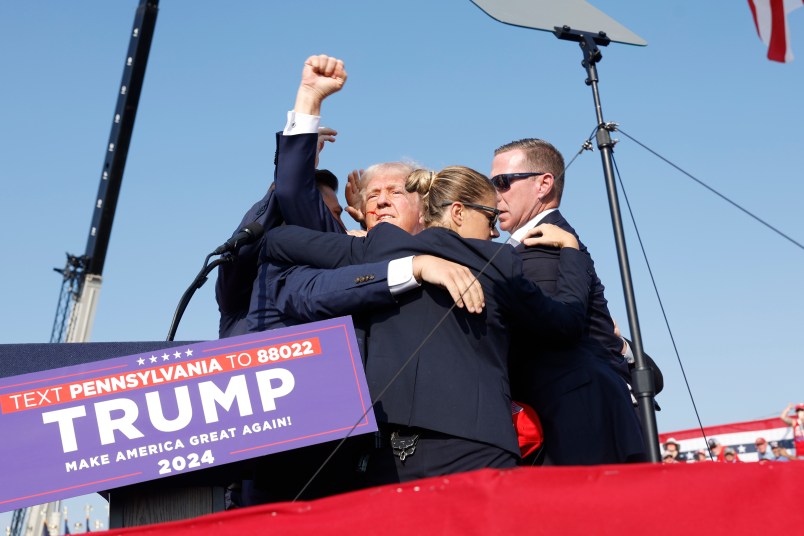
That day, firing from a nearby warehouse rooftop with a clear line of sight and no security to stop him, Thomas Matthew Crooks fired eight shots at Trump during an open-air campaign speech in Butler, Pennsylvania. A surreal series of events quickly spooled out, and have become the most lasting images of a chaotic 2024 presidential campaign. There was a bullet whizzing past Trump’s ear, Trump hitting the ground with blood pouring down part of his face, then leaping up with his fist in the air, and Secret Service agents trying to get him off stage.
And the conspiracy theories started immediately. Butler became the new Dallas in seconds, with a narrative cemented in the eyes of conspiracy believers even as event attendees were being hustled out of the venue. There was a deep need to find greater meaning and organization in an act that was quickly found to be the work of one shooter with little apparent motivation. Neither Oswald nor Crooks were the kind of people who make history, not like Kennedy and Trump. But somehow, these two losers found a way to write their names into the fabric of American lore. Something greater had to be at work. There had to be a conspiracy — who was behind it and why would have to be filled in later.
Like Kennedy, Trump’s shooting sparked immediate accusations of a deeper plot, carried out by international intelligence, political enemies, far-left or far-right agitators, or crime syndicates. There was no evidence of any of these, but in the first minutes and hours, something had to explain what had happened. And in the absence of facts, compelling fictions will do.
Both Oswald and Crooks exploited mistakes in Secret Service protection to do something that theoretically nobody should be able to do. Crooks scaled the roof of an unsecured warehouse after law enforcement lost sight of him, and fired again and again. The mistakes and missed chances of law enforcement were rolled into the conspiracy as proof the shootings had been allowed to happen, though there’s no evidence anything other than poor communication and performance were at work.
And neither Oswald nor Crooks left any clues to their apparent motive. Nobody ever found manifestos or writings or letters explaining their actions. Crooks was shot by snipers seconds after he fired on Trump, and Oswald was killed in police custody two days after the assassination by Dallas gangster Jack Ruby, who himself gave little coherent reason why he did it and died in prison. If they had lived, both shooters would have been questioned extensively and likely tried in public, which could have staunched at least some of the theories. Instead, they left little behind to explain themselves, allowing everyone else to fill in the blanks.
But the two incidents have one crucial difference, which would come to define how they are seen by both believers and skeptics. It was easy for believers in Kennedy conspiracy theories to claim his death came from a plot, even if they disagreed on who the plotters were. But if there was a plot against Trump, it couldn’t have been an especially effective one, given that he lived. Still, it couldn’t have just been a lone gunman at work. So it had to involve someone else.
And the “someone else” was quickly “found” by internet truth-seekers to be Trump himself.
Almost at once, social media was besieged by left-wing conspiracy theories that Trump staged the shooting to increase his chances of being re-elected in 2024. Details vary, but they all revolve around one complex and unbelievable piece of political stagecraft: Trump’s campaign conspired to hire an inexperienced shooter and allowed him to get off eight shots, nearly hit Trump in the head while wounding him at least somewhat, kill one of his supporters, and give the future president the photo opportunity of a lifetime that would seal the election.
Others would go even further, claiming that Crooks was firing blanks, that Trump cut his own ear to produce blood, and there was never any danger. It was all pro wrestling. Even the deaths were part of an elaborate piece of theater, sacrifices needed to sell the fakery to the rubes in the media. It wasn’t evidence, or even especially believable. But with Trump’s unexpected victory after a shambling campaign, the “staged shooting” became a compelling argument that Trump needed something to juice his prospects, and decided to just create it himself.
In early polling about Crooks, respondents of both parties overwhelmingly blamed him for the shooting, though they were ideologically split in blaming each other as well. And though the “staged fake shooting” plot is now nearly gospel truth among some on the left, just 15% of Democrats who responded to a YouGov poll days after Butler disagreed with the statement that Trump was shot in the ear.
But that was what the normies who don’t live online thought, because they aren’t awake. On Twitter, they knew. Individual social media posts immediately began to claim that the shooting was staged, just as longtime disinformation watchers knew they would. Many of these posts received thousands of shares and tens of thousands of likes in the chaotic minutes after the incident, claiming the attempt was “SO staged” or “staged AF” or “crisis actors, fake blood, and a claim to martyrdom.”
Fueled by the left’s belief that Trump would stop at nothing to win the election, even murder, the theories spread quickly. Those posts took with them a certainty that only deepened once Crooks’ background was revealed. By many accounts, including numerous interviews with people who knew him, Crooks was a quiet young man whose mental health was declining and who became increasingly obsessed with guns and political violence. He was essentially a nobody with no background of note, leaving little online footprint behind.
Even the shooter’s relative anonymity became grist for the conspiracy. The very smallness of Thomas Crooks became proof that he could not have been involved with something so big. As such, many believers will incorrectly claim that the media has never written anything about him and buried his existence, or that the shooting was never properly investigated.
Neither of those are true. Crooks was profiled by major news outlets both immediately after the shooting and in the months that followed. There hasn’t been a great deal of recent reporting on him because there’s nothing new to report. Again, he was an undistinguished young man with little history that would indicate why he did it.
And contrary to conspiracy theories that Trump personally ended the investigation into Crooks, both the FBI and Congress investigated the incident. They found serious errors by the Secret Service at every level. But serious errors are not evidence of a conspiracy or a cover-up. Both investigations released a great deal of material, and all of it is consistent with the idea of a young man who acted on his own for reasons that died with him.
Like Kennedy decades later, a few still frames or snippets of video became all the evidence believers would need. Most have been stripped of their original meaning, and transformed backwards into proof, despite being anodyne in the greater context of the event. The most egregious example for Butler might be the social media videos supposedly showing a giant American flag being lowered into position by a crane while press photographers were allowed to set up for Trump’s photo-op.
But these are not evidence of a conspiracy, because that’s not what happened. There was a large flag held by two cranes behind Trump during his speech, but it was never lowered, and videos of it “moving into position” appear to just be the fluttering flag being filmed by a moving camera. Photographers moved up to the stage because they were doing their job, and getting pictures of history as it unfolded. Nor is the fact that Trump “never talks about” the shooting proof it didn’t happen. Trump has mentioned it on many occasions, though not using the shooter’s name.
If there is a legitimate debate to be had regarding Butler, it involves the extent of Trump’s injuries, and whether they were exaggerated. Many of the descriptions of the wounding of Trump’s ear are not supported by photographic evidence or medical records, since the Trump campaign didn’t release any. And they strain credulity for what kind of damage a human ear can sustain and still be functional. Trump’s campaign claimed at the time that his ear wound was two centimeters wide, which doesn’t appear consistent with Trump’s ear now. There was even some early speculation that Trump wasn’t hit by a bullet at all, but by fragments of an object on stage. Something had to explain the discrepancy.
It’s natural that these inconsistencies would be used as evidence that the shooting was staged. But Trump playing up the extent of his wound does not mean the shooting didn’t happen. It simply means that we aren’t being told the whole truth about that aspect of the incident. Clearly there were shots fired. Trump was hit in the ear. A rally-goer was killed, and two others were hospitalized and released after being hit. None of that is fake.
Like the cavalcade of supposed shooters all sneaking around Dealey Plaza in Dallas waiting to fire hundreds of bullets at JFK, the mechanics of how exactly Trump would stage being shot at and nearly hit are deeply implausible. Such an act could go disastrously wrong in countless ways. Crooks was a poor shot with little training, and the idea that Trump would hire him to fire at his head and barely miss, then dive at the exact right moment and pop up for a picture, seems absurd. Nor does it offer any explanation for why Crooks would participate in a ruse that would end with his death.
And there was no need for such a stunt. Trump already had a slight lead in national polling just before the shooting, fueled by Joe Biden’s disastrous debate performance a few weeks earlier. Why take such a risk? Trump’s favorability rose somewhat after Butler, but that was also in the same week Trump announced JD Vance as his running mate. There’s no real evidence Butler changed the trajectory of the campaign, or had any role in Biden dropping out a few days later.
Trump and Kennedy are outsized figures who defined their era, befitting the existence of complex plots and high-level schemes trying to kill them. The fact that even presidents are just as much at the mercy of bad luck and opportunism as everyone else is deeply unsatisfying.
And this might be the deepest connection of all between Dallas and Butler. We want to believe there is more to them than what we’re being told, and that we are the ones who figured it out. We want them to be more than what they are. They are outsized events demanding equally outsized explanations. Sadly for their believers, the ordinary explanations are still the best ones we have.



It’s cathartic for us in the mainstream - I refuse to call us the Left, in the American case - to use the tools of the Right back at them once in a while. To deny, dilute and divert the reality of what happened by making up a fictitious narrative which cheapens and muddies the feelings ‘they’ have, and makes ‘their’ outrage seem performative and overwrought.
So was Ted Cruz’s father or Ted Cruz himself involved in the assassination of John F. Kennedy. Some people are saying that…
Naaah, the conspiracy theories started well before the shooting itself:
I don’t know anything about new assassination attempts, There is more about the Kennedy stuff. I’ll die believing that.
The House Select Committee agreed, back in '79. (Years later I was mentored by an attorney who had served one the House Select Committee. Yup.)