


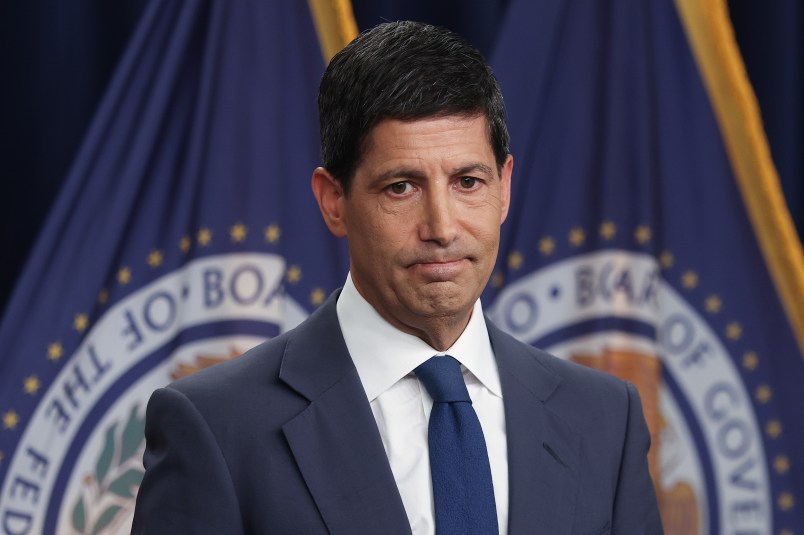
Trump’s new Federal Reserve Board Chair Kevin Warsh took two missteps in two opposite directions during and after yesterday’s Federal Open Market Committee (FOMC) rate decision. And it wasn’t necessarily the board’s choice to hold interest rates steady — a decision that was mostly expected given current economic conditions — that most rankled markets and economists. Rather, it was both what Warsh said, and also what he didn’t say, that put a diverse set of central bank stakeholders on alert.
When the FOMC on Wednesday issued its second rate decision since Warsh began leading the agency in May, the press release repeated information from the committee’s mid-June event.
“Productivity growth and capital investment are strong.”
But this time, there was more evidence than before that those assertions are not necessarily being borne out in the data.
Trump has continued to cast a resilient but stagnating economy in rosy hues, and engaged more aggressive and overt tactics to influence monetary policy at the Fed as he tries to force members of the central bank to cut interest rates. In tandem, Warsh’s pared-down approach to FOMC communications and use of the word “strong” to describe economic indicators showing weakness failed to fully reflect an economic reality which led three Fed governors to dissent from the majority decision and vote in favor of higher interest rates.
Labor productivity increased just 0.3% in the first quarter of 2026 according to the Bureau of Labor Statistics. That number was revised down by half a percentage point. The Federal Reserve Bank of Philadelphia’s survey of 33 economic forecasters projected U.S. gross domestic product would grow at a 2.1% annual rate in the second quarter of 2026, and revised down their growth projections for the remainder of the year, in a survey published in May. Then on Thursday, second quarter GDP came in even lower, slowing to 1.5% according to data released by the Bureau of Economic Analysis. Investment growth was also lower than the BEA had previously projected.
“There is still no evidence of an AI-driven productivity boom after three consecutive quarters of weak productivity growth,” Dean Baker, co-founder of the Center for Economic and Policy Research, wrote in a brief published Thursday.
Baker also noted that growth in AI investment, while still strong, slowed.
“The economy is soft and vulnerable,” Mark Zandi, chief economist at economic research firm Moody’s Analytics, said on X.
The Federal Reserve Board declined to comment on which data the FOMC relied on for its statement about strong productivity growth and investment.
“It would be concerning if factual misrepresentations are getting elevated due to political convenience,” former Fed economist Skanda Amarnath, who has accused Warsh of political puppetry in past interviews with TPM, said on X.
There are still positive aspects of the economy. Unemployment has not spiked. Forecasters surveyed by the Philadelphia Fed revised their annual GDP growth projections upward beginning in 2028. And investment growth still represents a positive contribution to overall GDP growth.
On Wall Street, markets responded negatively to Warsh’s refusal not only to speak about what the Fed might do in the future, but to even acknowledge what kinds of economic conditions might warrant a future rate hike. A Thursday BEA release on personal consumption expenditures, measuring the price people in the U.S. pay for things, showed price inflation well above the Fed’s 2% target and the Iran War has spiked the cost of energy, among other goods and services.
“If inflation continues to be elevated through the forecast period, interest rates could well be part of that solution, but I wouldn’t say it’s in isolation,” Warsh said during a Wednesday press conference.
He went on to leave the door open regarding whether the Fed’s 2% inflation target will remain after January, when a series of expert-staffed committees established by Warsh to initiate his stated goal of central bank “regime change” return with their findings.
“In Warsh’s press conference, he once again failed to specify how he intended to achieve his stridently asserted inflation resolve,” Michael Feroli, chief U.S. economist at JPMorgan, reportedly said in a note.
Investor concerns about inflation sent the 30-year treasury bond to its highest yield in 19 years.
“[Warsh] also cast doubt on whether PCE inflation will remain the Fed’s inflation target in the medium run,” Feroli said in his note. “Both of these points raise questions about the new chair’s credibility in delivering lower inflation.”



As expected, Warsh hasn’t a clue what he’s doing. He’s balancing his ignorance with his desire to please his boss and he’s failing on all accounts.
All as expected.
Did Layla even watch the hearing? It seems not. She totally missed Warsh’s refusal to explain the $100 million he got right after being appointed. He also refused to answer whether he had spoken to his corrupt underling about the accusations. His total lack of transparency and ethics went far beyond fiscal policy, but Layla did not notice.
You could be right, but it strikes me that maybe he’s just too scared to do anything. And that would be with good reason, as this is one of those nightmares in which it is likely that both of his two choices going forward will turn out to be the wrong one. Either way, he’s definitely not projecting, or inspiring, confidence.
How long before Trump decides to make these announcements himself, on Truth Social? With an extra $250,000 fee to get the news a little earlier than anyone else?
Yeah, but don’t forget he’s from central casting, and he cleans up real good. Shouldn’t that be enough for a Trump apointee?