

This book excerpt is part of Cafe, TPM’s home for opinion and news analysis.
After successfully completing the Joint Comprehensive Plan of Action (more commonly known as the Iran nuclear deal), the Obama White House faced a minor scandal. Ben Rhodes, one of the president’s chief deputies for national security affairs, gave a quote for a New York Times Magazine profile in which he bragged about creating an “echo chamber” of voices supporting the president’s plan. The White House provided the talking points, and outside experts at think tanks, universities, media outlets, and advocacy organizations validated the administration’s argument while maintaining the pretense of political independence. Obama’s domestic opponents cried foul, but Rhodes’ tactic had precedents in past campaigns of much grander scale, more lasting consequence, and in some cases more devious purpose.
The President’s Echo System is about presidents, private organizations, and the pursuit of ambitious foreign policy goals. But unlike most other treatments of the subject, it does not make the case that nefarious outside forces bribe, cajole, or bamboozle policymakers into betraying the national interest in favor of delivering benefits to a select few. Instead, the book explores an under-examined but crucial aspect of U.S. national security politics: collaborations between the White House and extra-governmental organizations. In contrast to the coercive relationships often presumed to explain misbegotten adventures, administrations facing political headwinds initiate symbiotic partnerships with like-minded private groups that help overcome public resistance and congressional opposition to their ambitious national security goals. Together, they mobilize popular support for use as leverage to secure legislative authorization and funding.
These partnerships have shaped the ecosystem of national security influence as it has evolved since its beginnings in the interwar years. The national security establishment tends to support an aggressive form of internationalism, which served the nation well during World War II and the early Cold War, but has also produced disasters in Vietnam and Iraq. The collaborations explored in this book contribute to this tendency. Because they involve serious political risks, presidents only choose to initiate them when they deem it necessary. That necessity arises more often (thought not exclusively) in the pursuit of aggressive, interventionist policies, which involve substantial investment in material resources and military mobilization that exceeds the president’s discretionary authority. Groups that help the White House achieve its goals flourish. They gain access to political, professional, and informational resources that yield advantages in the competitive environment of foreign policy influence. Whether these themselves policies succeed or fail, the collaborations that promote them empower participating organizations. The President’s Echo System explores their origins, evolution, and legacy.
The excerpt presented here appears in the book’s preface. It addresses two of the cases at the center of the Global War on Terror, the most prominent expression of U.S. grand strategy after the Cold War. Indeed, it was the Iraq War that motivated me to embark on this research. President Obama’s Afghanistan surge and Biden’s ultimate withdrawal reaffirmed what I learned in writing the book. And while I anticipated President Trump’s war in Iran, it had not yet begun when I wrote the preface, so I did not include any mention of it. Nevertheless, my argument helps to explain why the foreign policy establishment seems opposed to the policy: not because Washington’s foreign policy experts disagree with the claim that Iran poses a threat that the U.S. can neutralize with military force, but rather because Trump’s policy does not go far enough and because the White House has done so little to build popular support for the war. In fact, the administration has little use for such a campaign because it faces no effective opposition from Congress. The existing echo system stands ready to help the president mobilize the public, but he seems intent on building his own, with his preferred social media and without legacy organizations.
The following is an excerpt from a Frontline interview with Ahmed Chalabi, conducted in Baghdad in 2003, discussing the overthrow of the Iraqi regime earlier that year.
FRONTLINE: Many people who supported the war no longer do.
CHALABI: Yes.
FRONTLINE: They feel that they were suckered.
CHALABI: Yes, probably.
FRONTLINE: They say so.
CHALABI: Okay, I mean, I don’t—
FRONTLINE: Well, I mean, you know, half the people now feel that the war wasn’t justified on the grounds that it was argued for.
CHALABI: Okay.
FRONTLINE: Do you feel any discomfort with that?
CHALABI: No. We are in Baghdad now.
Chalabi was a Baghdad-born financier — with a doctorate in mathematics from the University of Chicago and a conviction for bank fraud in Jordan — who had presided over the Iraqi National Congress (INC) since the early 1990s. Part lobbying group, part political party, part government-in-exile, the INC spent the decade before the 2003 invasion of Iraq mobilizing support for toppling Saddam Hussein’s regime. But the interviewer’s implication that Chalabi had led the administration astray is misdirected. His organization should be understood not as an outside force pressing in on the president but as an on-again, off-again partner of the U.S. government.
The CIA provided the startup funding for the organization in 1992, and Chalabi partnered with the Clinton administration in a doomed insurgency operation in Iraqi Kurdistan in 1995. The CIA lost faith in the INC, but he still proved useful as a public relations proxy for anyone trying to make the case for regime change, especially when most of the foreign policy think tanks in Washington fit that description. Chalabi was a small but important part of a larger machinery of national security influence that had promoted regime change in Iraq for years before the invasion that began in March 2003.
The failures of the Iraq War did not put an end to the national security establishment’s consensus regarding the virtues of regime change and democratic nation-building as an antidote to terrorism or instability in the Middle East and central Asia. Even President Barack Obama, whose national political career began with a 2002 antiwar speech in Chicago, did not question the underlying logic of the prevailing consensus among the national security establishment. He believed in nation-building and democratization as a curative to terrorist threats. He just thought Iraq was a distraction from Afghanistan, the good war that George W. Bush had failed to prosecute with sufficient clarity of purpose. The national security establishment half agreed with him. While they applauded the “surge” in Afghanistan, many believed that the chief foreign policy lesson of those years was that a great power should never withdraw too hastily from a nation-building project (not that such projects should be avoided in the first place) and criticized him for abiding by the Status of Forces Agreement under which the United States withdrew the last of its troops from Iraq in December 2011.
When President Joe Biden followed through on his commitment to withdraw U.S. forces from Afghanistan in 2021, the majority of the national security think tank community responded with adamant disapproval. Leaders at Brookings, CFR, the Center for a New American Security, the Atlantic Council, AEI, and many more condemned the decision, predicting it would damage U.S. credibility, make Afghanistan an incubator for global terrorism, undermine U.S. competitiveness relative to China, and produce a host of other ills. As was the case with the Iraq War, disagreement among most national security experts centered not on whether to remain in Afghanistan but on why.
Granted, the Biden administration made grave errors in the planning and execution of the withdrawal, mistakes that caused terrible suffering, and the former president bears ultimate responsibility for that. Afghan citizens who had helped the United States in its mission should have received asylum along with their families, knowing that the Taliban would target them for punishment once it returned to power; some got visas, but many did not, and the process was a mess. Even U.S. citizens found themselves scrambling to secure passage home. Biden’s error was failing to marshal the bureaucratic resources necessary to achieve these tasks expeditiously. There seem to have been two reasons for that. First, many U.S. diplomats and functionaries in Afghanistan had a poor relationship with Biden dating back to his time as vice president. Biden had voiced skepticism about the viability of the Afghan surge, and the State Department personnel who served there reportedly resented him for it and resisted his orders to make the necessary preparations.
The second reason for Biden’s failure to command the bureaucracy? Many people in the State Department and in the think tanks of Washington refused to believe that he would go through with the withdrawal. Despite having made it a campaign pledge, and repeatedly reaffirming his intention after taking office, Biden could not convince the national security establishment that the United States would no longer remain in Afghanistan. This is the legacy of decades in which presidents have collaborated with outside organizations to promote expansionist foreign policies and rewarded those that helped mobilize public support. Many national security experts had held on to the belief that the occupation failed to produce a robust democracy not because the mission had been ill-conceived but because mistakes had been made in the execution and the mission was abandoned too soon. The withdrawal from Afghanistan gave experts the opportunity to rearticulate the arguments they had made about the withdrawal from Iraq. The belief that militarized democracy promotion serves U.S. interests has remained so entrenched in the national security establishment that few people believed the president would leave Afghanistan.
Why did the Biden administration not fight harder for his withdrawal policy in the court of public opinion? The president’s approval rating dropped 13 percentage points during the summer of 2021, going underwater for the first time in September; it never recovered during his time in office (though other factors certainly contributed). The public supported his decision to withdraw from Afghanistan, but not his handling of the evacuation. He might have used that initial support to demonstrate the seriousness of his intention to end the twenty-year occupation. Presidents do exactly that all the time. They use the bully pulpit to rouse a supportive public to put pressure on members of Congress and to demonstrate that they, not the president, will suffer the punishment of the voters if they refuse to go along. But Congress has little authority to obstruct a commander in chief bent on bringing troops home from deployment. Biden did not need anyone’s permission to go through with his decision. Perhaps if he had, he might have mounted a public relations campaign in partnership with outside organizations. This might have sent a signal to the diplomatic corps that they could not prevent the withdrawal. Even so, this tactic might have failed. Biden needed the cooperation of the State Department bureaucracy, but bureaucrats do not respond to electoral considerations the way legislators do. And any willing collaborators he could muster would face off against a broader, better-funded array of opponents among Washington think tanks, with established coalitions that had developed over decades.
President Trump has claimed that he always opposed the Iraq War, despite contemporaneous statements to the contrary, but now, in his second presidency, he has managed to fold his retrospective critique of the Iraq War into a broader revision of U.S. foreign policy and a condemnation of the entire ecosystem of expertise in Washington. Trump not only rejects the criticism leveled against him by the foreign policy establishment, but he also attacks the very existence of the organizations that house national security experts and the legitimacy of any constraints on his authority. He has shut down the United States Institute of Peace as well as the research programs of the Wilson Center, two congressionally chartered but legally independent foreign policy think tanks. He has reportedly ordered the IRS to investigate whether major foundations that support similar research should have their tax-exempt status revoked. These actions are likely against the law. But the courts have enjoined an astonishing number of actions taken by the administration to little effect, and Congress has proved entirely unwilling to assert itself, even over the power of the purse, which it normally guards with great jealousy.
One of the reasons why outside groups have proved valuable to presidents in the past is that the law has prohibited the executive branch from producing propaganda for distribution in the United States. Presidents have laundered information through private organizations to circumvent these restrictions. To be sure, the government has public affairs offices scattered throughout the executive branch, but they have not developed production that the law has prohibited them from using. They have tended to outsource these functions, but the advent of social media has made them much more accessible and available to everyone, including the White House. The current president owns his own such platform, as does one of his closest advisers, and the administration has shown itself more than willing and able to use both Truth Social and X to disseminate their own public relations content.
The White House has, for decades, capably directed foreign policy propaganda campaigns at home under a functioning system of prohibition and with an executive branch that views itself as operating under formal legal constraints. The current administration operates under no such prohibition and acknowledges no such constraints. Trump may succeed in dismantling the national security public relations machinery that I call the echo system, but he is more likely to build his own, only louder.
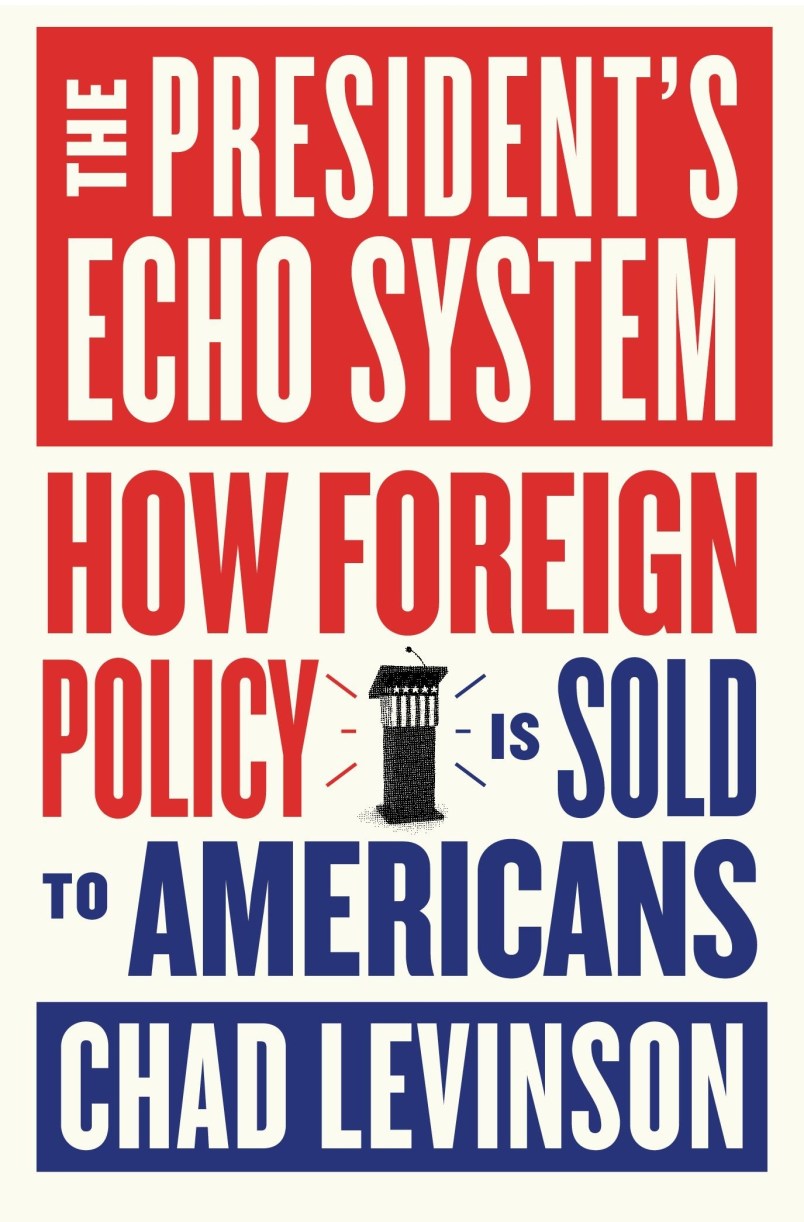
Excerpted from THE PRESIDENT’S ECHO SYSTEM: HOW FOREIGN POLICY IS SOLD TO AMERICANS by Chad Levinson, published by Harvard University Press. Copyright © 2026 by the President and Fellows of Harvard College. Used by permission. All rights reserved.


Informative and interesting.